
Key takeaways
- Start with 12-month TCO, not the monthly fee, when budgeting any chatbot.
- Setup, API usage, integrations, and maintenance frequently add substantially to the headline price.
- SaaS tools suit simple, single-channel use cases with no compliance requirements or proprietary integrations.
- Custom builds can cost less over 12 months than SaaS plus workarounds when regulated data, multiple systems, or domain-specific AI are involved.
What a chatbot costs in 2026: the fast-answer table
The monthly fee is the wrong number to anchor a budget to. The 12-month TCO(Total Cost of Ownership) is the only figure that lets a founder compare a SaaS subscription against a custom build on the same axis.
The table below maps five chatbot types to setup cost, monthly operating cost, and 12-month TCO. All figures are approximate ranges drawn from Elfsight's 2026 pricing guide and Jotform's chatbot pricing overview; verify against live vendor pages before committing.
What makes TCO diverge from the headline price? Setup fees, API usage charges, integration work, and ongoing maintenance all stack on top of the subscription. A tool that looks affordable at low volume can cost more than a custom system once conversation volume scales, seats multiply, and integrations require custom API work. That gap is where most budget surprises live.
What actually drives chatbot pricing up
Two quotes for "an AI chatbot" can differ by 5x. The reason is almost never the core software. It is the variables underneath the headline price.
Here are the five cost multipliers that move the number most:
- Custom training data preparation. Sourcing, cleaning, and labeling domain-specific content adds meaningful cost before a single conversation runs. For regulated sectors like healthcare or legal, this step alone can represent a significant portion of the total build budget. Master of Code Global's pricing breakdown covers development and integration cost ranges in detail.
- CRM and ERP integration. Pre-built connectors cost less than custom API work on proprietary or legacy systems. Each additional integration multiplies testing and maintenance scope.
- Compliance review. GDPR Article 25, HIPAA, and sector-specific requirements add architecture, documentation, and approval work. Cost depends on jurisdiction, data sensitivity, and existing infrastructure. Chatarmin's European pricing analysis provides useful framing for compliance and seat-licence patterns.
- API usage tiers. Per-conversation, per-resolution, or per-token billing rises quickly with volume. A flat-fee plan that looks cheap at low volume can cost more than a custom system at scale.
- Ongoing maintenance. Retraining, knowledge-base updates, and model tuning are recurring costs that rarely appear in a headline quote. These are the hidden costs that cause the most post-launch budget friction.
Stress-test every vendor quote against these five variables before treating it as a real budget figure.
When SaaS is genuinely enough
Not every business needs a custom build. There are three specific conditions under which a standard SaaS subscription is the right answer, and being clear about them makes the custom-build recommendation that follows more credible, not less.
- Your use case is a single channel with low-to-moderate volume and no proprietary integrations. A website FAQ bot or basic lead-capture assistant that does not need to connect to your CRM or ERP is a strong SaaS fit. The lower end of the SaaS monthly range handles this without custom build cost.
- You are pre-product-market fit or early-stage. When speed to launch and low upfront cost matter more than long-term control, a SaaS chatbot lets your team test and learn before committing to a custom build. The right time to go custom is after you know the use case works, not before.
- The chatbot does not touch regulated data and does not need domain-specific training. If there is no HIPAA, no GDPR-sensitive patient or financial data, and no need for industry-specific terminology, generic NLP is sufficient. The chatbot cost for small business in this scenario stays at the lower end of the range.
For businesses that have outgrown these three conditions, SaaS tools typically hit a ceiling. Multiple integrations, compliance requirements, or complex multi-turn workflows create workarounds that cost more in ongoing labor and maintenance than a custom build would have cost upfront. According to Molin AI's cost explainer, the gap between headline price and real operating cost is where most buyers encounter their first major budget surprise.
Not sure which path fits your business?
arsuno.ai Our Proof of Value model lets you see a working build before committing your full budget. If your use case sits on the edge of these three conditions, a short conversation is the fastest way to get a real number. Start the conversation
Build vs buy chatbot: the 12-month cost comparison
The build vs buy chatbot decision looks different when you put both options on the same 12-month cost axis. The Crunch's TCO model offers a useful framework. Compare a mid-market SaaS tool's monthly fees, setup, and integration costs against a custom build's one-time development fee plus hosting and maintenance.
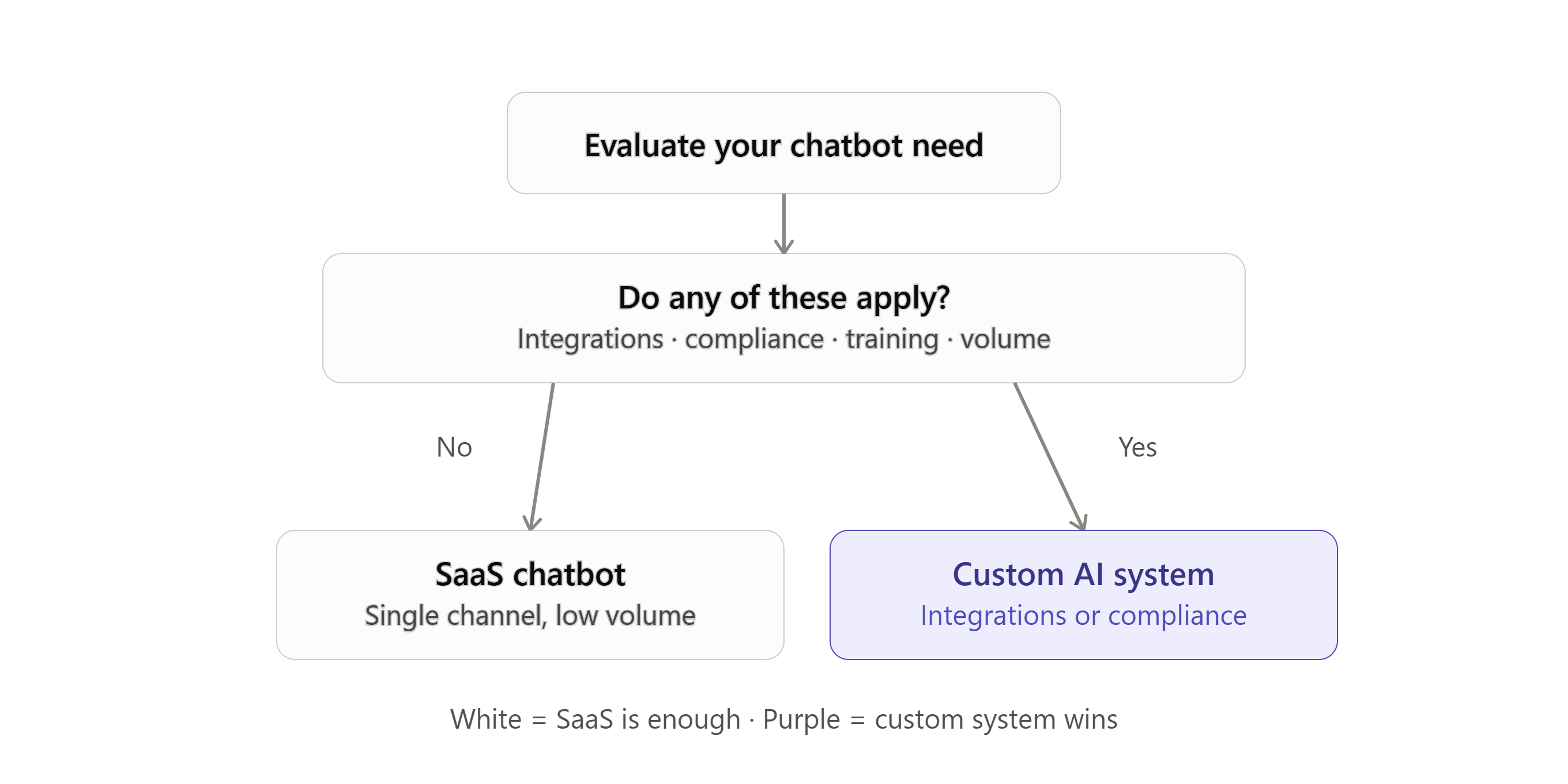
Four triggers indicate when the custom path wins on total cost:
- More than one proprietary system integration. Connecting to a CRM, ticketing system, and ERP simultaneously multiplies testing and maintenance on the SaaS side, often closing the cost gap within 12 months.
- Domain-specific AI training required. Medical, legal, or recruitment terminology defeats generic SaaS models. The ongoing prompt engineering and manual correction needed to compensate adds hidden labor cost that compounds monthly.
- Compliance requirements apply. When GDPR Article 25 or HIPAA governs your data, the compliance review work for a SaaS deployment can cost as much as a custom build designed with compliance from the start.
- Conversation volume is expected to scale. Per-conversation SaaS billing can exceed the annualized cost of a custom system once volume grows. Model usage at 2x and 5x current volume before committing to a billing model.
Running both options through a 12-month TCO lens, rather than comparing first-month fees, is the only way to make this decision on real numbers.
How to model chatbot ROI before you commit
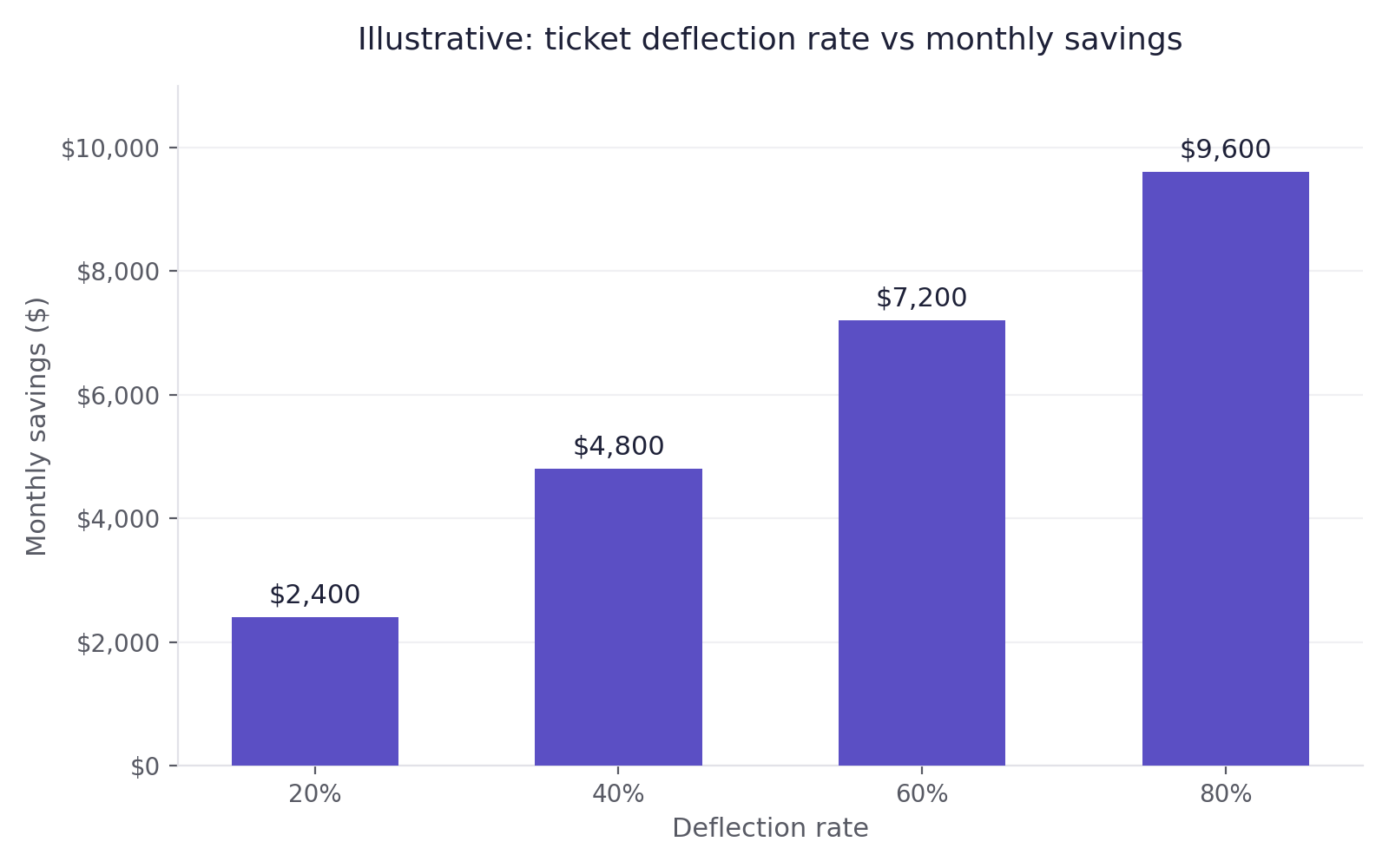
The payback period model is simple: divide monthly support cost saved by deflection by the total 12-month chatbot cost. The result tells you how many months until the system pays for itself.
Here is a worked example. If your support team handles 500 tickets per week at an average cost per ticket typical for your industry, a chatbot deflecting 40% of those tickets produces meaningful monthly savings. A custom AI system with a competitive 12-month total cost can reach payback in under five months at that deflection rate. A SaaS tool with a lower headline price but rising usage-based billing and integration fees can reach the same 12-month total faster than it first appears.
Real deployments confirm this math. Dunlop Sports handled approximately 275,000 interactions per year after deploying AI chat, with answer times falling 89% and CSAT reaching 95.3%. Best Egg automated 80% of chat inquiries in a compliance-sensitive environment. These are Zendesk's own reported figures; review the full Zendesk AI chatbot use cases page for source detail.
arsuno.ai's client results follow the same pattern. A psychiatry clinic in Switzerland achieved a 70% reduction in manual work and 3.5x automation efficiency. A recruitment company reached 2x faster project delivery and a 50% improvement in client satisfaction. When custom AI chatbot pricing is evaluated in payback terms rather than sticker price, the decision changes for most businesses with real support volume or compliance requirements.
Ready to model the numbers for your business?
arsuno.ai builds custom AI systems for healthcare, recruitment, and professional services teams. If your team is spending hours on tasks AI could handle, let's figure out what the real 12-month cost looks like for your situation.Book a discovery call
Start with the 12-month number, not the monthly fee
The monthly licence fee is the wrong anchor for a chatbot budget decision. The figure that determines whether SaaS or custom is the right path is the 12-month TCO. That means subscription plus setup, integration work, compliance review, API usage at your expected volume, and ongoing maintenance. Run both options through that lens before committing to either path.
Frequently Asked Questions
How much does a chatbot cost in 2026?
Chatbot cost in 2026 ranges from a low monthly SaaS fee for a basic FAQ bot to a five- or six-figure custom build for a compliance-grade AI system. Setup costs and monthly operating costs are separate: a SaaS tool may have a low monthly fee but meaningful onboarding and integration costs on top. Custom and enterprise builds sit well above basic SaaS on both dimensions. All figures should be verified at vendor pricing pages before you commit, as SaaS pricing changes frequently.
What is the monthly cost of a chatbot?
Monthly chatbot cost depends on the billing model: flat-fee SaaS, per-seat, per-conversation, or per-resolution. Usage-based billing can rise quickly once conversation volume grows, making a plan that looks affordable at low volume significantly more expensive at scale. Seats, add-ons, and overages routinely make the real monthly bill higher than the headline plan price. According to Chatarmin's pricing analysis, European deployments often include setup fees and seat licences that compound the base subscription cost.
What hidden costs are there in AI chatbot pricing?
The most common hidden costs are onboarding fees, data preparation, CRM or ERP integration work, API usage overages, and ongoing retraining labor. Implementation and support often add meaningfully to the base plan cost, especially for businesses with proprietary systems or domain-specific training requirements. One-time setup costs are distinct from recurring hidden costs: the former hits once, the latter compounds every month. A headline price that excludes these items is not a real budget figure.
How much does a custom AI chatbot cost?
Custom AI chatbot cost scales with complexity, integration depth, and compliance requirements. A simple single-channel build costs less than a multi-system, domain-trained agent designed for a regulated environment. Ongoing hosting, API usage, and maintenance costs add to the one-time build fee and should be modeled as part of the 12-month total. Master of Code Global provides development and integration cost ranges that reflect the high end of the custom build market.
Is it cheaper to build or buy a chatbot?
SaaS is cheaper to launch; custom can win on fit, control, and long-term cost when integration or compliance needs are present. The right comparison is 12-month total cost of ownership, not first-month pricing. A SaaS tool with multiple integrations, compliance overhead, and usage-based billing can reach the same 12-month total as a custom build while delivering less control and weaker domain-specific performance. The Crunch's TCO framework is a useful starting point for running this comparison.
What affects chatbot pricing the most?
The biggest cost drivers are complexity, integration depth, usage volume, custom training data requirements, and compliance obligations. Pricing also shifts with channel count, seat count, and the level of ongoing support included in the contract. According to Elfsight's chatbot cost guide, these variables are the primary reason wide cost ranges exist across the market, and two quotes that look similar on the surface can differ by 5x.