
Key takeaways
- AI automation services pricing is most commonly scope-based: ask for tiered project quotes, not open-ended hourly estimates.
- A realistic first engagement runs 4–12 weeks; you should see a working prototype before committing full budget.
- Know whether you need a rule-based workflow or an AI agent before briefing anyone: the distinction changes your budget significantly.
- Post-launch maintenance is a real, ongoing cost; confirm upfront whether monitoring, model updates, and bug fixes are retainer-included or billed separately.
What an AI automation agency actually delivers
Most agency websites describe what they do in broad strokes: "custom AI solutions," "intelligent automation," "end-to-end implementation." That language tells you almost nothing about what you're actually buying. Here's what a finished engagement looks like across the five major deliverable types. Understanding the scope of ai automation services before you brief a vendor is the single most useful thing you can do.
AI chat support is a trained conversational layer connected to your CRM, knowledge base, or scheduling tool. The output is resolved tickets, booked appointments, and escalation logs that reach your team only when a human decision is genuinely needed. Understanding what good customer support automation looks like in practice matters as much as the model choice.
Smart document handling uses OCR-enhanced extraction to turn scanned PDFs, intake forms, CVs, and invoices into clean, structured database records. The output is usable data rows, not a queue waiting for someone to re-key them.
Business process automation connects your existing SaaS tools through trigger sequences. A new lead enters your CRM, a task routes to the right rep, and a follow-up email goes out without anyone touching it.
AI business insights replaces the manual weekly report build. Instead of a spreadsheet marathon every Monday, you get one live dashboard pulling from multiple internal sources.
AI detection and content generation uses domain-trained models to flag anomalies, compliance gaps, or off-brand content at volume. The output is a reviewed queue, not a manual scan of hundreds of items.
arsuno.ai's published results show a psychiatry clinic in Switzerland achieved a 70% reduction in manual work and 3.5x automation efficiency after deploying an AI clinical assistant. A US recruitment company saw 2x faster project delivery and a 50% increase in client satisfaction after AI-accelerated candidate vetting.
One honest limit: if your process is simple and your tools already connect via native integrations, a SaaS tool may be sufficient before you commission a custom build.
Workflow automation vs AI agents: what the difference means for your scope
The distinction between workflow automation and AI agents is the most important self-diagnosis you can do before briefing any vendor. Getting it wrong means you either overpay for reasoning you don't need or underscope a system that will break the moment it hits an exception.
Workflow automation follows fixed rules and triggers. An invoice arrives, fields get extracted, the data pushes to your accounting system, and finance gets notified. No reasoning required. The path is predetermined, and the system does exactly what you told it to do every time. Tools like n8n, Make, and Zapier operate in this space. The build is faster, the cost is lower, and the ongoing maintenance is simpler because nothing unexpected is supposed to happen.
AI agents handle ambiguous, multi-step tasks where the next action depends on context. A support agent reads a complaint, decides whether the situation calls for a refund, a callback, or an escalation to a senior rep, and acts accordingly. The agent is not following a script; it is reasoning through a situation using an LLM. As Layer3 Labs' cost guide notes, this distinction directly affects how agencies scope, price, and test engagements.
The scope implication is direct. Workflow automation is faster to build, cheaper to run, and easier to maintain. AI agents require more data preparation, longer testing cycles, and higher ongoing monitoring because the model's behavior needs to be validated across a wider range of inputs. A buyer who thinks they need an agent but actually needs a workflow is likely being over-scoped and overbilled. Before your first vendor conversation, ask yourself: does my process always follow the same path, or does it require judgment calls? If the path is fixed, start with workflow automation. If judgment is genuinely required, then an agent build is justified.
How automation is priced: scope tiers for a 10–300 person business
Pricing for custom automation builds is most commonly scope-based rather than hourly, though hourly billing still appears for advisory and discovery work. The ranges below reflect current market conditions and should be treated as a snapshot, not a fixed benchmark, since rates shift as the market matures. Compliance requirements like GDPR or HIPAA add scope and cost depending on implementation specifics.
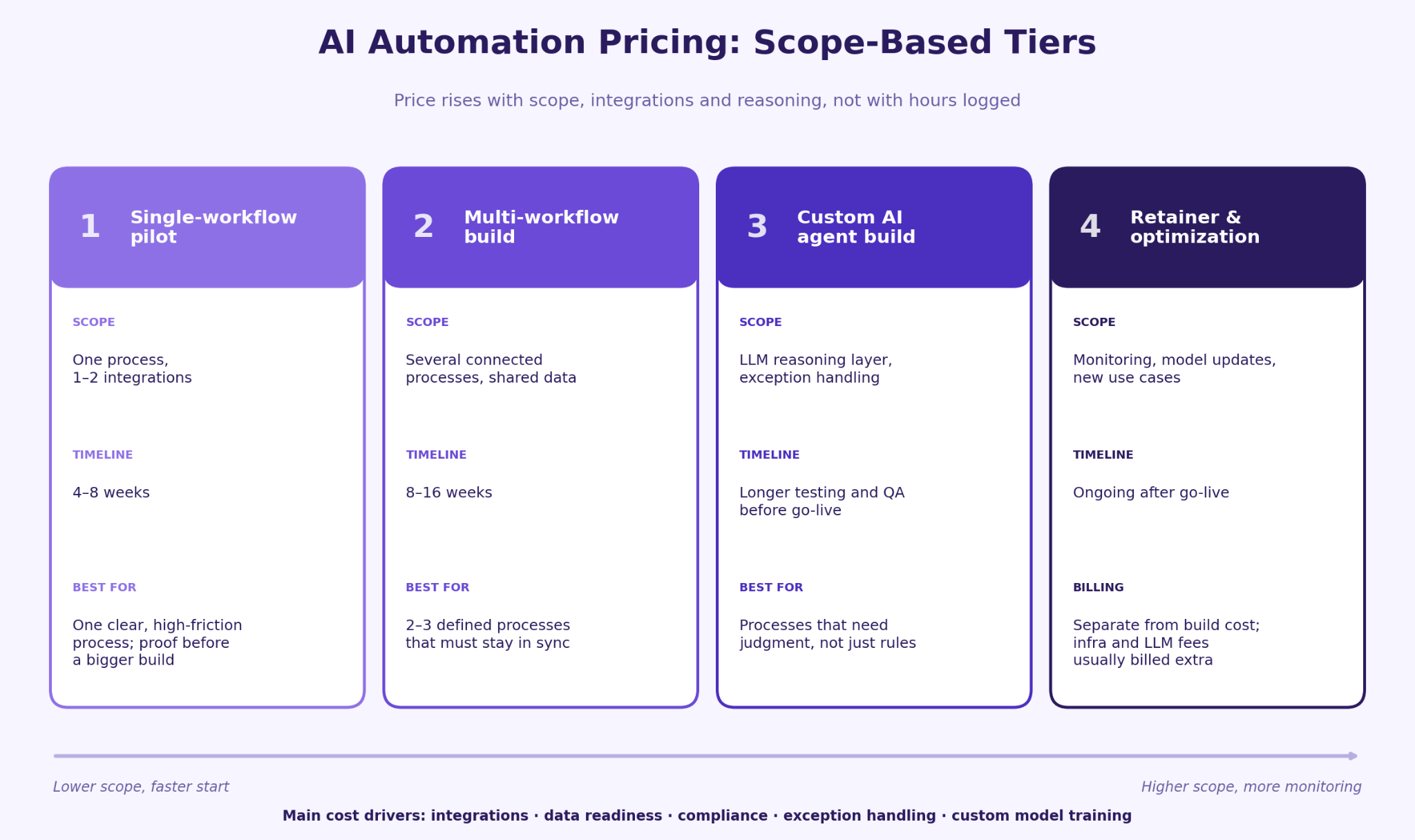
The tier you choose determines your build cost, your timeline, and how quickly you'll see a return.
1. Single-workflow pilot
The narrowest scope and the fastest path to a working system. This tier covers one automated process with one or two integrations. According to Anfloy's pricing guide and Evolv AI Agents, this is the entry point for most SMB first engagements. Start here if you have one clear, high-friction process and want proof before committing to a larger build.
2. Multi-workflow build
Several connected processes, more integration work, and a longer timeline. Cost drivers include the number of SaaS integrations, data readiness, and how many exception paths the system must handle. Atilab's 2026 pricing breakdown covers multi-model tier structures in detail. This tier suits teams with two or three clearly defined processes that share data and need to stay in sync.
3. Custom AI agent build
An LLM-reasoning layer with exception handling and domain-specific training. This tier is justified when your process requires judgment, not just rules. Expect longer testing cycles and more rigorous QA before go-live. The build timeline is longer and the ongoing monitoring requirement is higher than any workflow tier.
4. Retainer and optimization
Ongoing monitoring, model updates, and new use-case additions. This is a separate cost from the build and is where the partnership model matters most. Arsuno.ai has launched 30+ AI systems, retained 10+ clients for two or more years, and maintains a 98% client satisfaction rate, per arsuno.ai's published figures.
The primary cost drivers across all tiers are: number of integrations, data readiness, compliance requirements, exception-handling complexity, and whether you need custom model training or can use a pre-trained model.
Ready to scope your first engagement?
If your team is spending hours on tasks AI could handle, let's figure out what the right starting point looks like for your business.
Book a discovery call
What the engagement looks like from day one to go-live
For smaller scaling businesses, the biggest fear is usually the same: signing a contract and waiting months before seeing anything work. A well-structured engagement does not operate that way. Here's what the phases look like, anchored to arsuno.ai's published delivery model.
One note before the phases: enterprise consultancies can spend months in scoping alone before a single line of code is written. That is not the standard for a focused SMB engagement.
1. Strategy and alignment
Weeks 1–2. Define objectives, identify the highest-impact process to automate first, and assess data and tech readiness. arsuno.ai's published onboarding timeline is 1–2 weeks for this phase. The output is a clear brief, not a 40-page strategy document.
2. Proof of Value
Weeks 2–4. A working prototype the client sees before committing full budget. This is the structural differentiator between a focused agency and a large consultancy. You see the system handle real inputs before you approve the full build. For any first engagement, this phase should be non-negotiable.
3. Deployment and integration
Weeks 4–16, depending on complexity. Production build, API connections, staff onboarding, and QA. Integration depth and exception-handling complexity are the two factors that extend timelines most. A single-workflow build with one integration sits at the shorter end. A multi-agent build with five connected tools sits at the longer end.
4. Scale and optimization
Ongoing after go-live. Monitoring, model updates, and new use-case additions. arsuno.ai's published full deployment range is 1–6 months depending on scope, with the Scale and Optimization phase built in as a standard engagement component, not an upsell.
What happens after launch: maintenance, drift, and ongoing costs
The build cost is the number most founders focus on. The ongoing maintenance cost is the number that determines whether the system stays useful six months after launch.
Model drift is the most common post-launch issue. AI outputs degrade over time as your business data, language patterns, or process rules change. A system performing well at launch can slip without active monitoring. This is not a flaw in the technology; it is the nature of any model trained on a snapshot of your data.
Retraining cycles are a real recurring cost, not a one-time fix. How often a model needs updating depends on data volume and how frequently your underlying processes change. A recruitment shortlisting model may need quarterly updates as job market language shifts. A document extraction model may be more stable. Confirm the expected retraining cadence before you sign.
Integration maintenance is the silent risk. Connected tools update their APIs. A workflow that runs cleanly today can break without warning when your CRM or ERP releases a new version. Someone needs to own that monitoring, and it should be clear in your contract whether that's you or your agency.
What a retainer should cover versus what it typically does not: active optimization, new use-case additions, and model updates are retainer-included at well-structured agencies. Infrastructure costs and LLM usage fees are typically billed separately. As Atilab's pricing guide notes, maintenance and monitoring are recurring line items, not optional add-ons.
arsuno.ai's Scale and Optimization phase is a built-in engagement component. The company's 10+ clients retained for two or more years, per arsuno.ai's published figures, reflects that the retainer model works when it is structured correctly. Total cost of ownership includes the build, the retainer, and the infrastructure: budget for all three from the start.
Five questions to ask any AI automation agency before you sign
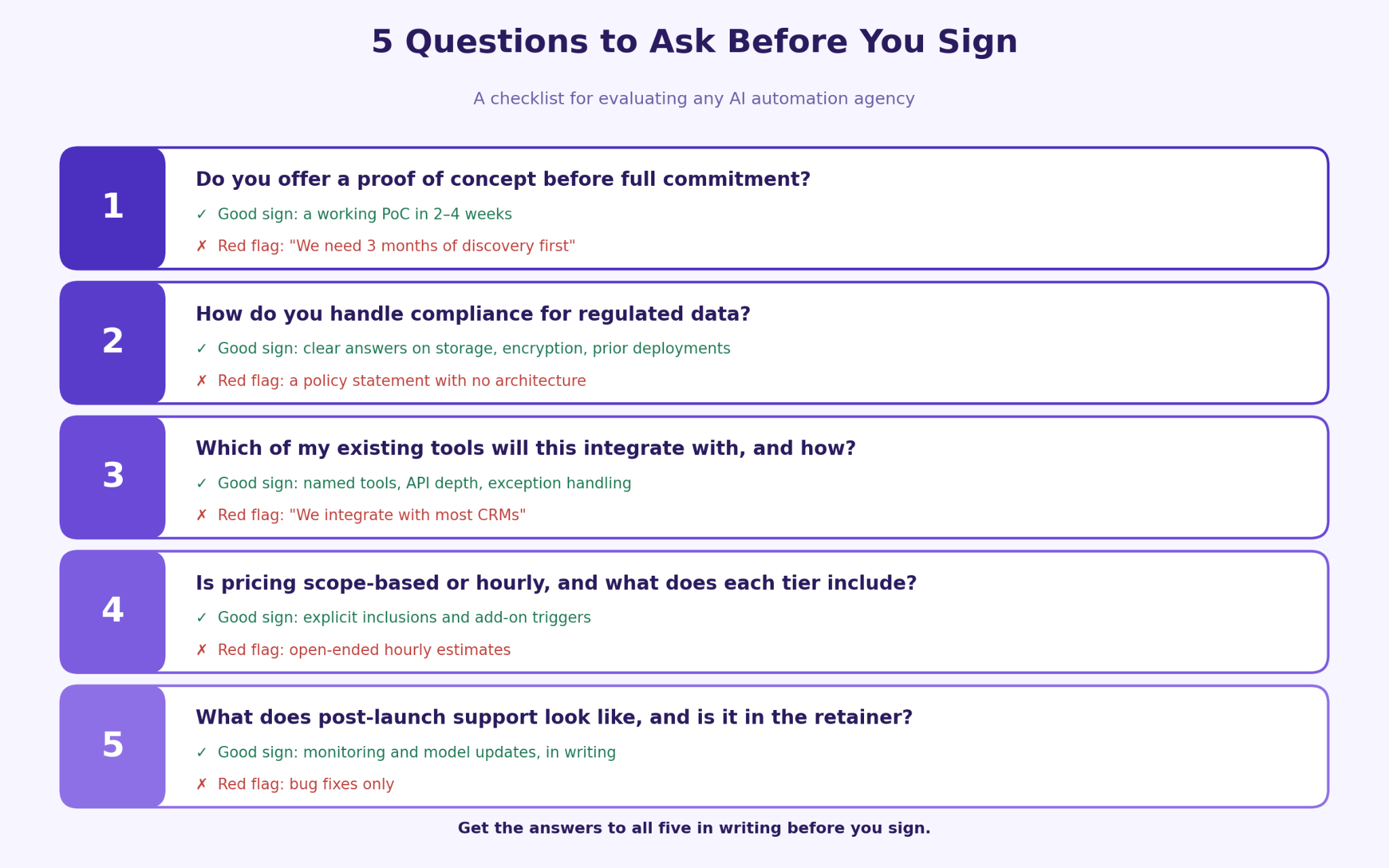
A custom automation build requires clearer post-launch commitments than a SaaS tool. These five questions filter out agencies that cannot deliver on their promises. The Digital Agency Network frames vendor comparison as a structured evaluation, not a gut-feel decision.
1. Do you offer a proof of concept before full commitment?
A PoC in 2–4 weeks is achievable and should be expected. If the answer is "we need 3 months of discovery first," that is a model designed to protect the agency, not you.
2. How do you handle compliance for regulated data?
Ask where data is stored, how it is encrypted, and whether the agency has deployed in your regulatory environment before. A policy statement is not a compliance architecture.
3. Which of my existing tools will this integrate with, and how?
Expect named tools, API depth, and specifics on exception handling. "We integrate with most CRMs" is not an answer. "We connect to HubSpot via the Contacts API and handle rate-limit errors with a retry queue" is.
4. Is your pricing scope-based or hourly, and what does each tier include?
Hourly estimates make it harder to protect against scope creep. Ask what is explicitly included at each level and what triggers an additional charge.
5. What does post-launch support look like, and is it included in the retainer?
Get this in writing before you sign. A retainer that covers monitoring and model updates is fundamentally different from one that covers only bug fixes. Knowing the difference protects your budget after go-live.
Curious what this would look like for your business?
arsuno.ai works with scaling teams to scope, build, and maintain custom AI systems. No commitment required to start the conversation.
Get a free consultation
Frequently Asked Questions
What does an AI automation agency do?
An AI automation agency designs, builds, and integrates systems that remove repetitive work from your operations. Common outputs include workflow automation, support triage, document handling, reporting dashboards, and internal process automation. Implementation typically includes staff onboarding, QA, and a handoff to monitoring, not just a setup and exit. The agency relationship usually continues post-launch to handle model updates and new use cases.
What services do AI automation agencies actually build?
Agencies build customer-facing systems like trained support chatbots and scheduling assistants, and internal systems like document extraction pipelines, automated reporting dashboards, and CRM-connected workflow sequences. The deliverable is always a connected process, not a single tool install. A finished engagement typically integrates two or more of your existing tools and produces a daily operational output your team can measure.
How much does AI automation cost?
Cost depends almost entirely on scope. A single-workflow pilot sits at the lower end of the market; a custom AI agent build with multiple integrations sits significantly higher. According to Anfloy's pricing guide, the range across project types is wide, and the most useful frame is scope-based tiers rather than a single number. Complexity, number of integrations, and compliance requirements are the primary cost drivers.
What should a small business expect to pay for AI automation?
A scaling company's first engagement is usually a scoped pilot covering one high-friction process. As Evolv AI Agents outlines, setup cost and ongoing management cost are separate line items, and both should be budgeted from the start. Infrastructure and LLM usage fees are typically not included in the build price. The most important question is not "what does it cost?" but "what does this tier include and what triggers an additional charge?"
How long does a first AI automation project take?
A focused single-workflow pilot can go from brief to live in 4–8 weeks. A multi-workflow build with several integrations typically runs 8–16 weeks. According to Anfloy's breakdown, integrations and exception handling are the two factors that extend timelines most. A proof-of-concept phase in weeks 2–4 is a reasonable expectation for any well-structured first engagement.
What is the difference between AI workflow automation and AI agents?
Workflow automation follows fixed rules and triggers: if X happens, do Y: making it faster to build, cheaper to run, and easier to maintain. AI agents use LLM reasoning to handle ambiguous, multi-step tasks where the next action depends on context, as mvplab.ai's guide explains. Agents require more data preparation, longer testing cycles, and higher ongoing monitoring than rule-based workflows. If your process always follows the same path, start with workflow automation; if genuine judgment is required, an agent build is justified.
How do I compare AI automation agencies before booking a call?
Ask whether they offer a proof of concept before full commitment, how they handle compliance for regulated data, and whether their pricing is scope-based or hourly. As DesignRush's agency guide frames it, structured vendor evaluation beats gut-feel comparison. Confirm what post-launch support includes and whether monitoring and model updates are in the retainer or billed separately. An agency that can answer all of these questions specifically is worth a serious conversation.