
Key takeaways
- Evaluate business process automation services on full service scope: discovery, change management, and ongoing optimization must all be in the contract.
- Match the delivery model to your compliance and integration complexity before shortlisting vendors.
- Demand a structured proof of value phase on your actual data before committing full budget.
- Baseline current hours, error rates, and SLA breach frequency before any vendor call: you cannot measure improvement without a starting point.What business process automation services actually cover
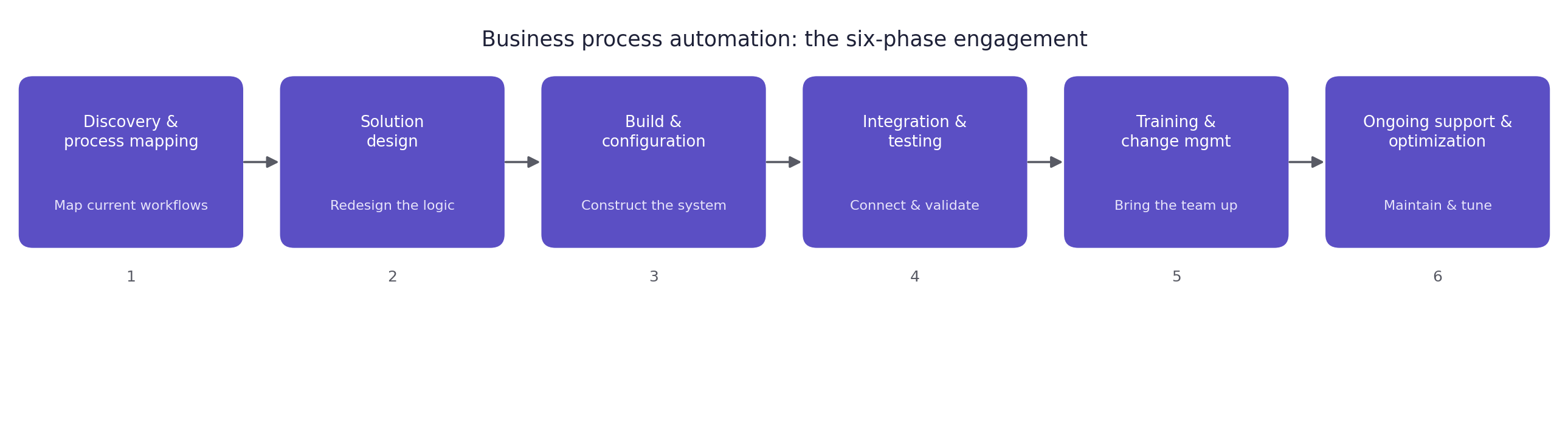
Most buyers enter vendor conversations expecting to buy a workflow. What they are actually buying is a six-phase engagement, and the phases they do not price in are the ones that determine whether the system survives contact with real operations.
The six phases most buyers do not fully price in
A complete business process automation engagement spans discovery and process mapping, solution design, build and configuration, integration and testing, training and change management, and ongoing support and optimization. As WiserBrand's service documentation outlines, the full delivery cycle goes well beyond building workflows. It includes mapping how work currently flows, redesigning that logic, and maintaining the system as processes evolve.
The problem is that many vendors only contract for the build phase. Discovery becomes a free scoping call. Change management becomes a one-page handover document. Post-launch optimization becomes a paid retainer you did not know you needed until the system starts breaking. Before you sign anything, confirm in writing which of these six phases are included and which are out of scope.
What workflow tooling covers and where it stops
Workflow automation services describe the tooling layer: routing tasks, triggering notifications, connecting apps, and moving data between systems. Platforms like n8n or Power Automate are well-suited to this. They handle simple, low-risk, non-regulated task routing effectively, and for that specific use case, they are the right choice.
Business process automation goes deeper. It redesigns the logic of how work flows across systems, handles exceptions when source data is malformed or a system is unavailable, and scales across departments and compliance boundaries. The distinction matters because an ops leader who buys workflow tooling when they need full-scope automation will spend the next six months building workarounds. For a closer look at where SaaS integrations fit and where they stop, the guide on [SaaS integrations](INTERNAL: Supporting: 5 Must-Have SaaS Integrations to Supercharge Your Workflow) covers the boundary in practical terms.
What to confirm is in scope before you sign
Four items are commonly excluded from standard vendor contracts: change management, staff training beyond initial onboarding, post-launch model optimization, and compliance documentation. Softweb Solutions' service documentation notes that the integration and monitoring layer is where most post-launch failures originate. This happens precisely because it is treated as a delivery assumption rather than a contracted deliverable.
Ask every vendor to confirm these four items in writing before you enter procurement. If any of them are described as "available on request" or "handled during onboarding," that is a scope gap, not a feature. Get the answer in the contract, not in a sales call.
Four delivery models compared: SaaS, freelancer, agency, consultancy
Before you evaluate any individual vendor, decide which delivery model fits your situation. The wrong model will fail regardless of how good the vendor is within it. As Velvetech's evaluation framework outlines, the choice between delivery models depends on risk tolerance, integration complexity, and the post-launch support your operations require.
Here is how the four main models compare across the criteria that matter most.
SaaS tools are the right answer for simple, non-regulated task routing. If your need is connecting two apps and triggering a notification, a platform like Power Automate will get you there faster and cheaper than any agency.
Freelancers carry high variance in reliability, end support at delivery, and rarely bring compliance architecture depth. They suit a single-system, low-stakes build where you have internal technical oversight and the cost of failure is low.
Custom AI automation agencies deliver across cloud, AI, frontend, backend, and automation layers, with industry-specific model training and a structured ongoing partnership. This model fits multi-system, regulated, or growth-stage builds where post-launch support is not optional.
Enterprise consultancies bring governance depth, but engagement models typically start in months and are built for organizations above 300 employees. For a 50–300 person business, the overhead will often outweigh the value.
Not sure which delivery model fits your situation?
arsuno.ai works with operations leaders to identify the right automation approach before a single line of code is written. No commitment required to start the conversation.Let's talk about your operations
What to evaluate before you sign: the core criteria
Knowing how to choose an automation partner requires more than reviewing a vendor's case study deck. You need a structured evaluation framework you can apply consistently across every vendor on your shortlist. This is the partner checklist that belongs in your first discovery conversation.
1. Industry experience in your specific sector
Ask for examples from your exact industry, not general automation case studies. Healthcare, recruitment, and professional services each carry workflow logic, terminology, and compliance requirements that do not transfer from generic experience. A vendor who has automated invoice processing for a logistics company has not demonstrated they can handle clinical intake data or candidate shortlisting pipelines. Ask for a comparable client example, and ask what went wrong during implementation, not just what went right.
2. Integration capability with your existing stack
Ask the vendor to demonstrate a working integration with your CRM, ERP, or document systems. Not a slide deck showing logos. A live example of data moving between systems in the way your process requires. If the vendor cannot demonstrate this before the contract is signed, they are asking you to fund the discovery of whether it is even possible.
3. Compliance readiness for your regulatory environment
GDPR compliance is a baseline requirement for any vendor handling personal data in a European context. For healthcare clients, ask specifically whether the architecture is designed to support HIPAA requirements. Vague answers here are disqualifying. A vendor who says "we take compliance seriously" without describing their encryption standards, data residency approach, or access controls has not built compliance into their architecture.
4. Post-launch support model
Ask what the support SLA looks like after go-live: response times, coverage hours, and escalation paths in writing. This is where most vendor relationships break down. The build phase ends, the team disperses, and the client is left with a system that has no one accountable for maintaining it. The HGS partner-selection guide identifies post-launch accountability as one of the most consistently underweighted criteria in vendor evaluations.
5. Proof of value structure before full budget commitment
Does the vendor offer a scoped pilot on your actual data before you commit full budget? This is the strongest buyer-protection mechanism available, and most vendors do not offer it as a standard phase. Withum's advisory documentation frames the proof-of-concept phase as a standard expectation for credible automation engagements. arsuno.ai reports a 98% client satisfaction rate across 30+ AI systems launched, with 10+ clients retained as long-term partners for more than two years, built on a proof-of-value-first model.
Integration and compliance: the questions you must ask
Integration failure is the most common source of post-launch disappointment in automation projects. It is also the most preventable, if you ask the right questions before signing. Every automation partner worth working with should be able to answer all of these in the first technical conversation.
1. Which systems must connect, and how will the vendor handle exceptions?
Ask specifically what happens when a source system is unavailable or returns malformed data. Every real automation encounters this. A vendor who cannot describe their exception-handling logic before the contract is signed is showing you exactly what post-launch support will look like: reactive, slow, and at your cost.
2. Who owns the data at each stage of the automation pipeline?
Where is data stored, for how long, and who can access it? These are not questions for your legal team to ask later. They belong in the first technical conversation. Data ownership and access control are among the most frequently deferred and most frequently regretted questions in automation procurement.
3. How does the architecture comply with GDPR?
For healthcare clients, ask whether the architecture is designed to support HIPAA requirements. Never accept a verbal assurance. Ask for documentation. A vendor with confirmed GDPR compliance and documented encryption in transit and at rest can answer this question in the first call. arsuno.ai's published security commitments confirm enterprise-grade encryption in transit and at rest, full GDPR compliance, and cross-geography data privacy adherence. That is the standard of answer you should expect.
4. What encryption standards apply in transit and at rest?
Ask for written documentation, not a verbal assurance. If the vendor cannot produce this, they have not built it. Encryption standards are not a detail to confirm during implementation.
5. Can you operate, maintain, and migrate without the vendor if needed?
Lock-in is a real risk in custom automation. Ask whether the system is built on documented, transferable architecture. Ask what the exit process looks like. A vendor who deflects this question is signaling that the relationship depends on your inability to leave, not on the quality of what they build.
How to calculate automation ROI before you commit
Operations leaders who walk into a CFO meeting with vague efficiency promises lose credibility. The ones who walk in with a baseline measurement and a realistic improvement range get budget approved. The methodology is straightforward.
Start by baselining the current state: hours spent on the target process per week, error rate or rework frequency, and SLA breach rate. These three numbers give you a cost floor. Apply arsuno.ai's published benchmarks as anchors: 60% operational overhead reduction, 3x efficiency increase, and 40% cost reduction. These are first-party figures from arsuno.ai's published service outcomes and should be treated as directional targets, not guarantees. Your actual results will depend on process complexity, data quality, and integration scope.
Then express the improvement in board-ready terms: hours recovered per month multiplied by fully loaded labor cost, plus error-related rework cost eliminated, plus SLA penalties avoided. That calculation gives you a payback period your CFO can evaluate. A credible vendor can help you build this model during the discovery phase. If they cannot, that is a red flag. ScienceSoft's implementation documentation provides a useful reference for how ROI evolves across the phases of a structured automation engagement.
The metrics to track post-launch are the same ones you baselined: hours per process, error rate, and SLA compliance. If the vendor cannot tell you how they will measure against those baselines after go-live, the engagement has no accountability structure.
Ready to build a business case for automation?
arsuno.ai can help you baseline your current operations and model realistic outcomes before you commit to a full engagement. Start with a conversation.Book a discovery call
Red flags that disqualify an automation partner
Most vendor conversations feel positive until they do not. These are the specific behaviors that signal a vendor is not ready to deliver a production-grade automation system.
They cannot describe their exception-handling logic before the contract is signed. Exception handling is the difference between an automation that works in a demo and one that works in production. If the vendor cannot explain what happens when a source system returns an error, they have not built for real-world conditions.
They offer no structured proof of value phase. A credible vendor can scope a pilot on your actual data and show results before you commit full budget. If the vendor skips straight to a full engagement proposal, they are asking you to absorb all the discovery risk.
They cannot produce written documentation for GDPR compliance or encryption standards. Verbal assurances on compliance are not compliance. If documentation does not exist in the first conversation, it does not exist in the architecture.
They have no post-launch SLA. Ask directly: what are your response times after go-live? If the answer is vague or deferred to a future conversation, you are looking at a build-and-exit model, not a managed partnership.
They cannot reference a comparable client example. General automation experience does not transfer to regulated or domain-specific workflows. If the vendor cannot name a client in your sector and describe what they built, they are proposing to learn on your project.
They ask for full budget commitment before delivering a working prototype. This is the clearest signal that the vendor's risk model is misaligned with yours. Any partner confident in their delivery will offer a structured pilot before a full contract.
Making the final decision: a practical shortlisting process
Once you have applied the evaluation criteria and eliminated vendors with disqualifying red flags, the shortlisting process should follow a consistent structure. Inconsistent evaluation is one of the most common reasons procurement decisions get reversed after implementation begins.
Start by scoring each vendor on the five core criteria: industry experience, integration capability, compliance readiness, post-launch support model, and proof of value structure. Use a simple weighted scorecard where compliance and post-launch support carry higher weight for regulated or multi-system builds. This forces the conversation away from which vendor gave the best demo and toward which vendor can actually deliver in your environment.
Run a structured reference check with at least one client from your sector. Ask the reference three specific questions: what went wrong during implementation, how the vendor responded when it did, and whether they would re-engage the same partner for a subsequent project. The answer to the second question is more predictive of long-term partnership quality than any case study the vendor will show you.
Require a written statement of work before any contract is signed. The statement of work should name every phase, define what done looks like for each, and specify what triggers additional cost. Ambiguity in the statement of work is not a negotiating position: it is a future dispute waiting to happen.
Finally, confirm the handover terms before you sign. Who holds the credentials at go-live? What does the documentation package include? What is the process if you need to migrate to a different vendor in 18 months? A vendor who cannot answer these questions clearly before the contract is signed will not answer them clearly after it is.
The shortlisting process is not a formality. It is the point at which you convert a vendor conversation into a structured accountability framework. The time you invest here is the time you save managing a failed implementation later.
Frequently Asked Questions
What do business process automation services include?
Business process automation services cover the full delivery cycle: discovery, process mapping, solution design, build and configuration, integration and testing, training, and ongoing support. Some providers only deliver the build phase, leaving change management, post-launch optimization, and compliance documentation as out-of-scope surprises. Before signing, confirm in writing which phases are included and what triggers additional cost. The gap between what you expect and what is contracted is where most implementation failures originate.
How do you choose an automation partner?
Start with industry experience in your specific sector, not general automation credentials. Then evaluate integration capability with your existing stack, compliance readiness for your regulatory environment, and the post-launch support model. As the HGS partner-selection guide outlines, a weighted scorecard across these criteria produces a more defensible decision than gut feel after a demo. Require a structured proof of value phase before committing full budget.
What should a business process automation partner checklist include?
Your checklist should cover technical depth, industry fit, integration capability, compliance architecture, support SLA, scalability, ROI evidence, and documentation standards. Add specific questions about data ownership, handover terms, and ongoing maintenance responsibilities. The checklist should be usable both for your own evaluation and as a document you can present to leadership or procurement when justifying your shortlist.
Should you hire a workflow automation consultant, agency, or do it yourself?
DIY works for simple, low-risk automations using SaaS tools where internal technical oversight is available and the cost of failure is low. A consultant fits narrow-scope, single-system builds with defined deliverables. A custom AI automation agency is the right model for multi-system, compliance-sensitive, or growth-stage builds that require full-stack delivery and post-launch support. As Elevate AI's delivery model comparison notes, the decision depends on risk tolerance, integration complexity, and how much ongoing ownership you need from the partner.
What proof should an automation vendor show before you sign?
Ask for comparable client results from your specific industry and a live integration demonstration, not a slide deck. Require a written post-launch support SLA and clear documentation of data ownership and handover terms. The strongest proof is a structured pilot on your actual data with agreed success criteria set before build begins. As Auxiliobits' vendor selection guide outlines, references, transparent ownership terms, and evidence of support capability are the three most predictive signals of a durable vendor relationship.
How long does an automation project take?
Timing depends on process complexity, integration scope, data readiness, and compliance review requirements. A credible benchmark, per arsuno.ai's published delivery data, is 1–2 weeks for onboarding and alignment, followed by 1–6 months for full deployment depending on complexity. Compressing any phase: discovery, proof of concept, build, or testing: increases post-launch risk. Set internal expectations against these ranges, not against vendor sales timelines.
What happens after automation goes live?
A credible partner provides ongoing monitoring, exception handling, bug fixes, and process tuning after launch. Ask whether post-launch support is a managed partnership with a written SLA or a handoff document and a ticket queue. As Softweb Solutions' service documentation notes, the integration and monitoring layer is where most post-launch failures originate. Confirm who owns the system, who holds the credentials, and what the escalation path looks like before go-live, not after the first incident.
What red flags should you watch for when choosing an automation partner?
The five clearest disqualifiers are: no structured proof of value phase before full budget commitment, vague answers about exception handling, no written post-launch SLA, a 12-month contract presented as the only engagement option before proof of value, and inability to explain data ownership and handover. Nordflux's partner-selection insights identify data access and handover clarity as the most frequently deferred and most frequently regretted questions in automation procurement. Any one of these behaviors is sufficient reason to end the conversation.
What should you ask about integration and data access?
Ask which systems must connect and how exceptions will be handled when source data is malformed or unavailable, then confirm who owns the data at each stage and where it is stored. Ask for written documentation of encryption standards in transit and at rest: never accept a verbal assurance. Finally, ask whether the vendor requires new tooling or can integrate with your existing infrastructure, and what the handover plan looks like if the engagement ends.
What is a proof of concept in automation?
A proof of concept is a scoped working prototype built on your actual data, with agreed success criteria defined before the build begins. It is distinct from a vendor demo, which runs in a controlled environment on prepared data. A genuine proof of value proves feasibility and value in your environment before you commit full budget, making it the strongest buyer-protection mechanism available in automation procurement.