

Key takeaways
- Building an AI-ready startup starts with sequence, not software. Document processes before buying tools.
- Run the 3-point readiness test: Is it written down? Does it repeat weekly? Is the error cost low enough to pilot safely?
- Start with one internal workflow, run a 2-4 week pilot, and measure before expanding.
- Volatile or judgment-heavy processes belong in the "delay" category. Fix the process first, then automate.
Why most founders get AI wrong from the start
Most founders don't have an AI problem. They have an operations problem they're hoping AI will solve.
The pattern is familiar: you sign up for a ChatGPT account, bolt Zapier onto your CRM, and add a generic chatbot to your site. Six months later, the team has built workarounds around the workarounds, you've spent real money, and the manual work is still there. You haven't automated your operations. You've just added more tools on top of them.
This is the tool-stacking trap, and it's the most common reason founders lose confidence in AI before they've actually tried it. As Startupik's lean AI guide points out, buying tools and building AI-first operations are two fundamentally different things. The first is a purchasing decision. The second is an operational design decision.
The distinction matters because AI is an accelerant, not a fix. It speeds up whatever process you point it at. If that process is clean, documented, and stable, automation multiplies your output. If it's chaotic, undocumented, or constantly changing, automation multiplies your problems. You'll encode the broken version of the workflow at scale, and it will cost you more to unwind than it would have cost to just hire someone.
The founders who get AI right don't start with tools. They start by asking: do we actually have a process here, or do we have a habit? A habit lives in one person's head. A process can be written down, handed off, and eventually handed to a machine.
That reframe is what separates a startup that uses AI tools from one that builds AI-first operations. The integrations that look impressive in a demo won't save you if the underlying workflow isn't legible. "Legible" has a specific meaning here: it means documented, repeating, and measurable enough to know whether the automation is working.
The rest of this article gives you the sequence to get there. Not a tool list. A roadmap.
The automation-readiness test for startup workflow automation
Before you automate anything, run this test. It takes ten minutes and will save you months.
Every workflow you're considering needs to pass three criteria. Fail any one, and it goes in the delay category. According to Definite's startup automation guide, most early-stage automation failures come from skipping exactly this check.
1. Is it documented?
The workflow must exist as a written sequence of steps, not as knowledge in one person's head. If you can't write it down in under 30 minutes, you don't have a process yet. You have a habit.
Automation executes the logic you give it. If the steps aren't written before you build, the automation will encode whatever the builder assumes happens, which is usually a partial, slightly wrong version of reality. Document first.
2. Does it repeat at least weekly?
High-frequency repetition is what makes automation ROI visible fast. A workflow that runs twice a year might be worth streamlining, but it rarely justifies the build cost at the early stage. You need enough repetitions to measure improvement and catch errors before the system becomes load-bearing.
Weekly or daily workflows are the right starting point. Monthly is marginal. Quarterly is almost always a delay.
3. Is the cost of an error low enough to pilot safely?
This is the criterion most founders skip. Automation errors in high-stakes workflows, such as compliance flags or contract terms, can be expensive and hard to reverse. Your first automation should live somewhere a mistake is visible, correctable, and caught before it reaches a client or regulator.
If an error here would be a serious problem, that workflow belongs in Phase 3, not Phase 1.
The delay rule: a workflow that fails any criterion doesn't get scrapped. It goes on a "not yet" list. Many workflows that aren't ready today will be ready in three to six months, once the process is documented and stable. The goal is to automate the right things in the right order, not to automate everything at once.
The startup automation roadmap for founders: phase by phase
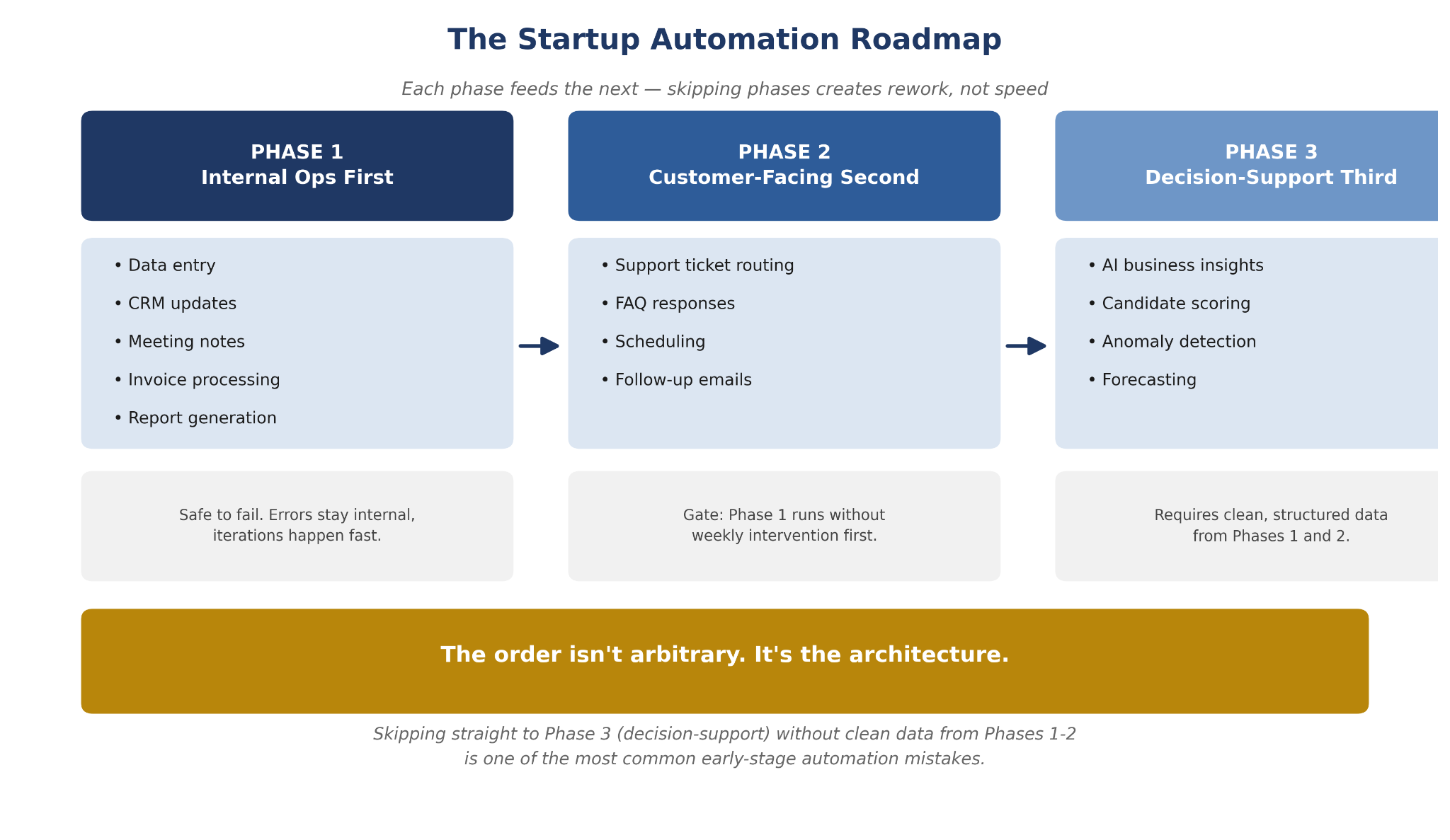
The sequence matters as much as the selection. Each phase feeds the next: clean internal data enables better customer-facing automation, which generates the structured output decision-support AI needs. Skipping phases doesn't save time. It creates expensive rework.
1. Phase 1: Internal ops first
Start with data entry, CRM updates, meeting notes, invoice processing, and report generation. These workflows are high-frequency, fully documentable, and invisible to clients if something goes wrong during the pilot.
You need a safe environment to learn how automation behaves in your specific stack. Errors stay internal, iterations happen fast, and time savings are immediate and measurable. That gives you the proof to justify the next phase.
2. Phase 2: Customer-facing automation second
Support ticket routing, FAQ responses, scheduling, and follow-up emails come next, but only after your internal ops are stable. Errors in customer-facing workflows are visible to clients, and a broken chatbot costs more than the time you saved. The AI customer support guide covers what this looks like for teams at this stage.
The gate between Phase 1 and Phase 2 is simple: if your internal automations run without weekly intervention, you're ready to move outward.
3. Phase 3: Decision-support automation third
AI business insights, candidate scoring, anomaly detection, and forecasting require clean, structured data to function accurately. That data comes from Phases 1 and 2. Attempting decision-support automation first is one of the most common early-stage mistakes, because the AI has nothing reliable to reason from.
M Accelerator's case study documented a small B2B SaaS startup that automated three sales-adjacent workflows using n8n and CRM integrations. Treating it as a process-first rollout rather than a broad tool replacement added throughput without growing headcount. That sequencing decision was the reason it worked.
The order isn't arbitrary. It's the architecture.
What to skip or delay: automation mistakes that cost founders most
Knowing what not to automate is as valuable as knowing what to start with. Here are the three categories that consistently create technical debt and staff frustration when automated too early.
Volatile workflows
Any process that changes its rules or steps more than once a month isn't worth automating yet. The automation will break faster than it saves time. You'll spend more hours maintaining it than you would have spent doing the task manually, and your team will quietly route around it within weeks. Stabilize the process first. Then automate it.
Undocumented or judgment-heavy decisions
Pricing negotiations, complex client relationship management, nuanced hiring decisions, and clinical assessments all require contextual judgment that early-stage AI automation can't reliably replicate. This isn't a permanent limitation. It's a stage limitation. These workflows belong in Phase 3 at the earliest, and only after you've built the data foundation that makes AI judgment trustworthy.
High-error-cost processes
Anything where a mistake triggers a compliance event, a client complaint, or a financial loss is not a Phase 1 candidate. As Mean CEO's automation playbook notes, the most costly automation failures happen when founders skip the error-cost assessment. They automate high-stakes work before the system has been validated on lower-risk tasks.
The principle that ties all three together is this: fix the process first, then automate it. Automation doesn't repair broken workflows. It locks them in. If you're considering automating something your team currently struggles to execute consistently, document and stabilize it first. Revisit it once it's running cleanly.
How to measure whether your first automation is working
If you don't have a baseline, you don't have a result. You have a feeling.
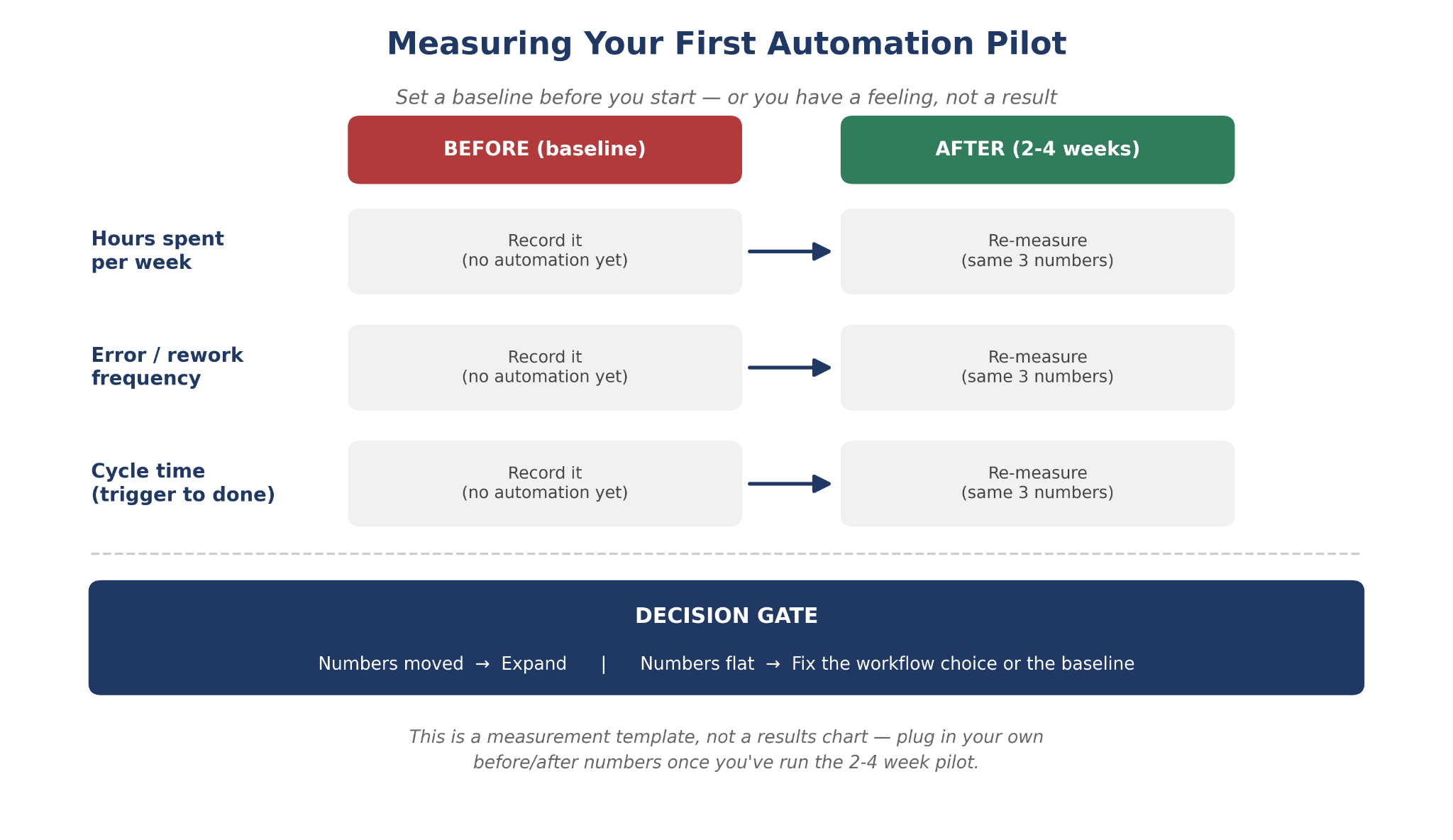
Before you run any automation, record the current state of the workflow: time spent per week on the task, error or rework frequency, and cycle time from trigger to completion. This takes 20 minutes and makes everything that follows defensible. Without it, you can't tell your co-founder, your board, or yourself whether the automation actually worked.
Set your baseline
Write down three numbers before you start: hours spent per week on this workflow, how often something needs correcting, and how long it takes from trigger to completion. These are your before numbers. Everything else is comparison.
Track three metrics
After two to four weeks, measure the same three things. Hours saved per week tells you the time value. Error rate before versus after tells you the quality improvement. Cycle time tells you whether the process is actually faster or just differently slow.
A 10-person team can track all three in a shared spreadsheet. You don't need infrastructure. You need discipline.
Know your ROI visibility window
If two to four weeks pass and the numbers haven't moved, the problem is usually one of two things: the workflow wasn't the right choice, or the baseline was too vague to detect a real change. Both are fixable. Manyforce's automation guide recommends defining your success metric before launch, not after, so you're not reverse-engineering a justification.
arsuno.ai clients who ran this approach have published real results. A Swiss psychiatry clinic reported a reduction in manual work and improvement in automation efficiency. A US recruitment firm reported faster project delivery and improved client satisfaction, as published on arsuno.ai. These are client-reported outcomes, not guarantees. They show what becomes visible when you measure from a real baseline.
Starting without a long commitment: the pilot-first principle
The safest way to evaluate any automation is to run it on one workflow, measure the result, and decide whether to expand. This approach has been shown to separate successful AI adoption from expensive failed implementations. It's backed by multiple guides for non-technical founders, including Layer3 Labs and Startbrain's AI startup guide.
What a responsible pilot looks like
One workflow. A defined 2-4 week window. A baseline metric before launch. A clear decision gate at the end: expand, adjust, or stop. No 12-month lock-in required. The pilot answers one question: does this automation save time and reduce errors on this specific workflow? If yes, expand. If no, you've learned something valuable for a fraction of a full deployment's cost.
arsuno.ai's Proof of Value model
Onboarding takes 1-2 weeks. A working proof of concept is delivered before full budget commitment. Full deployment runs 1-6 months depending on complexity. The Proof of Value phase confirms the automation works in your environment before you scale it. You're not committing a full budget to an untested system.
What this means for a lean team
You don't need a dedicated engineer to start. The pilot is designed for a 10-person team with one stretched developer and a clear operational pain point. If you can describe the workflow in plain language, you can pilot it. Teams without technical depth can still run a rigorous, measurable test and arrive at a defensible go or no-go decision within a month.
Frequently Asked Questions
What should a startup automate first?
Start with the workflow that repeats most often and carries the lowest risk if something goes wrong.
Internal operations, such as CRM updates, meeting notes, and report generation, are the safest first candidates.
The goal is to find a task that is documented, happens at least weekly, and where an error is visible and correctable before it reaches a client.
What makes a workflow automation-ready?
A workflow is automation-ready when it passes three tests: it's written down as a step-by-step sequence, it repeats at least weekly, and the cost of an error is low enough to catch during a pilot.
If any one of these is missing, the workflow belongs in the delay category, not the build queue.
Unstable or judgment-heavy processes should be stabilized first, then reconsidered.
Documentation is the non-negotiable prerequisite.
How can founders evaluate AI automation before committing budget?
Run a pilot on one workflow with a defined 2-4 week window and a baseline metric established before you start.
Measure hours saved, error rate, and cycle time before and after.
If the numbers move, you have proof.
If they don't, you've learned which variable to fix.
What processes should startups avoid automating too early?
Avoid automating any workflow that changes its rules more than once a month, any decision that requires contextual judgment, and any process where an error triggers a compliance event or client complaint.
These aren't permanent exclusions.
They're stage-based delays.
Fix the process, stabilize it, and revisit once it's running cleanly.
How do small teams use AI without a data team?
Start with one workflow, not an AI stack.
Choose something that can be described in plain language and doesn't require complex data infrastructure to run.
Clean process design matters more than technical depth at this stage.
A structured pilot with a clear baseline metric is something any 10-person team can run without a dedicated engineer or data analyst.
How do you measure ROI from startup AI automation?
Record three numbers before you start: hours spent per week on the workflow, error or rework frequency, and cycle time from trigger to completion.
After 2-4 weeks of automation, measure the same three numbers and compare.
The gap is your ROI signal.
If it's not visible within the pilot window, the workflow choice or the baseline measurement needs adjustment.
When should a startup start using AI automation?
Start when you have a repetitive workflow with measurable pain and a written process you can hand to a machine.
You don't need a large team, a full tech stack, or an engineering hire first.
Readiness is about process clarity, not company size.
A 5-person team with one well-documented workflow is ready to pilot.