

Key takeaways
- Chatbot development cost depends on five variables: bot type, integration depth, channel count, data sensitivity, and handoff logic.
- Platform subscriptions start lower but compound through overage fees, seat scaling, and add-ons that rarely appear in headline pricing.
- Custom builds carry higher upfront cost but can reach a lower total cost of ownership at moderate-to-high conversation volume.
- Run a proof-of-concept before full commitment to reduce financial risk on a custom build.
What drives chatbot development cost in the first place
Two chatbots can look identical to the end user and carry price tags that differ by an order of magnitude. The reason is almost always one of five variables: bot type, integration depth, channel count, data sensitivity, and support handoff logic.
Bot type is the first cost lever. A rule-based FAQ bot follows decision trees and requires no model training. An NLP-driven bot interprets natural language and needs labeled training data and ongoing prompt refinement. A generative AI system adds model API costs, fine-tuning, and safety guardrails. Each tier compounds the build estimate, as Cleveroad's cost breakdown and Elfsight's pricing guide both confirm.
Integration depth is the most common reason a "simple" chatbot quote doubles. Connecting to a CRM, help desk, or ERP requires custom API work, authentication layers, and ongoing maintenance a standalone bot does not.
Channel count, data sensitivity, and handoff logic each add distinct engineering scope. Multi-channel deployment across web, WhatsApp, and SMS means separate configuration and testing per channel. GDPR-compliant architecture adds security layers. Intelligent human-escalation routing reads conversation context before transferring to an agent. If you're thinking about automating customer support without disrupting the human experience, these handoff decisions matter most.
Understanding these five variables lets you evaluate any build path on equal terms.
Custom build vs. platform subscription: cost comparison
The number that matters isn't your launch cost. It's what you've spent by month 24, including every recurring fee, overage charge, and integration cost that wasn't in the original quote.
"Total cost of ownership" (TCO) means every dollar spent to keep the system running over a defined period, not just the initial build or subscription fee. Platform subscriptions look attractive at launch because the upfront cost is low. But base plan fees, seat growth, overage charges, and add-on modules compound monthly.
All figures are illustrative. Actual costs vary by scope, provider, and usage.
At moderate conversation volume, the cumulative platform bill typically overtakes the amortized custom build cost before month 24. The rest of this article gives you the tools to test that against your own numbers.
Hidden fees that inflate your platform subscription
Platform pricing pages are built to show you the best-case monthly number. The five fee categories below are what change that number in practice.
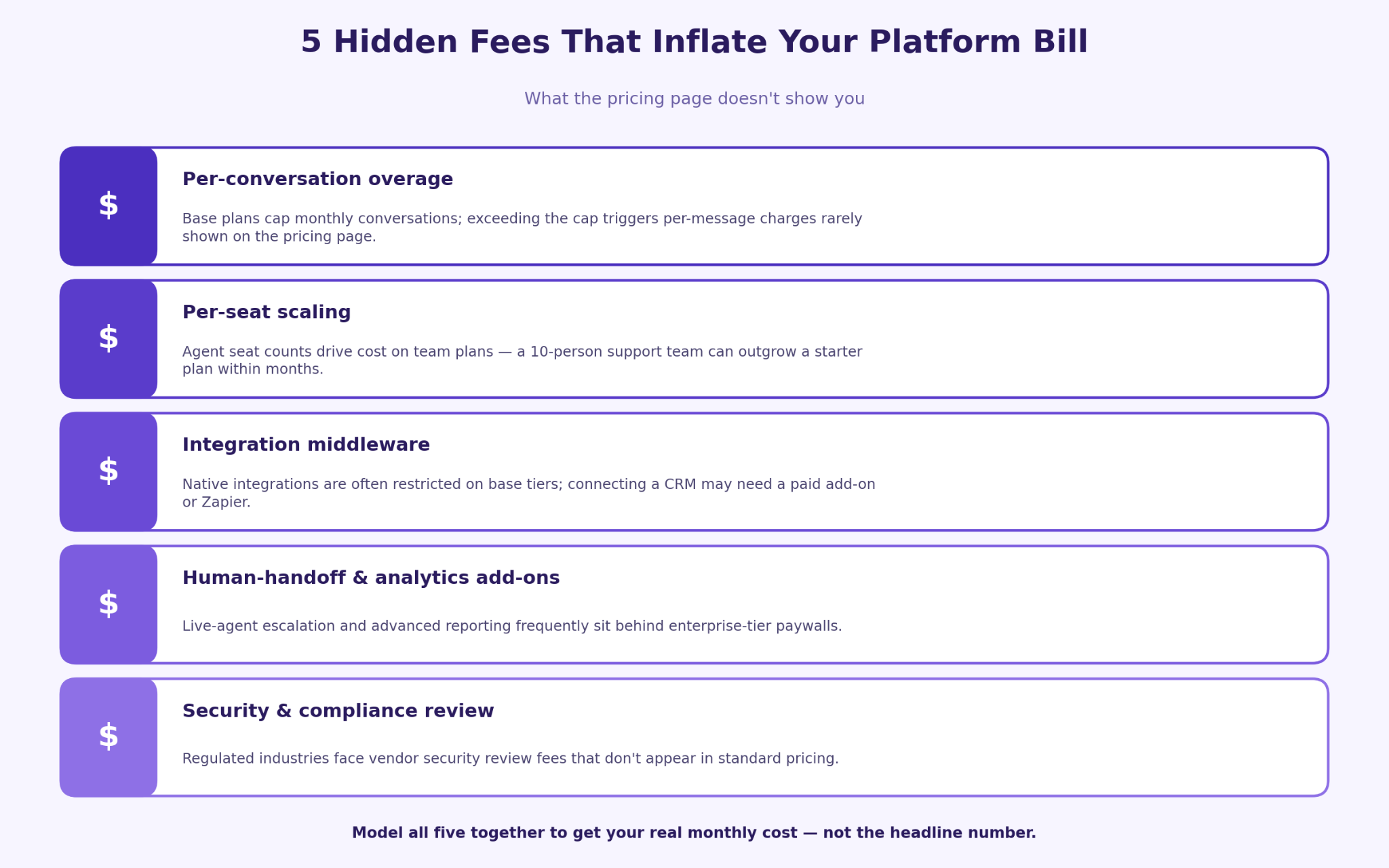
Per-conversation overage is the most common surprise. Most base plans cap monthly conversations, then charge per message once you exceed that cap at a rate that rarely appears on the pricing page. As Featurebase's chatbot pricing analysis shows, this fee structure can push a predictable monthly cost into variable territory fast.
Per-seat scaling hits teams earlier than expected. Agent seat counts drive cost on team and growth plans, and a 10-person support team can push a starter plan into the next tier within months of launch.
Integration middleware and add-on modules reveal the platform model's limits. Native integrations are often restricted on base tiers, so connecting to a CRM may require a paid add-on or a third-party tool like Zapier, adding a recurring cost that belongs in your total cost calculation.
Human-handoff and analytics add-ons are frequently sold as separate paid modules. Live-agent escalation and advanced reporting often sit behind enterprise tier paywalls, as Tidio's pricing breakdown illustrates across its plan tiers.
Security review and compliance costs apply in regulated industries. Healthcare and financial services businesses often face vendor security review fees that don't appear in standard pricing. A subscription that looks affordable at launch can become several times that once seat growth, overage charges, integration middleware, and add-on modules are factored in.
When a platform subscription is the right answer
Not every business should build a custom chatbot. For some use cases, a platform subscription is the faster, cheaper, and lower-risk path.
If your conversation volume is low, a platform subscription gets you live in days, costs less to run, and carries no engineering overhead. For early-stage businesses testing whether a chatbot adds value at all, that's the rational starting point. The upfront investment in a custom build cannot be recovered quickly at low volume. The maintenance overhead is a real cost that belongs in any honest comparison.
The platform case is also strong when your use case is genuinely simple: a single-channel website FAQ, non-sensitive data, no CRM integration, and a team that needs something running this week. No-code and low-code platforms are purpose-built for this scenario. Deploying a custom system here is over-engineering the problem.
The honest framing: building custom when a platform would do wastes budget that could go elsewhere. The custom build case only holds when volume, integration depth, data sensitivity, or workflow complexity makes the compounding platform cost real. If those conditions don't apply today, start with a platform and revisit when they do.
Custom chatbot ROI and the 24-month break-even
The ROI case for a custom build is clearest when you measure it against ongoing operational savings, not upfront build cost alone.
One UK case documented by Softomatesolutions handled 130 of 200 daily enquiries without human intervention. That 65% containment rate translated to roughly 52 staff hours saved per month. The result was £3,200/month in reduced support costs and first-response time dropping from 3.8 hours to under 3 seconds. Reported payback period: 4 months.
The 24-month TCO pattern is consistent at moderate volume. Platform subscriptions start lower, but seat growth, overage charges, and add-on modules compound monthly. As Dante AI's cost comparison shows, the cumulative platform bill typically crosses the amortized custom build cost between months 18 and 24 for teams running meaningful conversation volume.
Three variables determine your break-even. Conversation volume matters because overages erode the platform cost advantage above a moderate threshold. Integration depth adds middleware or maintenance cost for each connected system. Data sensitivity in regulated industries often requires compliance add-ons that push platform TCO sharply upward.
arsuno.ai's proof-of-concept model addresses the "what if the custom build fails" objection directly. A working prototype is built before the full budget is committed, so you validate the system against real conversations before committing the full investment.
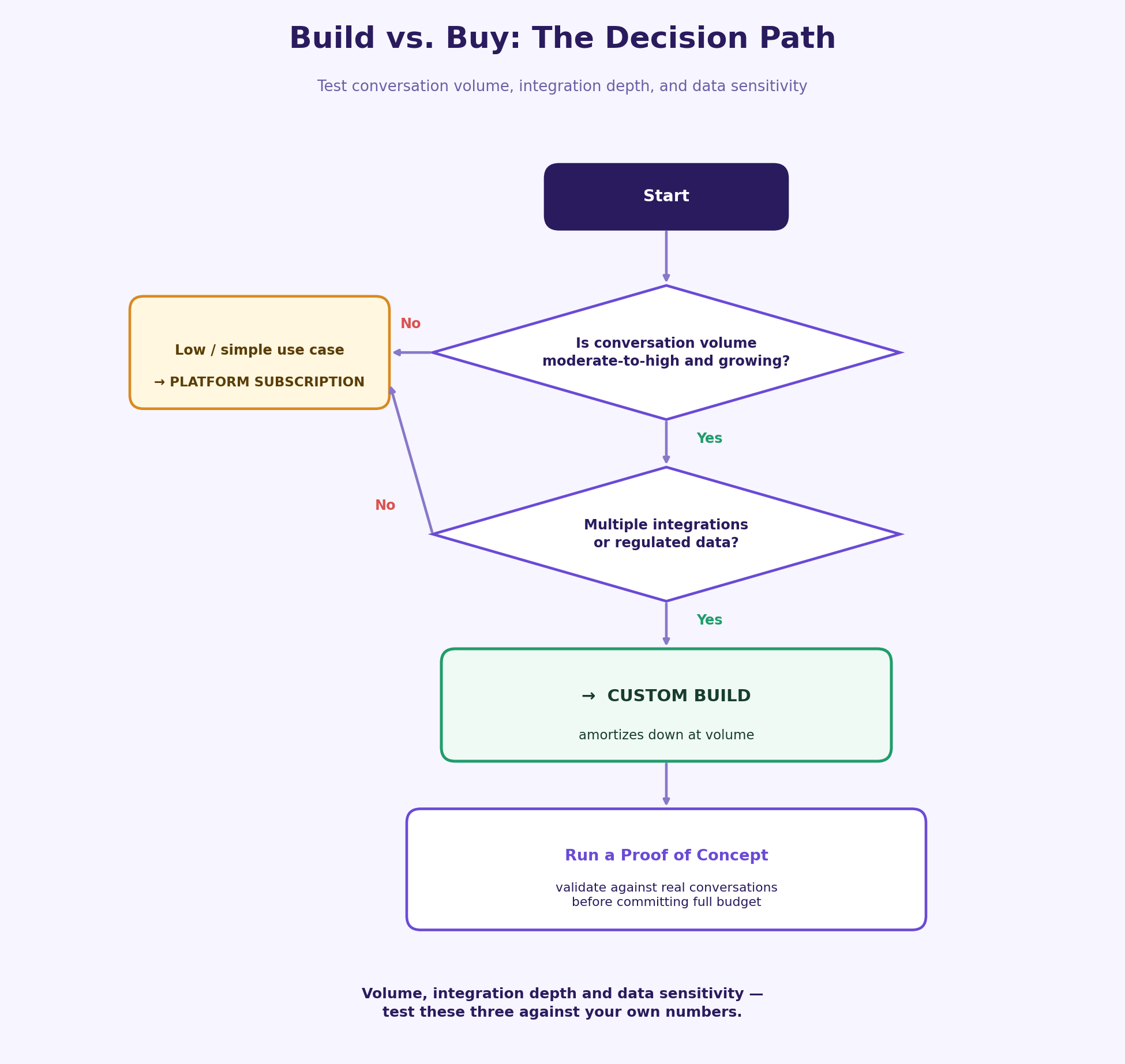
The 24-month number is the one that matters
Headline platform pricing is not the number that determines whether you made the right call. The 24-month total cost of ownership is. A subscription that looks attractive at launch can compound significantly once seat growth, overage charges, integration middleware, and add-on modules are factored in. A custom build that looks expensive at launch can become the cheaper option by month 18 once those compounding costs are modeled honestly.
You now have three variables to test against your own numbers: conversation volume, integration depth, and data sensitivity. Run them honestly. If your volume is low, your data is non-sensitive, and you need something live this week, a platform is the right answer today. If your volume is growing, your workflows are complex, and your data touches regulated systems, the custom build math starts working in your favor faster than the upfront cost suggests.
The next step is a scoping conversation where you bring your actual numbers: monthly conversation volume, the systems you need to connect, and your data sensitivity requirements. arsuno.ai will tell you which path makes sense for your specific stack. A proof-of-concept can answer the question before you commit the full budget. Book a no-commitment discovery call
Frequently Asked Questions
How much does it cost to build a chatbot?
Cost varies widely based on bot type, integration depth, and channel count. A rule-based FAQ bot costs significantly less than a generative AI system with CRM integration and compliance requirements.
The more useful figure is 24-month total cost of ownership, which accounts for recurring fees, overages, and maintenance on either path. Getting a scoped estimate against your specific requirements is the only reliable way to compare options.
What affects chatbot pricing the most?
Integration depth is the single biggest cost driver on a custom build, because each connected system adds API work and ongoing maintenance. On a platform subscription, seat count and conversation volume are the primary variables that push costs beyond the headline price. Data sensitivity adds compliance requirements that increase cost on both paths, but more sharply on platform subscriptions in regulated industries.
How do chatbot platform subscription fees work?
Most platforms charge a base monthly fee that covers a capped number of conversations and agent seats. Exceeding those caps triggers per-conversation or per-seat overage charges that rarely appear on the main pricing page. Add-on modules for live-agent handoff, advanced analytics, and integrations are frequently sold separately, as Tidio's pricing breakdown illustrates across its plan tiers. Modeling all five fee categories together gives you the real monthly cost.
What is a chatbot proof of concept and why does it matter?
A proof of concept is a working prototype built against your actual data and workflows before the full budget is committed.It lets you validate that the system handles real conversations correctly before you invest in a production build. For custom builds, it is the most practical way to reduce financial risk and confirm the ROI case before full commitment.
Should I build a custom chatbot or use a platform?
For low-volume, low-complexity use cases, a platform subscription is usually faster and cheaper to launch.
For teams with growing conversation volume, multiple integrations, or regulated data, the compounding cost of platform fees often makes a custom build the lower-cost option over 24 months.
The honest answer depends on your specific volume, integration depth, and data sensitivity requirements