
Key takeaways
Choosing custom AI vs off the shelf comes down to four operational signals, not budget alone.
Custom AI earns its cost when your workflow is unique, process volume is high, compliance is non-negotiable, or integrations run too deep for any packaged tool. The real cost comparison spans 24 months, not launch day.
Why the build-vs-buy question is the wrong starting point
Most founders frame this as a budget decision made on launch day. "Can we afford to build?" is the question they bring to the first vendor call. It is the wrong question, and asking it first almost guarantees a bad decision either way.
The question that actually matters is: which choice costs more in friction, workarounds, and missed scale over the next 24 months? That reframe changes everything. A SaaS tool that costs hundreds of dollars per seat per month looks affordable until you count the three manual reconciliation steps your team runs every morning. Add the integration middleware bolted on six months in, and the annual price increases that compound over time.
None of those costs appear on any invoice line labeled "AI." They show up in hours lost, errors caught too late, and headcount added to manage the gap. This is what we call the friction tax: the accumulated cost of a tool that almost fits your workflow. Off-the-shelf tools are built for the median use case, which means they fit most businesses adequately and almost no business perfectly.
The further your operations sit from the median, the heavier that tax becomes. As the enterprise AI guide from CIO notes, the distinction between embedded AI, platform AI, and fully custom AI is not just architectural. It reflects fundamentally different assumptions about who owns the workflow and who bends to fit whom.
Custom AI carries a real upfront cost and an ongoing maintenance commitment. That is not a caveat to bury. Discovery, prototyping, deployment, model retraining, compliance reviews, and ongoing optimization are all real line items. The question is not whether custom costs more to start.
It is whether it costs less to operate at your process volume and workflow complexity, once you account for everything the SaaS stack quietly bills you for in time and workarounds. The assumption that custom is always slow and expensive is also outdated. arsuno.ai's engagements start with a Proof of Value phase. Onboarding runs one to two weeks before any full budget is committed.
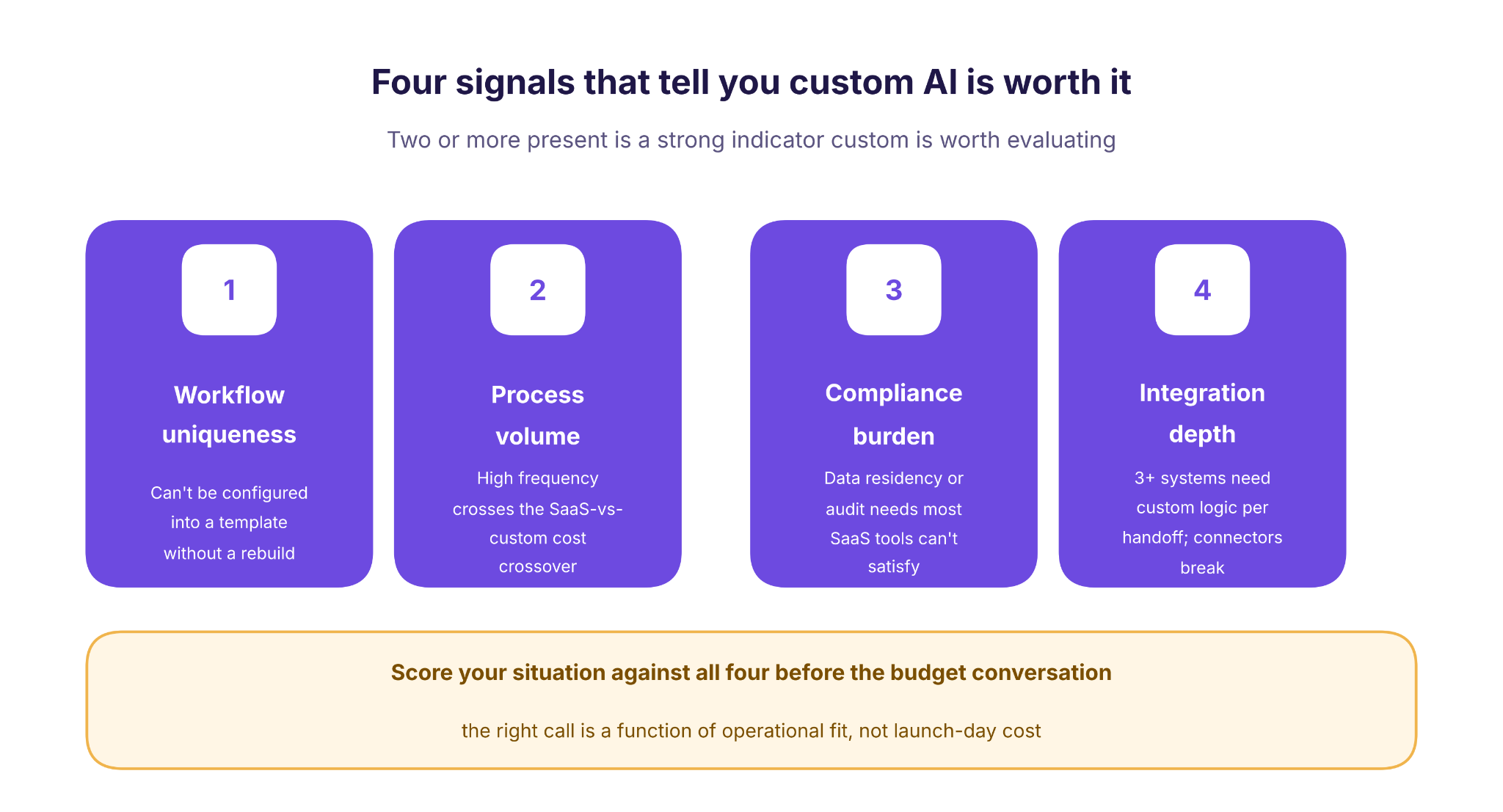
That model changes the risk calculus significantly. You are seeing a working prototype before the full build begins, which means you can validate fit before the major spend lands. What determines which path is right for your business is not your current budget. It is four specific operational signals.
Two or more of these present in your situation is a strong indicator that custom is worth evaluating seriously. The rest of this article walks through each signal, the 24-month cost model, and two situations where we have told clients to stay with SaaS. Start with the signals.
The four signals that tell you custom AI is worth it
The build vs buy AI decision becomes clearer when you stop asking "is custom worth it in general?" and start asking "does my situation cross any of these four thresholds?" Each signal is a testable condition, not a vague principle. Score your own situation against them as you read.
1. Workflow uniqueness
The test is simple: can you configure an off-the-shelf tool to match your process without rebuilding your workflow around the tool? If the answer is no, that gap compounds over time. Every workaround your team builds today becomes a dependency tomorrow. Standard CRM workflows, generic support ticketing, and commodity email sequences are well-served by SaaS.
But if your intake process involves multi-source data synthesis, your candidate vetting requires weighted scoring against proprietary criteria, or your compliance review follows a non-standard sequence, no template will hold. You will spend more time maintaining the workaround than the tool itself. That overhead grows as your volume does.
2. Process volume
High-frequency, repeatable processes reach a crossover point where per-seat SaaS costs and manual review overhead exceed a custom build's total cost of ownership. If your team processes hundreds of documents per week or handles thousands of support interactions per month, the math changes materially. SaaS per-seat pricing scales linearly with volume. A custom system's maintenance cost scales less sharply than per-seat licensing.
The build vs buy timelines for custom AI are longer upfront, but at sufficient volume, the ongoing economics favor a purpose-built system within 18 to 24 months.
3. Compliance burden
Regulated industries, including healthcare, finance, and legal, face data residency rules, GDPR requirements, and audit trail obligations that most third-party SaaS tools are not built to satisfy. Many off-the-shelf tools do not offer the data control, on-premises deployment options, or compliance documentation these environments require.
arsuno.ai built a custom AI clinical assistant for a psychiatry clinic in Switzerland that synthesized complex patient data into integrated summaries while maintaining full GDPR compliance. The result was a significant reduction in manual work and a substantial improvement in automation efficiency. That outcome was achieved because the system was built to the clinic's compliance and workflow requirements, not adapted from a generic template.
4. Integration depth
When your automation must connect more than two or three internal systems with custom logic at each junction, generic connectors break. CRM, EHR, ATS, and ERP systems each have their own data models and API behaviors. A workflow that touches all four requires custom integration logic at every handoff point.
Basic middleware handles simple linear connections. It typically does not handle the conditional logic, bidirectional sync, or error handling specific to your data structure at the depth complex multi-system workflows require. At that depth, a custom build is not a premium option. It is the only viable path.
For a broader look at how these signals apply to business process automation, the linked guide walks through how to evaluate vendor options once you have confirmed a custom build is warranted.
What custom AI actually costs over 24 months
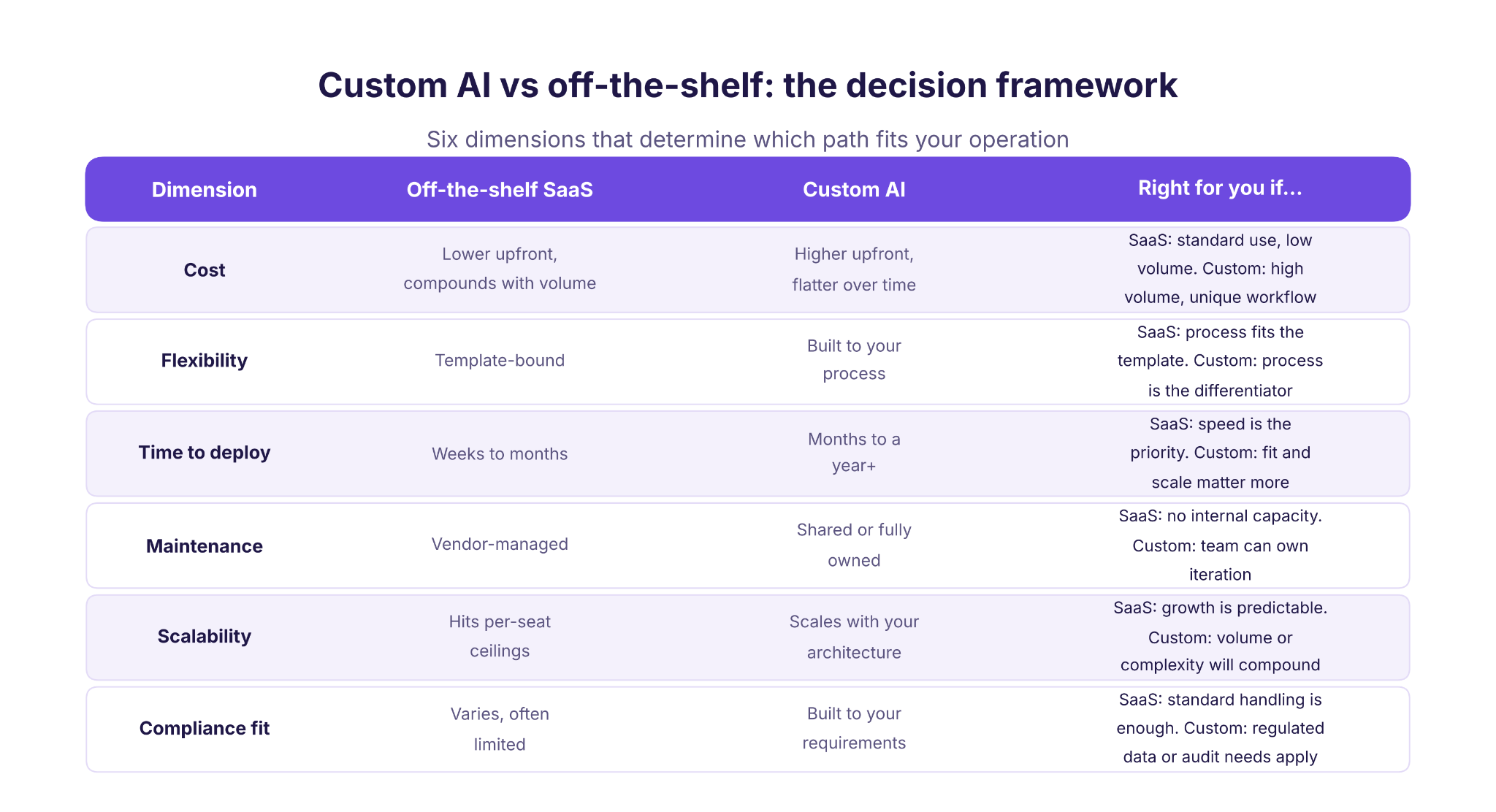
The custom AI vs SaaS cost comparison looks very different at month one versus month twenty-four. Most founders see the upfront build cost and stop there. That is the wrong place to stop.
On the SaaS side, the costs that rarely get totaled before a renewal decision include: per-seat fees across three to five tools, annual price increases that compound over time, integration middleware to connect tools that do not talk natively, and the internal labor cost of the manual steps your team runs to compensate for what the SaaS stack cannot do automatically. None of those last items appear on a vendor invoice. They show up in your team's calendar as recurring tasks that should not exist.
On the custom build side, the real costs include the discovery and prototyping phase, full deployment, and then ongoing maintenance: model retraining cycles, compliance reviews, and model updates as the underlying AI landscape shifts. As the enterprise decision guide from WalkMe notes, governance and ongoing optimization are not optional additions to a custom AI investment. They are the investment. Budgeting only for the build and not the maintenance is the most common planning error in this category.
For market-benchmark custom AI development cost ranges, Kellton and SoluLab both publish project cost ranges by complexity tier. These vary significantly by scope, data readiness, and vendor. Do not treat any published range as a fixed price for your situation. What they confirm is that simpler, well-scoped projects cost substantially less than enterprise-grade multi-system builds.
The gap between a well-scoped custom build and an accumulated SaaS stack narrows faster than most founders expect once volume grows. Omdena's cost guide provides useful framing on the 24-month ROI window and the conditions under which custom becomes the more economical path.
The crossover point
The crossover point is the moment when a custom system's ongoing maintenance cost becomes cheaper than the SaaS stack's compounding per-seat fees. It is not a fixed number. It depends on your process volume, how many tools you are running, and how much internal labor your current stack demands.
For a business processing high document volumes or running large-scale support operations, the crossover often arrives within 18 to 24 months. For a smaller team with standard workflows and low volume, it may never arrive. For chatbot-specific decisions, the cost dynamics have their own variables. The chatbot development cost guide walks through how those decisions differ from broader automation builds, with scoped examples of custom vs platform economics.
A concrete public example: ShipBob, a logistics and fulfillment company, evaluated multiple off-the-shelf AI solutions before selecting a tailored knowledge management platform built on Contextual AI. It was deployed across more than 500 employees in 14 teams. According to the published case study, the deployment saved ShipBob over 10,000 employee hours in wait time annually. That outcome was not available from any generic tool they evaluated.
One honest caveat: ROI timelines vary by scope, data readiness, and team adoption. Maintenance is an ongoing commitment, not a one-time cost. Budget for both the build and the years that follow it, or the economics will not hold.
When to stay with SaaS: the two cases we have seen
Choosing SaaS over custom AI is not a consolation prize. It is the right call when the four signals are not present. As the build vs buy framing from Vendasta makes clear, buying when speed and proven capability matter more is a legitimate strategic principle, not a fallback. Here are two situations where we have seen that principle apply directly.
Scenario 1: Standard workflow, frustrated team
In one case we see regularly, a professional services firm came to us convinced they needed a custom AI intake system. Their team was frustrated with the tool they had, response times were slow, and they were manually copying data between two platforms every morning. On the surface, it looked like a custom build problem.
When we mapped the actual workflow, every step matched a standard intake pattern. The frustration was not a workflow problem. It was a configuration problem. The SaaS tool they were using had the capability they needed but had never been set up to use it. We recommended they invest in proper configuration and onboarding instead of commissioning a build. The problem was resolved in three weeks without a single line of custom code.
The signal here is workflow uniqueness. If your process maps cleanly to what a well-configured SaaS tool can do, a custom build adds cost and complexity without adding value. Frustration with a tool is not the same as having outgrown it. Diagnose before you build.
Scenario 2: Low volume, early-stage operation
A second case involves early-stage businesses that have not yet accumulated the process volume to justify a custom build. A recruitment agency approached us wanting a custom AI sourcing and screening system. The brief was compelling: proprietary scoring, multi-source candidate synthesis, and automated outreach sequencing.
We asked one question: how many candidates does your team process per week? The answer was forty. At that volume, the per-seat cost of a well-chosen SaaS ATS with AI features was a fraction of what a custom build would cost to develop and maintain. The crossover point would not arrive for years, if ever, at that scale. We recommended a SaaS-first path with a clear trigger: revisit custom when weekly candidate volume exceeds two hundred consistently.
The signal here is process volume. Custom AI earns its cost at scale. Below a certain threshold, the economics simply do not support it. Knowing that threshold before you commission a build is the difference between a smart investment and an expensive lesson.
These two scenarios are not edge cases. They represent a significant share of the inquiries we receive. The honest answer is sometimes "not yet" or "not for this." A vendor who never tells you that is not an advisor. They are a salesperson.
How to evaluate a custom AI partner
Assuming the four signals point toward a custom build, the next decision is who to build with. That choice carries its own risks, and the wrong partner is as costly as the wrong tool. A few criteria separate a capable partner from one who will deliver a prototype and disappear.
The first criterion is whether the partner will tell you not to build. Any agency that responds to every brief with a custom build recommendation is not evaluating your situation. They are selling their default product. A responsible partner runs a scoping or discovery phase before committing to a build. That phase should produce a genuine recommendation, not a pre-written proposal.
The second criterion is how the partner handles the post-launch period. Custom AI requires ongoing maintenance: model retraining, monitoring, compliance reviews, and updates as the underlying models evolve. Ask any prospective partner what their post-launch engagement model looks like. If the answer is vague or positions maintenance as an optional add-on, that is a red flag.
The build is not the hard part. The hard part is keeping the system accurate and compliant as your data and your business change. The third criterion is proof at your scale and in your vertical. Case studies from enterprise deployments are not evidence that a partner can serve a 30-person operations team.
Ask for examples at your company size and in your industry. If they cannot produce them, ask how they would handle the constraints specific to your context, including data sensitivity, integration complexity, and internal technical capacity. arsuno.ai reports a high client satisfaction rate across more than 30 AI systems launched, spanning healthcare, recruitment, professional services, and logistics.
That figure is a vendor self-report and should be weighed alongside direct reference conversations and scoped discovery work. No metric replaces a structured conversation about your specific situation. Reaching out to the team directly to discuss a specific use case is the right starting point before any proposal is written.
The fourth criterion is transparency about what the system will not do. Every custom AI system has constraints: data it cannot process reliably, edge cases it handles poorly, and conditions under which it will need human review. A partner who presents a system as fully autonomous without those caveats is either overselling or has not stress-tested the build. Honest scoping of limitations before deployment saves significant cost and credibility after it.
Evaluating a partner on these four criteria takes time, but it is the only reliable way to distinguish between a vendor who will deliver a working system and one who will deliver a demo. The build-vs-buy decision does not end when you choose custom. It continues into every conversation about scope, timeline, and what success actually looks like twelve months after launch.
When you are ready to move from framework to action, the most useful next step is a structured scoping conversation rather than a proposal request. A good partner will use that conversation to challenge your assumptions, not confirm them. That challenge is what separates a system that works from one that looked good in the demo and struggled in production.
Frequently Asked Questions
Is custom AI more expensive than off-the-shelf software?
Custom AI typically costs more upfront than off-the-shelf software, but the total 24-month picture is more nuanced. Per-seat SaaS fees, integration middleware, annual price increases, and the internal labor cost of manual workarounds all accumulate in ways that rarely appear on a single invoice. At sufficient process volume or workflow complexity, a purpose-built system often becomes the more economical path within 18 to 24 months.
When should you build AI instead of buying it?
Building makes sense when your workflow is genuinely unique, your process volume is high enough to reach a cost crossover, your compliance environment requires data controls that SaaS tools cannot provide, or your integrations involve conditional logic across multiple systems that generic connectors cannot handle. If two or more of those conditions apply, a custom build warrants serious evaluation. If none apply a well-configured SaaS tool is almost always the.
How long does custom AI development take?
Timeline depends heavily on scope, data readiness, and integration complexity. A well-scoped, single-workflow build with clean data can move from discovery to deployment in a matter of months. Multi-system builds with compliance requirements and legacy integrations take longer. Responsible partners run a discovery or prototyping phase first, which lets you validate fit and refine scope before the full build timeline and budget are committed.
What are the disadvantages of off-the-shelf AI?
Off-the-shelf AI tools are built for the median use case, which means they fit most businesses adequately and almost no business perfectly. The further your workflow sits from that median, the more workarounds your team accumulates. Those workarounds create dependencies, add manual steps, and generate a friction tax that grows with volume.
Which businesses should avoid custom AI and stay with off-the-shelf tools?
Businesses with standard workflows, low process volume, or limited internal capacity to own ongoing maintenance are typically better served by SaaS. Early-stage operations that have not yet validated their core processes at scale should also default to off-the-shelf tools and revisit the custom question once volume and workflow stability are established. The cost and complexity of a custom build only make sense when the operational signals genuinely support it.
What SaaS limitations most commonly trigger a switch to custom AI?
The most common triggers are per-seat pricing that scales faster than the business can absorb, integration gaps that require manual reconciliation steps to bridge, compliance requirements that the vendor cannot meet, and workflow constraints that force the team to adapt their process to the tool rather than the other way around. When those limitations start generating measurable labor cost or compliance risk the case for a custom build becomes worth. It depends on the task, the tools already in place, and how much should stay with a person.
How can we calculate the two-year total cost of custom AI versus SaaS?
Start by totaling all SaaS costs across your current stack: per-seat fees, middleware, annual increases, and the internal labor hours spent on manual steps the tools cannot automate. Then model the custom build side: discovery, deployment, and ongoing maintenance including retraining and compliance reviews. The crossover point is where the custom system's flat maintenance cost falls below the SaaS stack's compounding fees.