

Key takeaways
- AI automation for clinics works best as a connected system: intake, scheduling, documentation, and EHR writeback must link in sequence, not operate as isolated tools.
- Define the human-AI boundary before you build: clinical judgment, risk assessment, and sensitive escalations must stay with trained staff.
- Embed GDPR or HIPAA compliance inside each workflow stage, not as a final check.
- A 1-2 week proof-of-concept lets you validate results before committing full budget.
Why manual admin is the bottleneck most clinics refuse to name
Most clinics don't have a staffing problem. They have an operations problem disguised as one.
Front-desk staff at small-to-mid-size clinics typically split their day across intake form collection, appointment confirmation calls, insurance and referral checks, and routine patient queries. Every one of those tasks is repeatable and low-judgment. Yet they consume the same hours that should be available for patient-facing work, clinical coordination, and the exceptions that genuinely need a human decision. When a front-desk team spends the first two hours of every morning on outbound confirmation calls, that is not a staffing shortage: it is a workflow design problem.
The hidden cost runs deeper than staff hours. Manual data entry into the EHR creates transcription errors, delayed records, and downstream clinical risk that compliance audits surface too late. A patient whose intake information is entered incorrectly creates a chain of small problems: wrong medication history flagged, a follow-up missed, a referral delayed. Records updated a day after the appointment compound that risk at every stage. As clinical workflow research shows, administrative burden on clinical staff directly reduces the time available for documentation and patient interaction.
The Swiss psychiatry clinic that arsuno.ai partnered with faced exactly this pattern. Clinical staff were absorbing administrative work that prevented them from focusing on patient interaction and risk assessment. Intake forms arrived on paper or via email. Scheduling was managed through outbound calls. Patient data was manually transcribed into the EHR after appointments. The result was a front-desk team stretched thin and a clinical team spending a significant portion of their day on tasks unrelated to clinical care.
One scope note before going further: this article uses a specialist mental health clinic as the operating model. GP practices, dental clinics, and urgent care centers share many of the same pressures, but the specific workflow boundaries, compliance requirements, and EHR configurations will differ. Treat this blueprint as a starting point, not a universal prescription. Adapt each layer to your own practice type and regulatory context.
What the Swiss psychiatry clinic automated, and what it kept human
arsuno.ai built a custom AI clinical assistant for the Swiss psychiatry clinic. It synthesizes complex patient data into integrated summaries, supporting risk assessment and diagnostic accuracy while freeing clinical staff for direct patient interaction. According to arsuno.ai's published case study, the engagement produced a 70% reduction in manual work and 3.5x automation efficiency. These figures are published on the arsuno.ai website and attributed to this engagement; they are not independently verified by a third party.
The design decision that made this work was not the technology itself. It was the explicit definition of what the AI would handle, what staff would review, and what only a clinician would decide. That boundary is the architecture. Without it, you have a tool. With it, you have a system.
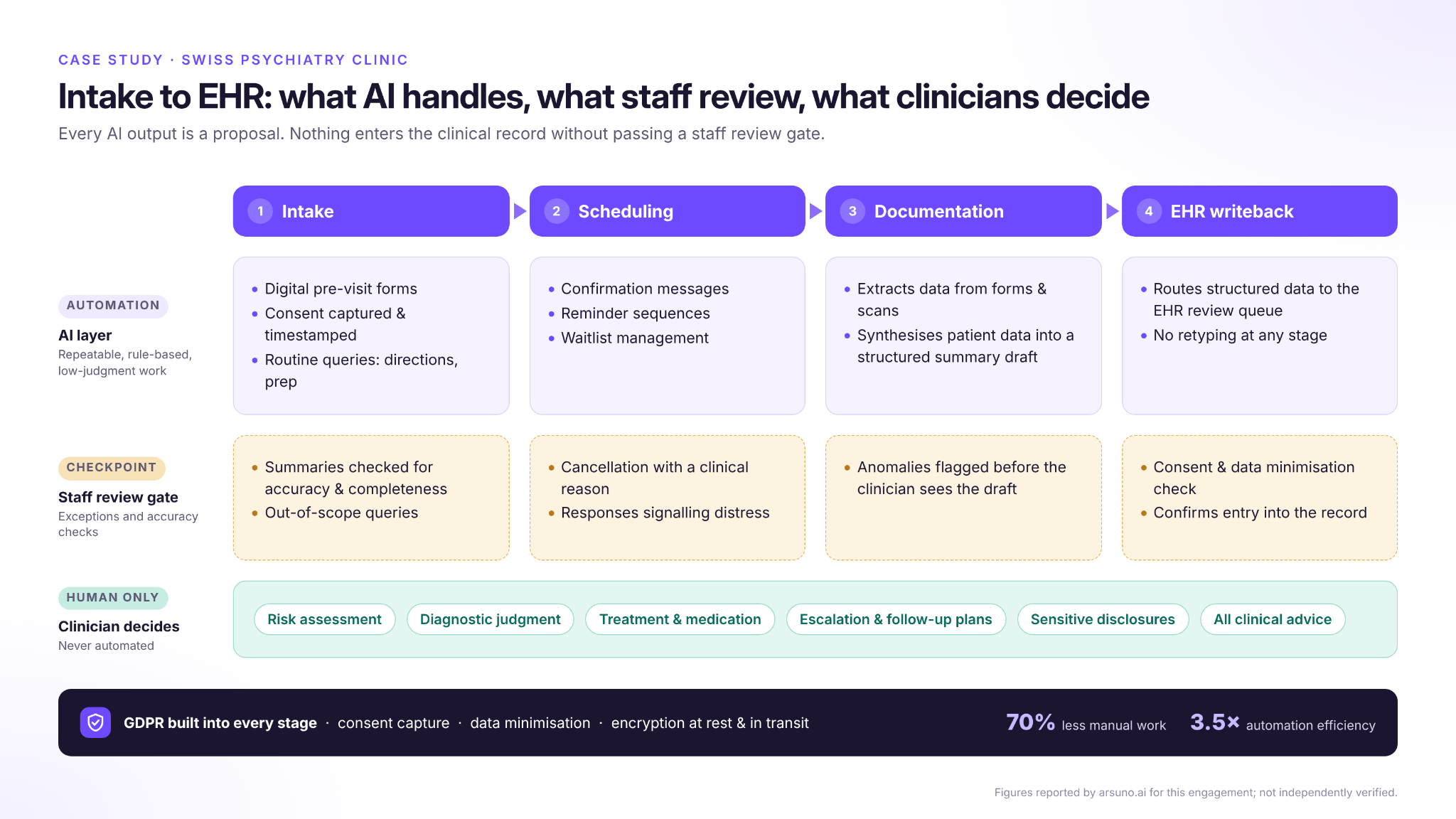
The boundary rules above are not arbitrary. In a psychiatry context especially, the cost of an AI making an autonomous clinical judgment is not a minor operational error: it is a patient safety and liability issue. The system was designed so that no AI-generated output enters the clinical record without a staff review gate. Every summary draft is a proposal, not a record.
Compliance was built into the workflow design from the start. The Swiss clinic operates under GDPR, not HIPAA. Consent capture, data minimization, and encryption at rest and in transit were designed into each stage of the workflow rather than added as a final check. US-based clinics should note that HIPAA's minimum necessary standard governs what data is collected and how it is stored. The principle resembles GDPR's data minimization requirement, but the regulatory framework and documentation obligations differ. Verify your obligations with a qualified compliance advisor before scoping any build.
For broader context, a registered clinical trial at Psychiatrie St. Gallen in Switzerland is actively evaluating an AI ambient scribe for psychiatric appointments. It measures note-writing time and impact on the therapeutic relationship. This is a separate initiative from the arsuno.ai case study and has not yet published outcome data. It does signal that Swiss psychiatry institutions are actively evaluating AI documentation tools in clinical settings.
The four-layer clinic automation stack: intake, scheduling, documentation, and EHR
The Swiss psychiatry clinic deployment is a useful operating model because it runs all four layers as a connected system. Each layer feeds the next, and compliance checkpoints are embedded within each stage rather than isolated in a separate review step. The result is a workflow where data captured at intake arrives in the clinical record in a structured, reviewed format without being retyped at any point.
1. Intake
The intake layer is where patient-facing automation for medical practices begins. A custom AI chatbot handles appointment requests, pre-visit form collection, and routine patient queries before any staff member is involved. Forms are digital, timestamped, and consent-captured at the point of completion. You can see how a purpose-built ai chatbot for small business handles multi-turn patient conversations without requiring a human to monitor every exchange, including after-hours queries that would otherwise sit unanswered until the next morning.
GDPR compliance at this layer means collecting only the data necessary for the appointment: demographics, reason for visit, relevant history, and consent confirmation. For US clinics, HIPAA's minimum necessary standard applies to the same decision. As intake workflow benchmarks from Curogram show, digital intake reduces front-desk workload while improving data completeness before the appointment begins.
2. Scheduling
The scheduling layer handles confirmation messages, reminder sequences, and waitlist management automatically. This reduces no-shows and frees front-desk staff from outbound confirmation calls. Automated reminders are one of the highest-ROI applications in this stack because the cost of an empty appointment slot is immediate and measurable. A clinic running 30 appointments per day with a meaningful no-show rate loses revenue every week to a problem that automated reminders directly address.
Staff review gates apply when a patient response signals an exception. A cancellation with a clinical reason, a response suggesting distress, or a request outside the scripted scope all route to a staff member rather than an automated reply. The automation handles the routine; staff handle the exceptions. That division is what makes the scheduling layer safe to deploy in a clinical environment.
The healthcare automation guide from Mediaforce outlines how scheduling automation integrates with voice AI and follow-up workflows. This reinforces that the scheduling layer is not a standalone feature but part of a connected patient communication system.
3. Documentation
The documentation layer is where AI extracts structured data from intake forms, scanned documents, and clinical notes. It then routes a structured draft to the EHR queue for staff review before any entry is confirmed. The automated document processing approach covers typed documents, scanned PDFs, and handwritten forms using OCR enhancement. This is particularly relevant for clinics still receiving paper-based referrals or handwritten clinical notes from external practitioners.
The compliance checkpoint here is non-negotiable: no AI-generated documentation enters the clinical record without a staff review gate. The AI produces a draft; a staff member confirms it. This control keeps the automation within safe and legally defensible boundaries. For clinics evaluating how documentation automation connects to their EHR without creating duplicate entry or record fragmentation, the clinical workflow automation guidance from Get Freed describes the practical handoff in detail.
4. EHR writeback
The EHR writeback layer closes the loop from intake to record. Structured, staff-reviewed data is written to the EHR via the integration path chosen for the clinic's stack. This layer eliminates duplicate entry and transcription error. Data captured at intake arrives in the clinical record in the same structured format, without being retyped at any point.
The four-layer model works because each stage produces structured, reviewed output that the next stage can use without reformatting or manual intervention. The Swiss psychiatry clinic's published reduction in manual work came from running all four layers as one connected system rather than automating individual tasks in isolation. Major health systems are reaching the same conclusion: connected workflow automation is now a strategic priority across the sector, not just an efficiency experiment at smaller practices.
How clinic automation connects to your existing EHR
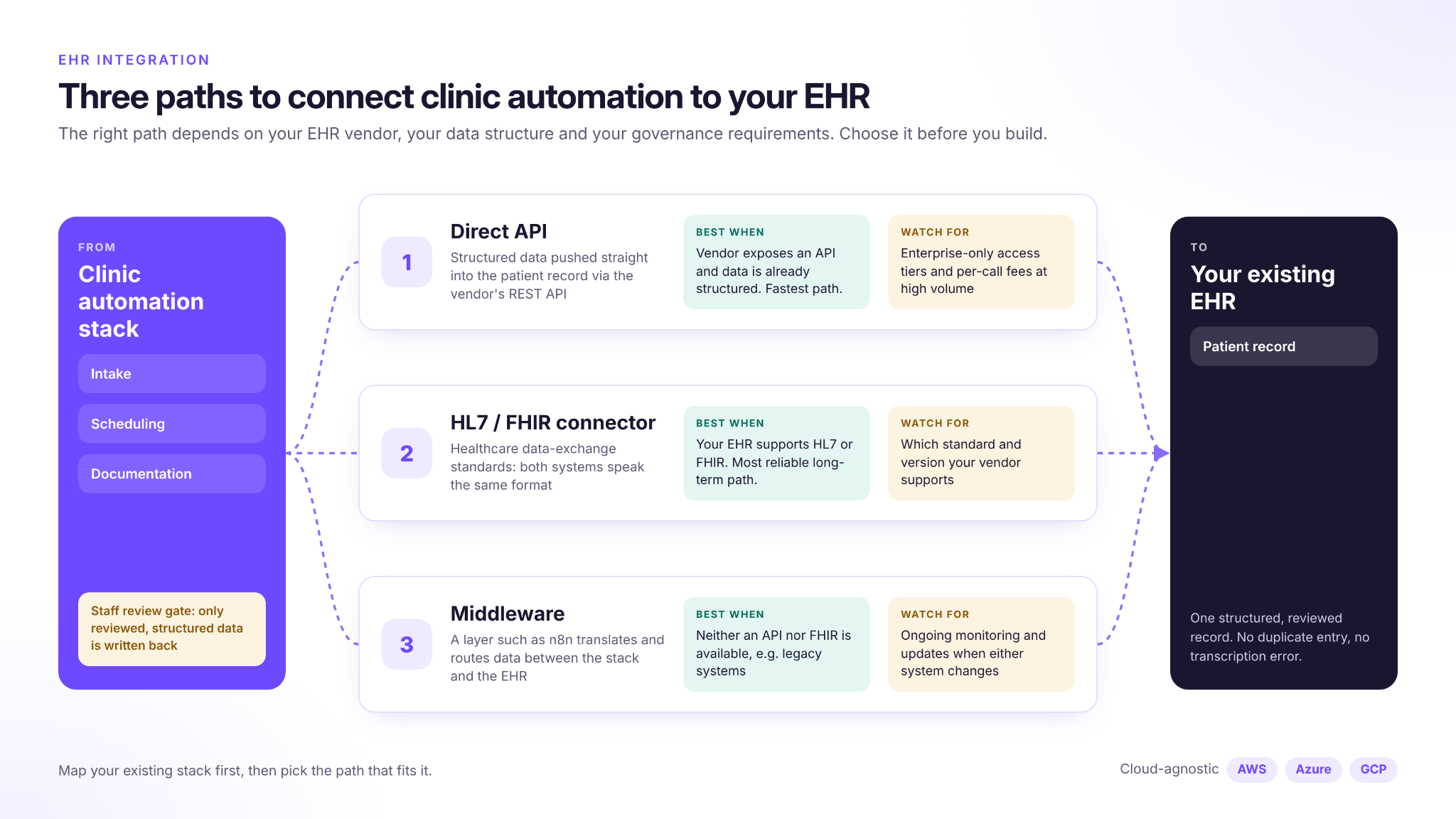
EHR integration is where many clinic automation projects stall. The obstacle is rarely the technology itself: it is that the path depends on your EHR vendor, your existing data structure, and your data governance requirements. There are three practical options, and choosing the right one early saves significant rework later. You can review arsuno.ai's full feature capabilities to understand which integration approach fits your infrastructure before scoping a build.
1. Direct API
Some modern EHR platforms expose REST APIs that allow structured data to be pushed directly from the intake or documentation layer into the patient record. This is the fastest path when the vendor supports it and your intake data is already structured. The data handoff is direct, with no intermediate system to maintain.
The honest caveat: not all EHR vendors offer API access at affordable tiers. Some restrict it to enterprise licensing levels, and others charge per-call fees that make high-volume intake automation expensive. Check your vendor's developer documentation before assuming this path is available. Factor API access costs into your build estimate from the start.
2. HL7/FHIR connectors
HL7 and FHIR are healthcare data exchange standards. They let two systems pass patient records in a structured, interoperable format without a custom translation layer. Many established EHR platforms support at least one of these standards. For clinics on those platforms, this is often the most reliable long-term path because it uses a standard the vendor already supports. Think of HL7/FHIR as a shared language: neither system needs to be rebuilt, just configured to speak the same format.
The 2026 clinical operations guide from US Tech Automations explains how API, HL7, and FHIR integration paths work in practice. It covers the governance and access considerations clinics encounter when connecting automation to a legacy EHR stack.
3. Middleware orchestration
When neither direct API nor FHIR is available, a middleware layer sits between the automation stack and the EHR, translating and routing data. arsuno.ai uses n8n for workflow orchestration in this configuration, which provides flexibility for legacy systems without requiring the EHR vendor to expose a new integration point. The trade-off is maintenance: a middleware layer requires monitoring and updates when either the automation stack or the EHR changes.
arsuno.ai's cloud-agnostic infrastructure across AWS, Azure, and GCP means the integration path is chosen based on your existing setup, not vendor preference.
How to estimate ROI before you commit
The Swiss psychiatry clinic's published metrics give a useful anchor: a 70% reduction in manual work and 3.5x automation efficiency across intake, documentation, and scheduling. Those numbers are vendor-reported and specific to that deployment. Your clinic's baseline will differ. The framework below lets you apply the same logic to your own numbers before any build begins.
Start with staff hours. Count the weekly hours your front-desk and admin team spend on intake form collection, outbound confirmation calls, manual EHR data entry, and routine patient queries. Multiply by your average hourly staff cost. That is your current operational baseline for those tasks. A conservative automation model typically recovers a substantial portion of those hours, depending on how many of your current tasks are repeatable and rule-based.
Add no-show cost. Calculate your average appointment revenue and multiply by your weekly no-show count. That figure is the revenue lost to the scheduling gap that automated reminders directly close. Clinics running a high daily appointment volume with a meaningful no-show rate typically find this is the fastest-return line item in the entire automation stack.
Factor in error reduction. Manual EHR transcription errors create downstream costs: follow-up calls, duplicate records, compliance exposure, and delayed referrals. These are harder to quantify precisely, but most clinic managers can identify two or three recurring error patterns from the past quarter. Assign a conservative time cost to each correction cycle and include it in your baseline.
The result is a rough three-line ROI model: hours recovered, revenue protected, and error cost avoided. arsuno.ai's 1-2 week proof-of-concept onboarding means you can test the model against live data before committing full deployment budget. That is a materially different risk profile from an 8-month EHR integration project with no outcome data until go-live.
What a phased implementation looks like in practice
Clinic automation projects fail most often not because the technology is wrong but because the scope is set too wide at the start. The Swiss psychiatry clinic's deployment succeeded in part because it was staged: a defined proof-of-concept before full rollout, with each stage producing measurable output before the next began.
A realistic phased model for a small-to-mid-size clinic looks like this. In the first one to two weeks, arsuno.ai maps your current workflows and identifies the highest-volume repeatable tasks. It then builds a proof-of-concept covering intake and scheduling. Staff interact with the system on a subset of real appointments. This stage answers the practical questions: Does the intake form capture what we need? Do reminder sequences reduce outbound call volume? Is the EHR integration path we chose technically viable?
In weeks three through six, the documentation layer is added. AI-generated summary drafts are introduced into the staff review workflow. Clinicians see structured drafts before the appointment and confirm or amend them before EHR entry. This is the stage where the human-AI boundary rules are tested in practice, not just on paper. Adjustments to the review gate, the summary format, and the escalation triggers happen here.
Full deployment across all four layers typically runs one to six months depending on clinic size, EHR complexity, and the number of workflow exceptions needing custom routing. The patient intake automation guidance from Cornerstone Custom AI reinforces that phased rollout with defined human checkpoints is the standard for safe clinical automation deployment, not the cautious option.
The key difference from a traditional IT project is that each phase produces operational value before the next begins. You are not waiting six months for a system that may or may not work. You are running a live proof-of-concept in week one and building from evidence. That sequencing also makes it easier to bring clinical staff along: each stage is small enough to evaluate, adjust, and approve before the next layer is introduced. Change management is far simpler when staff can see results at each step rather than being asked to trust a system they have never used.
Frequently Asked Questions
What clinic admin tasks are most commonly automated with AI today?
The highest-volume tasks that clinics automate first are intake form collection, appointment confirmation and reminder sequences, routine patient queries (directions, pre-visit prep, cancellation requests), and structured data entry into the EHR. These tasks share the same characteristics: they are repeatable, rule-based, and low-judgment. Automating them recovers staff hours for the exceptions and patient interactions that genuinely require a human decision.
How should AI intake and documentation connect to an existing EHR?
Connection depends on your EHR vendor, your existing data structure, and your governance requirements. The three practical paths are direct API integration, HL7/FHIR connectors using healthcare data exchange standards, and middleware orchestration for legacy systems. Choosing the right path early prevents significant rework later, and a pre-build stack assessment is the most reliable way to identify which option is viable for your setup.
What compliance safeguards do clinics need for AI automation?
Compliance safeguards must be embedded inside each workflow stage rather than applied as a final review. For EU and Swiss practices, GDPR requires consent capture, data minimization, and encryption at rest and in transit at every stage where patient data is handled. US clinics must meet HIPAA's minimum necessary standard for data collection and storage.
What should still stay human in a clinical workflow?
All risk assessment, diagnostic judgment, and treatment decisions must remain with a qualified clinician regardless of how much of the surrounding workflow is automated. Staff should also handle any patient communication that falls outside scripted scope, any response that signals distress or a clinical concern, and all escalation decisions. The AI produces structured drafts and routes routine tasks every output that enters the clinical record requires a staff review gate.
Can AI handle patient intake and scheduling?
Yes, and these are typically the first two layers clinics automate because the tasks are high-volume, rule-based, and low-judgment. AI handles appointment requests, pre-visit form collection, confirmation messages, and reminder sequences without requiring staff involvement for each exchange. Staff review gates activate when a patient response signals an exception a cancellation with a clinical reason a distress indicator or a query outside scripted scope so the automation handles the routine.
Is AI for clinics HIPAA compliant?
AI tools can be deployed in a HIPAA-compliant configuration, but compliance is not automatic: it depends on how the system is designed, what data it handles, and what contractual and technical safeguards are in place. A Business Associate Agreement with your AI vendor is a baseline requirement. Data minimization, encryption, access controls, and audit logging must be built into the workflow architecture.
How can a clinic estimate the ROI of workflow automation?
Start by counting the weekly staff hours spent on repeatable admin tasks: intake forms, confirmation calls, manual EHR entry, and routine queries: and multiply by your average hourly staff cost to establish a baseline. Add the revenue lost to no-shows each week, since automated reminders directly close that gap. Finally, assign a conservative time cost to recurring transcription error correction cycles.
.webp)