
Key takeaways
This AI executive search case study documents how a USA-based recruitment firm achieved 2x faster project delivery and +50% client satisfaction after deploying a custom AI workflow (arsuno.ai-reported outcomes). AI handled database search, CV parsing, and candidate ranking. Recruiters retained final shortlist approval, all candidate calls, and every client interaction. Onboarding took 1-2 weeks with full ATS integration. Outcomes depend on data readiness and workflow complexity.
What manual executive search actually costs
Manual executive search is a time problem before it is a quality problem. Before a consultant makes a single candidate call, they have already spent hours querying databases, downloading CVs, reading each profile individually, and building a ranked document by hand. That sequence consumes a significant share of billable capacity on work that produces no direct client value.
Passive-candidate identification makes it worse. Senior roles require research across LinkedIn, niche databases, and referral networks, each with incomplete profiles and calibration conversations that multiply time per search. A consultant running three concurrent searches can spend the majority of their week on sourcing before touching relationship work.
The scale of this cost is documented externally. An unnamed executive search firm reported to Findem a 59% reduction in sourcing time after AI adoption, saving approximately 78 hours per search and 74% of research time. That figure is a separate, vendor-reported reference point that shows what manual research costs before automation enters the picture.
For agencies exploring how AI fits their broader operations, the guide on AI for recruitment agencies covers which tasks automate well and which stay human across different agency models.
The pattern is consistent: manual executive search front-loads consultant effort into low-judgment database work, leaving less capacity for the advisory and relationship activity that actually wins and retains clients.
The AI-assisted workflow: what changed at each stage
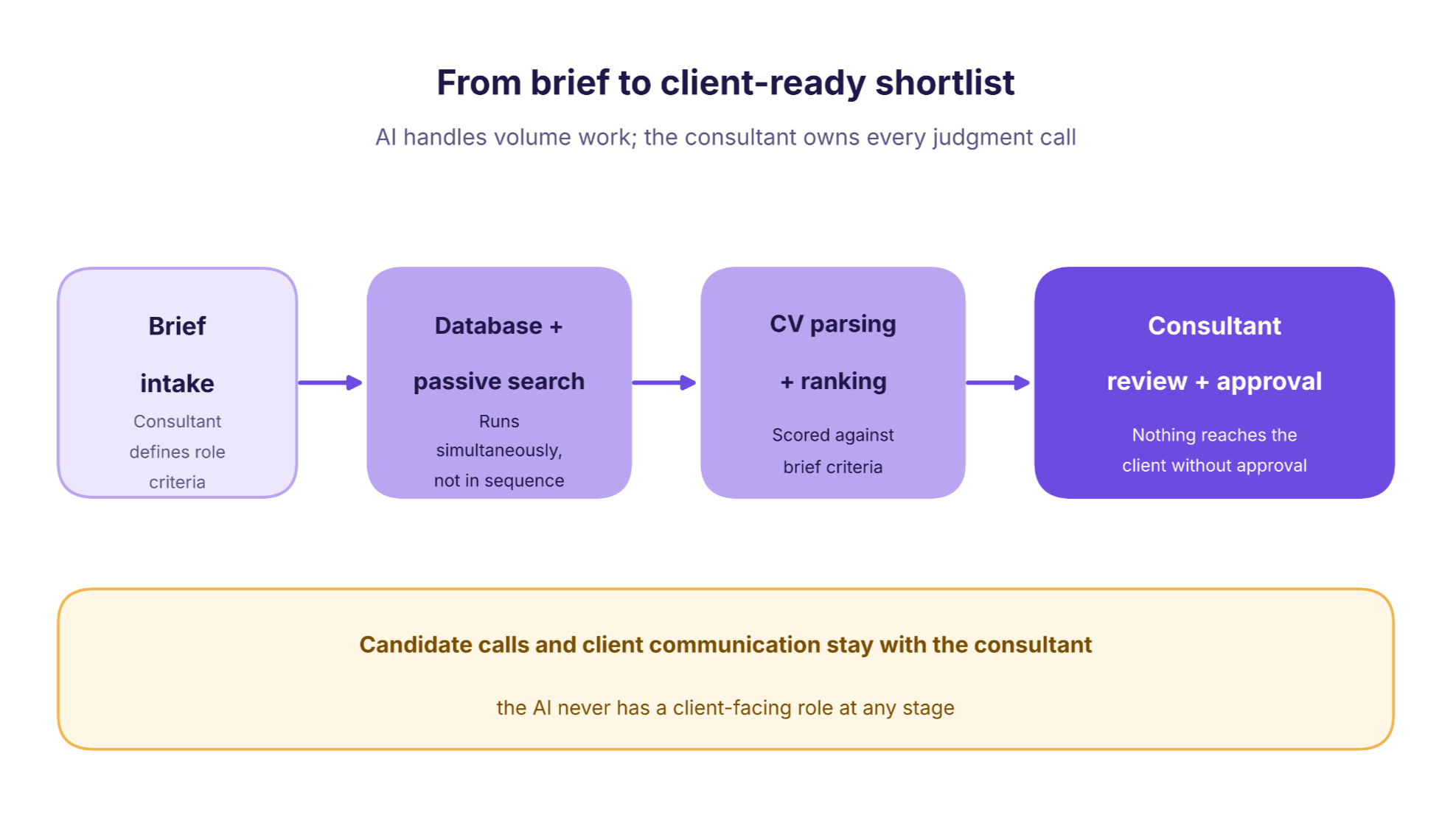
The manual process followed a fixed linear sequence: receive brief, query databases, download CVs, score by judgment, build a ranked document, write client notes. No step ran in parallel. Every hour spent on database work was an hour not spent on candidates or clients.
The AI-assisted process restructured that sequence. After the consultant inputs the brief, the system runs structured database and passive-candidate searches simultaneously, parses CVs against role criteria, and produces a ranked output with scoring rationale. The consultant reviews, validates, and approves before anything reaches the client.
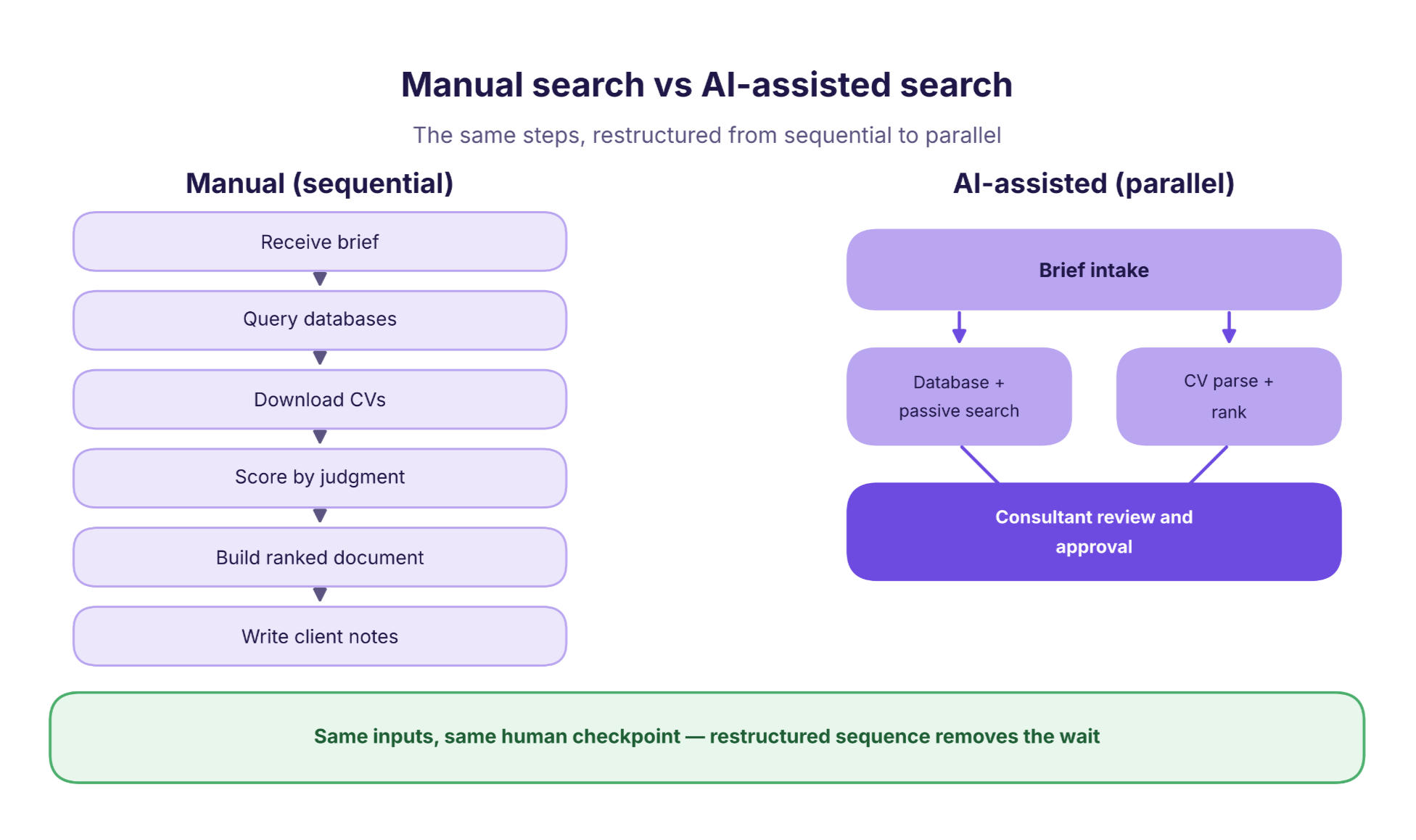
The critical design decision was integration rather than replacement. The custom AI recruitment workflow connected to the firm's existing ATS rather than displacing it. Consultants kept their familiar tools; the AI added a structured layer between brief intake and recruiter review. A vendor-reported before/after framing from a staffing agency context confirms that a structured handoff between automation and human review is what separates useful AI from a black box.
The result: AI handled the volume work, consultants owned the judgment work. That boundary is what made adoption straightforward.
What stayed human: the boundaries of automation
No ranked output reached a client without consultant review and sign-off. That was not a policy decision made after deployment; it was a design requirement built into the workflow from the start. The human-in-the-loop checkpoint is the structural feature that separates AI-powered candidate shortlisting from automated rejection.
Candidate validation calls stayed entirely with the recruiter. Relationship-building conversations, calibration discussions, and all client communication remained human responsibilities. The AI had no client-facing role at any stage.
Exception handling required recruiter judgment. Non-standard profiles, career transitions, portfolio roles, and candidates with confidential availability were flagged by the system for manual review rather than auto-scored. The AI surfaced ambiguity; the consultant resolved it. That distinction matters for executive search, where a significant share of the strongest candidates do not fit a clean criteria match.
arsuno.ai's Scale and Optimization phase keeps this boundary intact over time. As the firm's brief criteria evolve and new role types appear, the system is adjusted through an ongoing partnership rather than left to drift. Research from Softomate Solutions on AI CV screening in UK recruitment agencies confirms that shortlist-to-interview conversion improves most when human review remains a mandatory checkpoint rather than an optional override.
The relationship quality that defines executive search did not move to AI. It stayed with the consultants, who now had more time to use it.
Results: time saved, placements delivered, clients retained
arsuno.ai's USA-based recruitment client achieved 2x faster project delivery and +50% client satisfaction after deploying the custom AI workflow. These are arsuno.ai-reported outcomes from one engagement, not independently audited figures, and should not be read as universal benchmarks.
For external reference: an executive search firm reported in a Findem vendor case study a 59% reduction in sourcing time, saving roughly 78 hours per search. That is a separate, vendor-reported data point and should not be blended with arsuno.ai's client results.
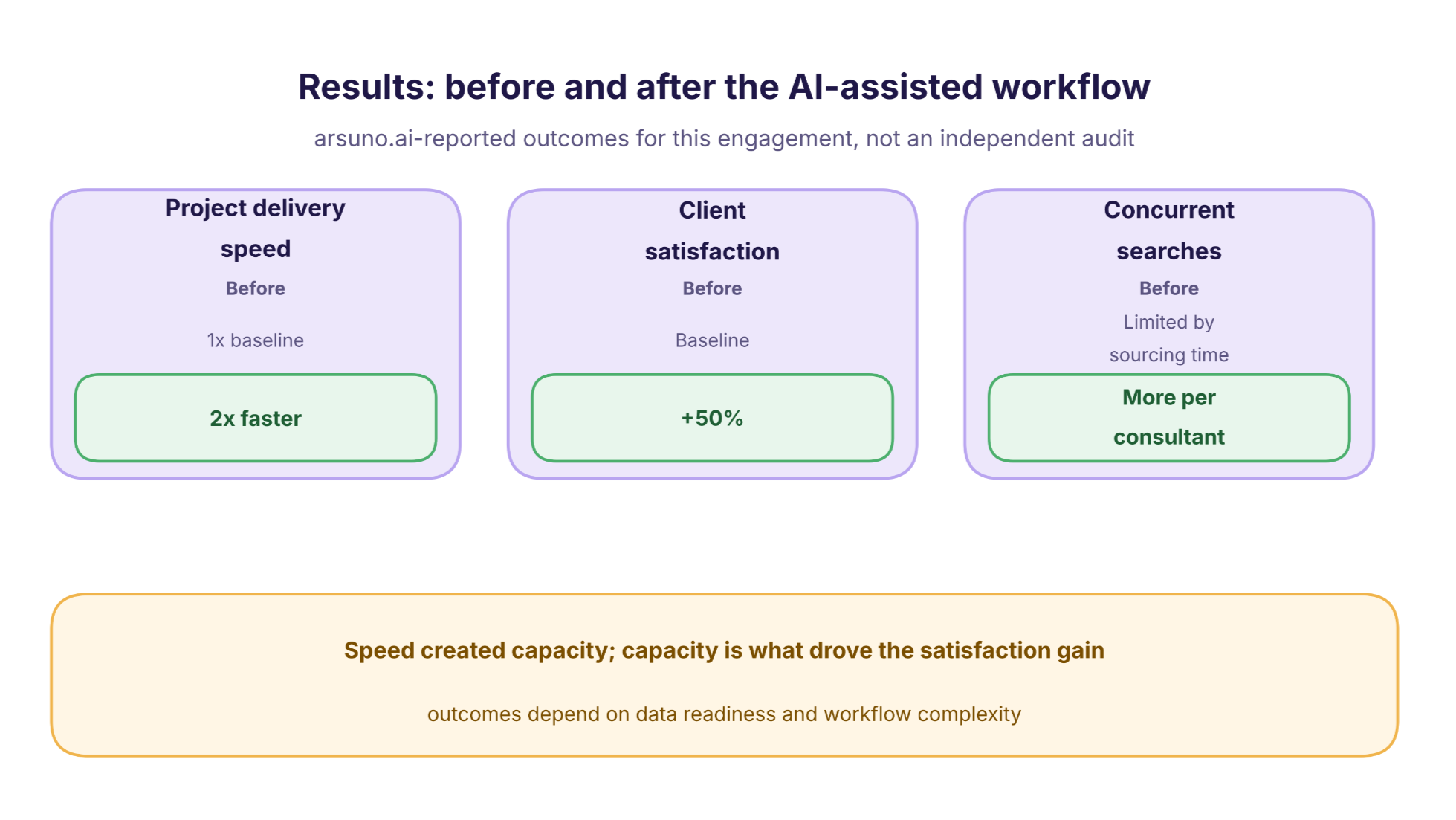
The more important story is the capacity effect. Faster delivery meant consultants could handle more concurrent searches without adding headcount, and that additional capacity is what drove the satisfaction improvement. Speed created room; room improved service quality.
Outcomes depend on data readiness, workflow complexity, and role type. A NinjaHire case study on AI recruitment ROI in an IT staffing context (vendor-reported) documents a comparable pattern: time-to-submit reductions translate into placement volume gains only when quality controls remain in place alongside the automation.
Implementation: onboarding, integration, and what the firm controlled
arsuno.ai's onboarding runs 1-2 weeks, with full deployment taking 1-6 months depending on complexity and integration scope. For this recruitment client, onboarding covered ATS connection, brief-criteria configuration, and a working proof of concept before any full commitment was made.
The Proof of Value phase is the primary differentiator against consultancies that spend months scoping before a client sees anything working. The firm tested the configured system against real briefs and approved the design before deployment proceeded, removing the largest adoption risk for agencies burned by overpromising vendors.
The firm retained control over scoring criteria, brief input, and recruiter review thresholds throughout. The AI talent acquisition tools integrated with the existing ATS and CRM without replacing them, with an AI layer added between search and review.
For UK, Swiss, and EU recruitment buyers, arsuno.ai states its deployments are designed to support GDPR requirements, with enterprise-grade encryption in transit and at rest included as a baseline. Buyers should review applicable data-processing agreements to confirm compliance for their specific deployment.
arsuno.ai reports 10+ long-term partners retained for two or more years and a 98% client satisfaction rate across all engagements. Digitalent documents a brief-to-shortlist timeline of approximately one week as one documented example of what a structured AI-assisted process can achieve, though timelines vary by role seniority and candidate availability.
Teams ready to explore a custom build can contact arsuno.ai to discuss a proof-of-concept scoped to their workflow.
Frequently Asked Questions
Can AI reduce the time it takes to create a candidate shortlist?
Yes, with the right workflow design. An unnamed executive search firm reported in a Findem vendor case study a 59% reduction in sourcing time, saving approximately 78 hours per search. Separately, arsuno.ai reports that its USA-based recruitment client achieved 2x faster project delivery after deploying a custom AI workflow.
How does AI screen and rank executive candidates?
The system ingests the search brief, runs structured queries across the ATS and external databases, parses candidate CVs against role criteria, and produces a ranked output with a scoring rationale for each profile. Candidates with incomplete or non-standard profiles are flagged for manual review rather than auto-scored. The recruiter then reviews the ranked output, validates the top candidates, and approves the shortlist before it reaches the client.
What criteria does AI use to score candidates?
Scoring criteria are configured against the specific search brief rather than applied as generic keyword matching. Typical inputs include role-specific requirements, seniority level, relevant sector experience, geography, and compensation alignment where that data is available. Required criteria are weighted differently from useful but non-essential signals, so a strong match on core requirements surfaces above a broad match on secondary ones.
How does AI work alongside recruiters: what stays human?
The automated steps cover database search, CV parsing, preliminary ranking, and summary preparation. The human steps cover consultant validation, candidate calls, client communication, and exception handling for non-standard profiles. An explicit approval checkpoint sits between the AI-generated ranked output and any client submission, so no shortlist reaches a client without recruiter sign-off. Relationship decisions, calibration conversations, and client advisory work remain entirely with the consultant.
What is a typical brief-to-shortlist timeline for executive search?
Timelines vary significantly based on role seniority, confidentiality requirements, and how much of the search relies on passive-candidate outreach. Digitalent documents a brief-to-shortlist timeline of approximately one week as one documented example for an AI-assisted executive search. This should be treated as a single illustrative benchmark rather than a universal norm. Confidential searches and highly specialized roles typically take longer regardless of automation.
How is recruitment AI ROI measured?
The most defensible measurement framework tracks time per shortlist, recruiter hours recovered, and number of concurrent searches handled. Pair those efficiency metrics with quality indicators such as client satisfaction or placement outcomes. arsuno.ai reports +50% client satisfaction and 2x faster project delivery for its recruitment client, attributed as company-reported figures with no independent audit.
Can AI recruitment automation work with an existing CRM or ATS?
Yes. arsuno.ai's custom AI recruitment workflow integrates with the firm's existing ATS and CRM rather than replacing them. Candidate profiles, role briefs, scoring outputs, and recruiter review records move through familiar systems, with the AI operating as a structured layer between brief intake and consultant review. Data handoffs are configured during the onboarding phase, and the firm retains control over scoring criteria and review thresholds throughout the engagement.
.webp)