

Key takeaways
- AI for recruitment agencies works best as a connected four-stage pipeline where each stage feeds the next with cleaner data, compounding time savings faster than any single point tool.
- Automated screening reclaims the most consultant hours per week, shifting that time directly to client relationships.
- AI scores and ranks candidates, but human judgment owns the final shortlist decision.
- Confirm GDPR compliance and ATS integration depth before any screening automation goes live.
Why point tools keep recruitment agencies stuck
Your consultant is spending 8-10 hours every week on manual CV screening. That is not a productivity problem. It is a structural one: the tools your agency runs were never designed to talk to each other, and no one has time to force them to.
Most agencies operate with a standalone ATS, a separate sourcing plugin, a disconnected email sequence tool, and a spreadsheet holding everything together. Each tool works in isolation. The ATS stores candidates. The sourcing tool finds new ones. The email tool sends follow-ups. But moving a candidate from one stage to the next requires manual re-entry, copy-paste between systems, and status updates that live in someone's head rather than a shared record.
The result is broken handoffs. A consultant sources a strong candidate on LinkedIn, manually adds them to the ATS, separately triggers an outreach sequence, then updates a pipeline spreadsheet after a call. That is four separate actions for one candidate movement. Multiply that across 15 active searches and the administrative overhead becomes the job, not the recruitment.
As recruitment automation has evolved, the gap between what point tools promise and what a connected workflow delivers has widened. Point tools automate one step. A connected workflow automates the handoff between steps, which is where most of the time actually disappears.
The real cost is not admin hours alone. It is the placement speed lost when a shortlist that should take two days takes five, and a competitor delivers first. In a market where clients measure agencies by delivery speed and shortlist quality, that gap is a revenue problem. A client who gets a faster, sharper shortlist from another firm does not come back.
Agency economics make this concrete. Revenue per recruiter, fill rate, and time-to-shortlist are the metrics that determine whether your business grows. None improve when consultants spend the first half of their week on tasks that do not require their expertise. A consultant who reclaims significant screening time per week has more hours to run deeper searches, build client relationships, or open new roles.
The agencies pulling ahead are not using more tools. They are using fewer tools that connect to each other, so every stage of the placement process feeds the next automatically.
The four-stage AI placement pipeline
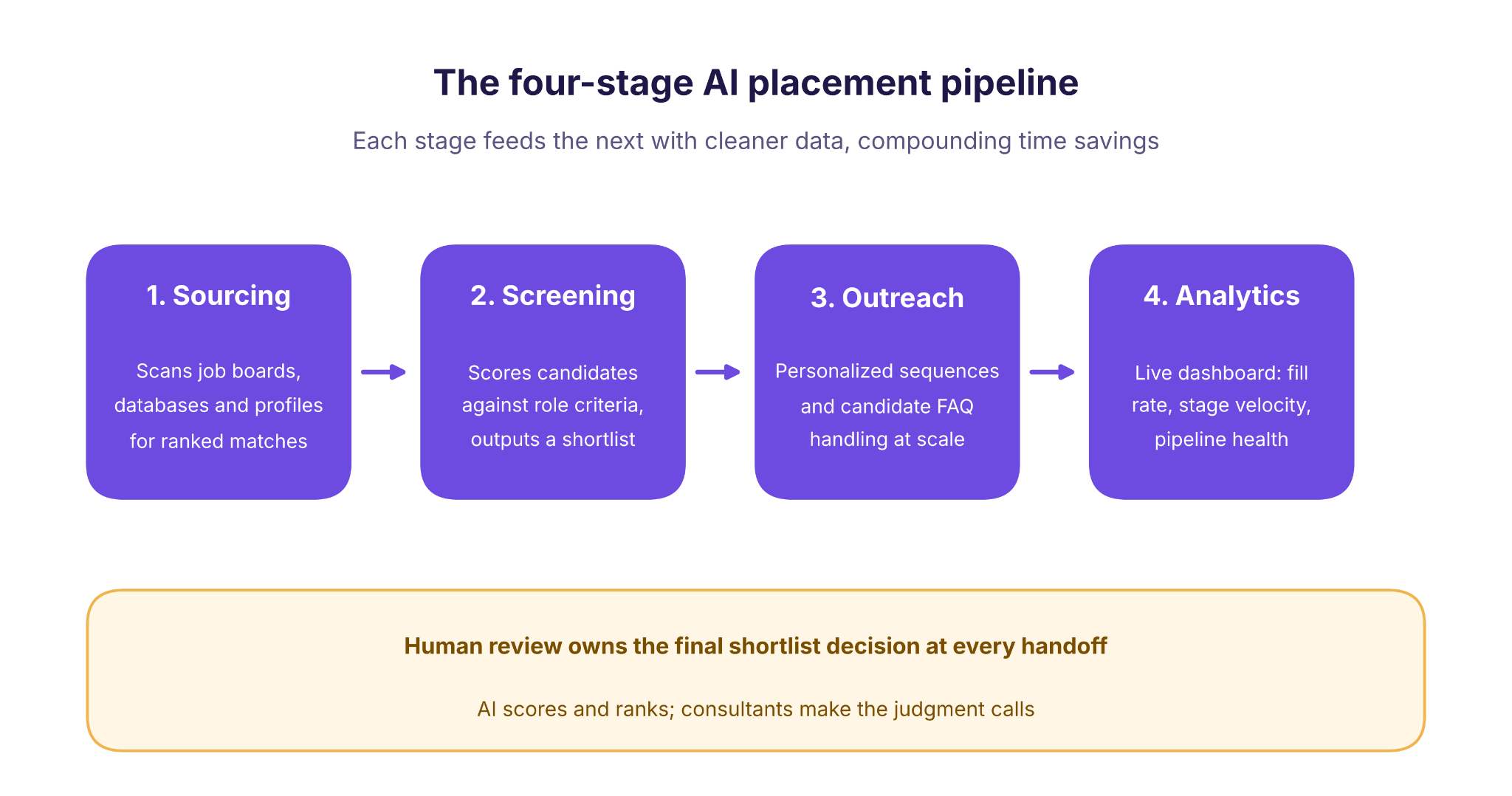
A connected AI placement pipeline is an operating model decision, not a technology one. These four stages form the structural spine of how agencies move from brief to placement faster, with each stage passing cleaner data to the next rather than creating another isolated record.
1. Stage 1: AI candidate sourcing
AI sourcing scans job boards, internal databases, and public professional profiles to surface matched candidates against structured role criteria. The output is a ranked list, not a raw dump of names, and it feeds directly into Stage 2 without manual re-entry. Your consultant defines the criteria, the AI does the scanning, and the consultant makes judgment calls on who to advance.
2. Stage 2: Screening and shortlisting
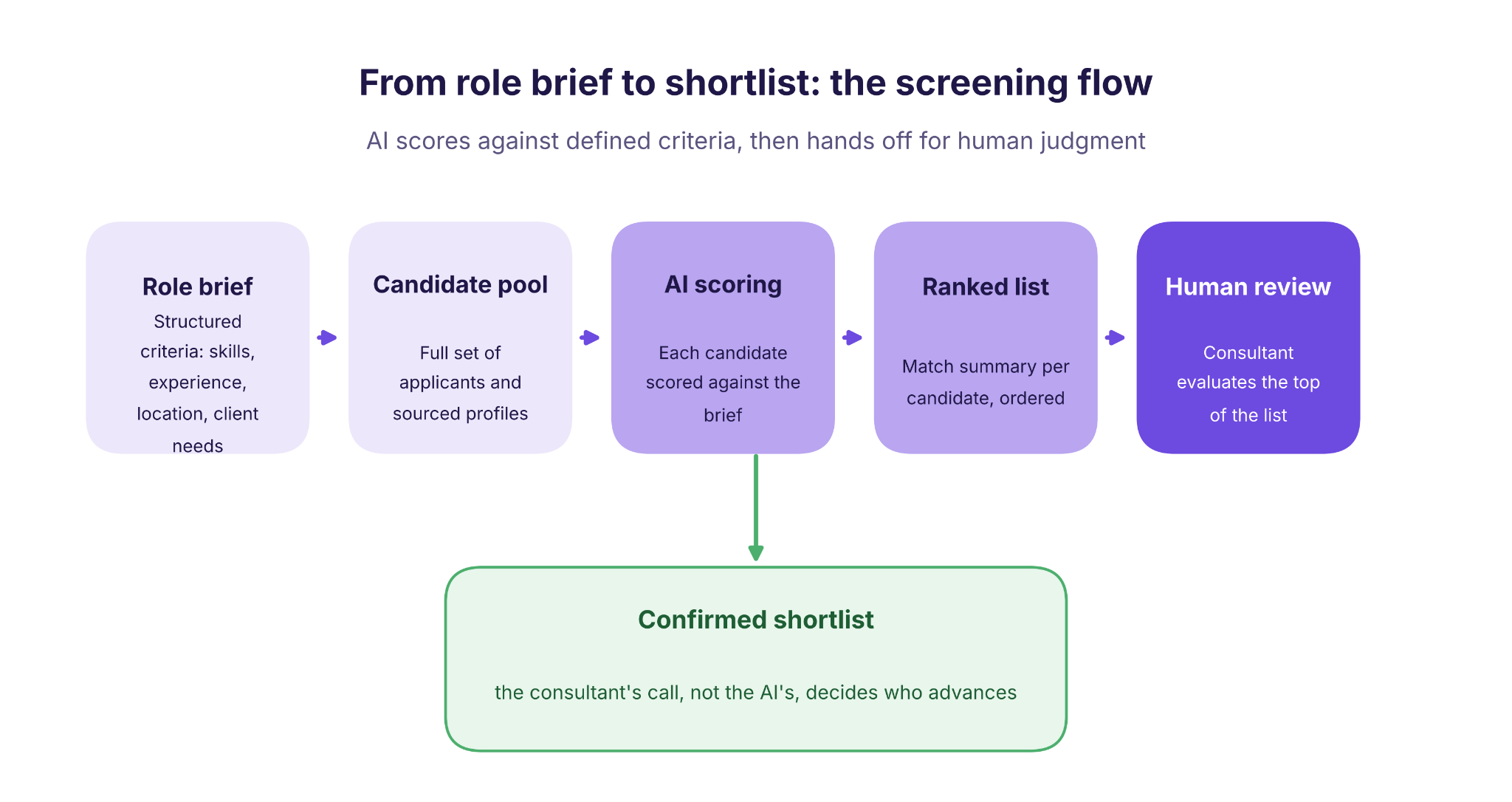
This is where the most consultant hours are reclaimed. AI scores and ranks candidates against structured criteria from the role brief: skills, experience level, location, and client-specific requirements. Each candidate gets a structured match summary, and the full pool is presented as a ranked list for human review.
Automated candidate screening works by scoring against defined criteria, not making subjective assessments, so it removes the large portion of a pool that clearly does not fit. Your consultant spends their time on the candidates that might.
3. Stage 3: Outreach and engagement
Once a shortlist is confirmed, AI sequences personalized follow-up messages and handles candidate FAQ responses at scale. A consultant managing 12 active searches cannot personally send status updates to 40 candidates per role. AI handles the administrative layer of communication so the consultant's time appears where it matters: offer negotiation, client briefing, and candidate commitment conversations.
4. Stage 4: Placement analytics
A live dashboard shows pipeline health, fill rate, time-to-shortlist per consultant, and stage velocity in real time. The agency owner sees which searches are stalling before a client relationship is at risk. This replaces the manual weekly report pulled from disconnected systems.
The compounding argument is straightforward. Sourcing feeds screening with ranked candidates. Screening feeds outreach with a confirmed shortlist. Outreach feeds analytics with engagement data. Time savings multiply at each handoff, which is why a connected pipeline consistently outperforms four separate tools doing the same jobs in isolation.
Where the biggest gains compound: sourcing and screening in depth
Sourcing and screening account for the majority of manual consultant hours in most agencies, and they are the stages where AI can operate at a scale no individual recruiter can match.
AI-powered sourcing tools work by matching structured role criteria against large candidate pools and surfacing ranked results rather than raw lists. A consultant reviewing a ranked, matched shortlist works faster and makes better decisions than one sorting through hundreds of unranked applications. The AI does not decide who gets the job. It decides who is worth the consultant's attention.
Screening quality depends on two things: the specificity of the role criteria and the quality of the training data behind the scoring model. AI scores against defined criteria. If those criteria are poorly specified or the training data reflects historical bias, the output will reflect those problems. Candidate ranking tools are most effective when the role brief is structured and detailed, not vague or copied from a previous search.
The EU AI Act classifies employment screening as a high-risk use case. For agencies operating in the EU, and increasingly under evolving frameworks in the UK and Australia, any AI screening tool needs to handle explainability and audit requirements, not just deliver a ranked list. This is a real constraint and should be part of every vendor evaluation conversation.
The proof that this works comes from a specific engagement. arsuno.ai built an AI system for a US-based executive search firm using advanced analytics to deliver superior shortlists faster than traditional methods. What changed was the sourcing-to-shortlist sequence: candidates were ranked against structured criteria before any consultant reviewed them. Consultant time went to evaluation and relationship work rather than initial sorting.
GDPR compliance is not optional for agencies handling candidate data. CVs, contact details, and employment history are personal data under GDPR, which means a lawful basis for processing, right-to-erasure handling, and data encryption are requirements. Confirm implementation details with any vendor, not just their marketing claim.
For executive search agencies, the sourcing and screening distinction matters more than it does in volume staffing. High-volume contingency recruiting benefits most from bulk screening speed. Executive search benefits most from the synthesis layer: structured research summaries, relationship context, and briefing accuracy that AI can surface before a consultant picks up the phone. The best AI recruiting platforms for staffing and search firms reflect this distinction in how they structure their workflows.
Stages 3 and 4: outreach, engagement, and placement analytics
The first two stages of the pipeline reclaim consultant hours. Stages 3 and 4 redirect those hours toward the work that actually builds client relationships and closes placements.
AI outreach sequences personalize messages at scale and handle candidate FAQ responses without consultant involvement. For an agency managing 15 active searches simultaneously, candidates on every search receive timely, relevant communication without a consultant manually drafting each message. The same principle that applies to HR chatbots answering employee questions at scale applies to candidate-facing communication: conversational AI handles the repetitive layer of follow-up so the human voice appears at the moments that matter.
Outreach automation is not about removing the human element from recruitment. It is about removing the administrative repetition so the human element appears at the right moment. Offer negotiation, candidate commitment conversations, and client briefings all require a consultant who is fully present and informed. Those conversations are harder to have well when the same consultant has spent the morning sending 40 status update emails.
Recruiter productivity automation at the analytics layer gives the agency owner a real-time signal rather than a weekly summary. A live placement analytics dashboard shows time-to-shortlist per consultant, fill rate by role type, and pipeline stage velocity as it happens. If a search is stalling at the outreach stage because response rates are low, the owner sees that on Tuesday, not the following Monday when the client calls.
For executive search agencies, analytics need to track more than volume metrics. Relationship depth, candidate research quality, and briefing accuracy matter as much as pipeline throughput. A specialist search that moves fast but delivers a weak shortlist has not improved. The analytics layer should reflect what quality means for your specific search model, not just what is easiest to count.
The practical outcome of Stages 3 and 4 working together is that the agency owner shifts from reactive management to proactive pipeline oversight. Problems surface before they become client issues. Consultants spend their time on high-value conversations rather than administrative follow-up. The data generated by the full pipeline feeds back into sourcing and screening criteria for the next search, making the whole system sharper over time.
What agencies need in place before deploying AI
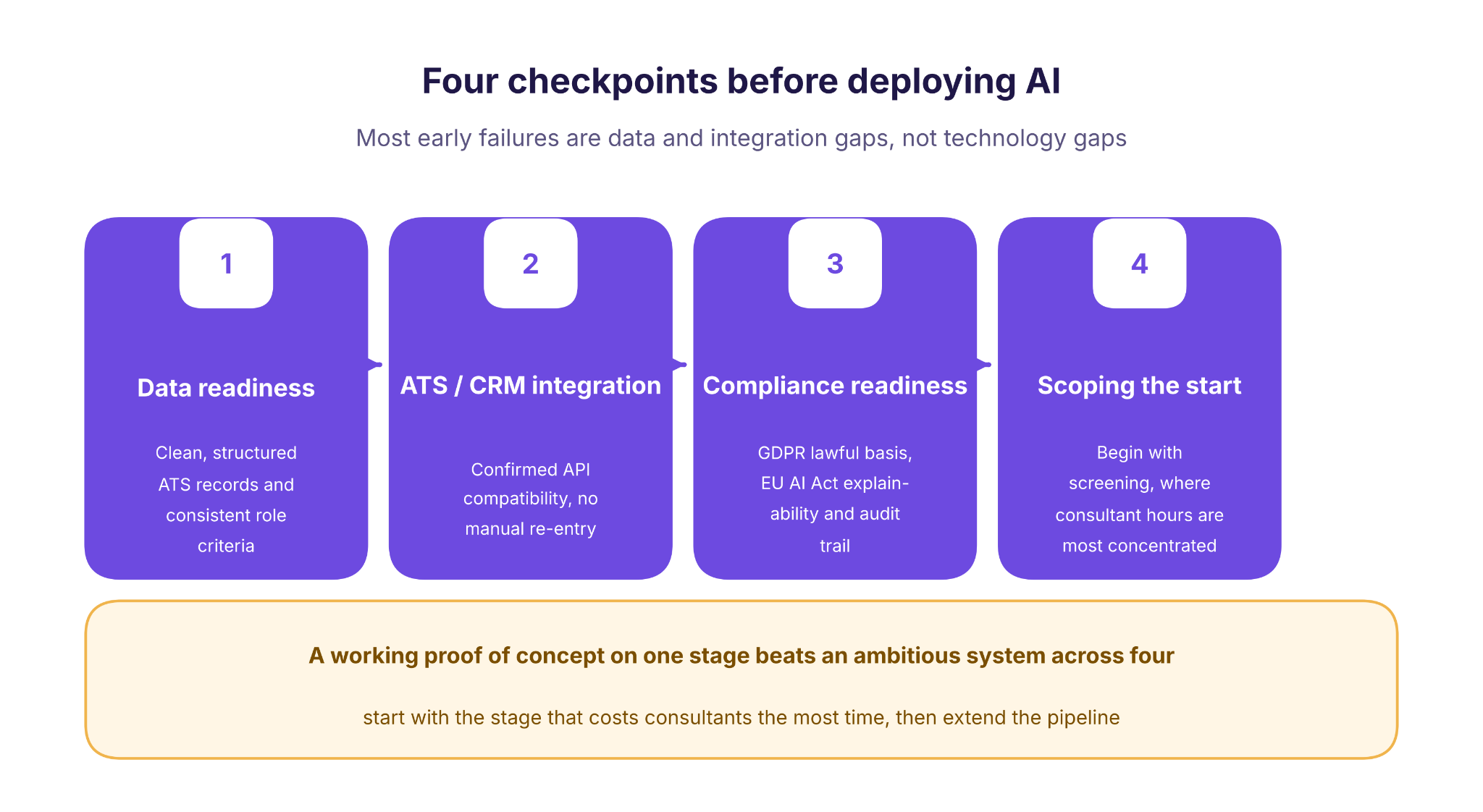
The fastest way to underperform with AI automation is to deploy it before your data and systems are ready. Most early automation failures are not technology failures. They are data readiness and integration failures that the technology exposed.
Data readiness is the first checkpoint. AI screening quality depends on structured, consistent role criteria and a candidate database clean enough to be useful. If your ATS contains duplicate records, inconsistent job titles, and role briefs copied from three searches ago without updating, the AI will score against that noise. Cleaning your ATS is unglamorous work no vendor will do for you, and it is the most common reason early automation underperforms.
ATS and CRM integration is the second checkpoint. The four-stage pipeline only compounds time savings if data moves between stages without manual re-entry. That requires confirmed API compatibility between your existing ATS and any new AI layer. Ask vendors for integration documentation, not just a feature list. A system that cannot write back to your ATS has not automated your workflow. It has added a parallel one.
Compliance readiness is the third checkpoint. The EU AI Act adds regulatory consideration for agencies operating in the EU, and similar scrutiny is emerging in the UK and Australia under their respective developing frameworks. Employment screening is classified as a high-risk use case, which means explainability and audit trail requirements apply to any AI screening tool used in those markets. GDPR compliance for candidate data means a lawful basis for processing, right-to-erasure handling, and data encryption in transit and at rest. These are implementation requirements, not optional features.
Scoping the right starting point is the fourth checkpoint. Most agencies see the fastest return by starting with screening and shortlisting, because that is where consultant hours are most concentrated. Sourcing automation adds further speed once the screening layer is working. Understanding AI automation services scope timelines and pricing before committing helps set realistic expectations about what a proof of concept delivers versus a full deployment.
A phased approach reduces risk. A working proof of concept that automates one stage well is more valuable than an ambitious system that automates four stages inconsistently. Start with the stage that costs your consultants the most time, prove the ROI, then extend the pipeline.
Measuring what matters: the metrics that tell you if it is working
Deploying AI without a clear measurement framework is how agencies end up with automation they cannot evaluate. These are the metrics that actually tell you whether your AI pipeline is delivering.
Time-to-shortlist per consultant is the primary signal. If AI screening is working, the time from role brief to confirmed shortlist drops measurably. Track this per consultant and per role type before and after deployment. A shortlist that takes five days before automation and two days after is a concrete, client-visible improvement.
Recruiter hours saved weekly is the second signal. Track how many hours per consultant per week shift away from manual CV review and administrative follow-up. This is the input metric that drives every downstream outcome: more time per consultant means more active searches, better candidate relationships, and faster client responses.
Fill rate and placement velocity are the output metrics. If time-to-shortlist drops but fill rate stays flat, the bottleneck has moved downstream, likely to offer negotiation or client decision speed. Analytics that show stage velocity across the full pipeline tell you where the constraint is, not just whether the first stage improved.
Client satisfaction and retention are the lagging indicators. Clients who receive faster, higher-quality shortlists renew and refer. Clients who experience inconsistent delivery churn. Improvements in client satisfaction come directly from shortlist quality and delivery speed improving together, not from either metric in isolation.
The agencies that get the most from AI automation are the ones that set baseline measurements before they deploy anything. Without a baseline, you cannot prove the value, cannot optimize the system, and cannot make the case for the next stage of investment.
Frequently Asked Questions
How do recruitment agencies use AI across sourcing, screening, and placement?
Recruitment agencies apply AI across the full placement workflow rather than at a single stage. At sourcing, AI scans job boards, internal databases, and professional profiles to surface ranked candidate matches against structured role criteria. At screening, it scores candidates and produces shortlists for human review. At the placement stage, analytics dashboards track pipeline velocity and fill rate so agency owners can intervene before a search stalls.
Which AI workflow delivers the fastest time-to-placement gains for agencies?
Screening and shortlisting automation typically delivers the fastest initial gains because that is where manual consultant hours are most concentrated. Agencies that start with AI screening see time-to-shortlist drop first, with outreach automation adding further speed gains once the shortlist workflow is stable. The compounding effect comes from connecting both stages so the output of screening feeds directly into outreach without a manual handoff step in between.
Can AI screen candidates fairly and accurately?
AI screens candidates by scoring against defined, structured criteria rather than making subjective assessments, which removes the portion of a pool that clearly does not fit and surfaces the candidates worth a consultant's attention. Accuracy depends on the specificity of the role brief and the quality of the scoring model's training data; poorly specified criteria or biased training data will produce flawed output. Human review of the ranked shortlist remains essential, and agencies should ask vendors how their tools handle explainability and audit requirements, particularly under the EU AI Act's high-risk classification for employment screening.
How does AI rank candidates for shortlisting?
AI ranking tools score each candidate against structured criteria drawn from the role brief, such as skills, experience level, location, and client-specific requirements, and then order the full pool by match strength. The output is a ranked list with a structured match summary for each candidate, not a binary pass-or-fail decision. Consultants review the ranked list and make the final shortlist call with the AI handling the initial sorting that.
What does recruitment automation actually cover?
Recruitment automation covers the full range of workflow stages from sourcing through placement, not just CV screening. At the sourcing stage, AI scans job boards, databases, and professional profiles to surface ranked matches. At the screening stage, it scores candidates against structured criteria and produces shortlists for human review.
What implementation risks and compliance issues should agency owners consider?
The most common implementation risks are data readiness failures and integration gaps rather than technology problems: an ATS with inconsistent records or a new AI layer that cannot write back to existing systems will underperform regardless of the tool's capability. Compliance requirements are a separate and mandatory consideration, particularly for agencies operating in the EU, where the EU AI Act classifies employment screening as a high-risk use case requiring explainability and audit trails. GDPR requires a lawful basis for processing candidate data, right-to-erasure handling, and data encryption in transit and at rest.
How can AI help recruiters source candidates faster?
AI sourcing tools match structured role criteria against large candidate pools across job boards, internal databases, and public professional profiles simultaneously, surfacing ranked results rather than raw lists. A consultant working from a ranked, matched shortlist makes faster decisions than one sorting through unranked applications, because the AI has already filtered out candidates who clearly do not fit. The sourcing output feeds directly into the screening stage without manual re-entry.
.webp)