

Key takeaways
This AI clinical assistant case study documents a 70% reduction in manual intake-preparation work and 3.5x automation efficiency for a regulated European mental health clinic, as reported by arsuno.ai. The system operated within a GDPR-aligned architecture, with data minimization and role-based access controls built in from day one. Every AI-generated summary required clinician review and approval before clinical use. This account also includes an honest retrospective on what we would change.
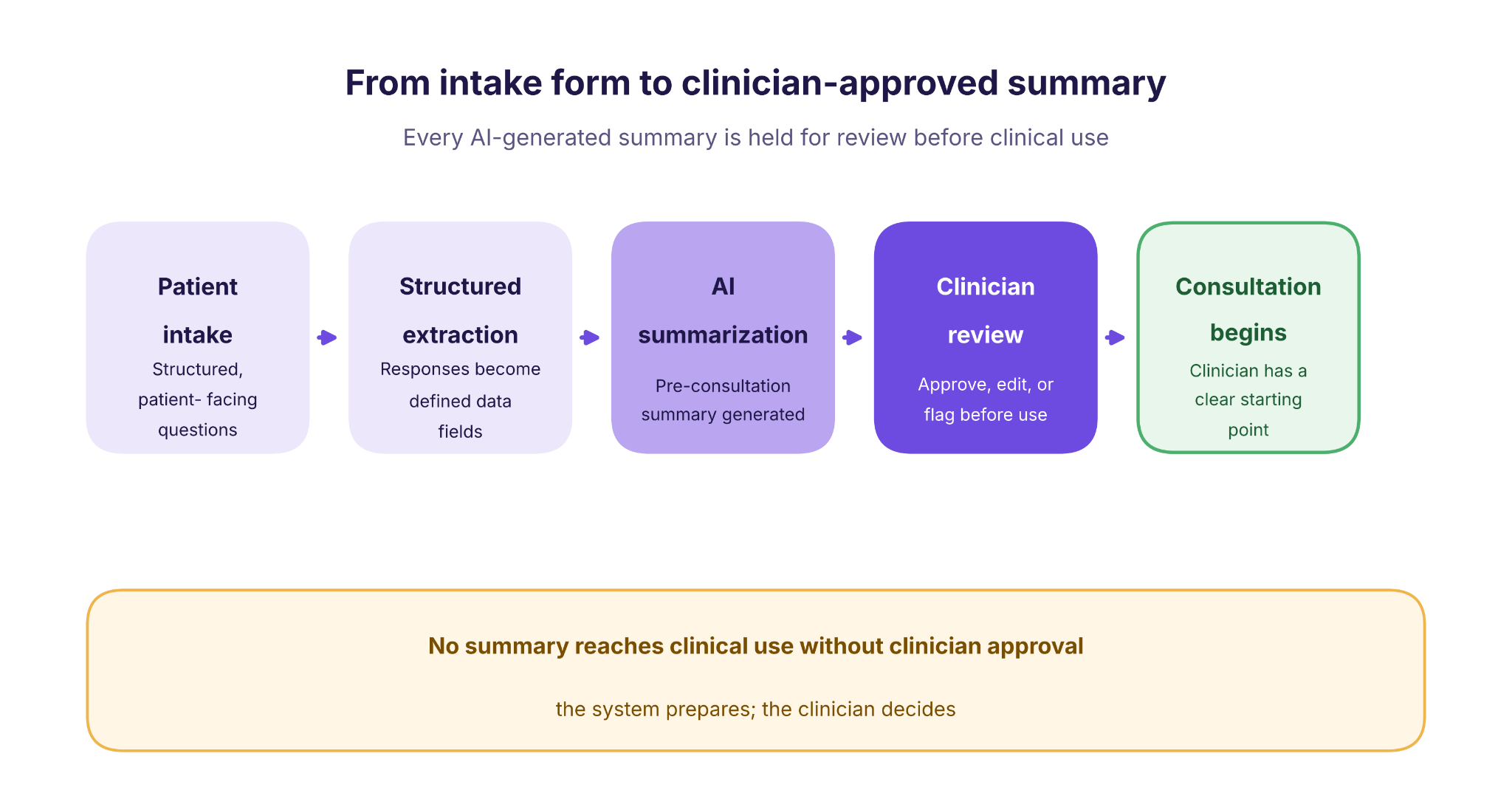
The intake-preparation burden before the build
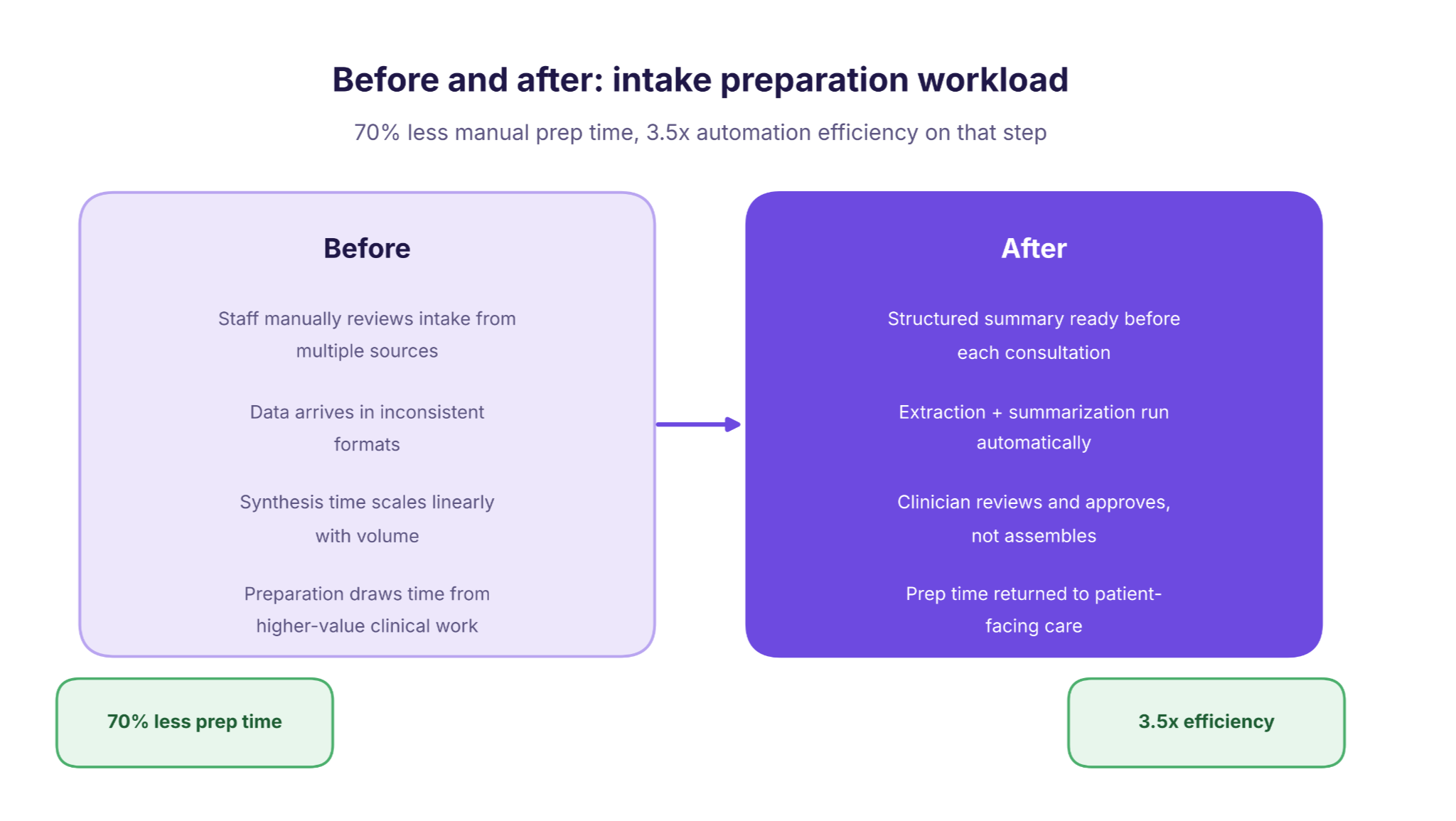
Before the build, clinical staff at a regulated European mental health clinic spent significant time before each consultation manually reviewing and synthesizing patient intake information. The data existed, but it arrived from multiple sources in inconsistent formats, requiring a skilled staff member to assemble it into a coherent pre-consultation picture. That synthesis step, not the data collection itself, was the bottleneck.
The problem did not scale. As appointment volume grew, the preparation burden grew with it. There was no way to add more consultations without adding more preparation time, and that time was being drawn from staff who had higher-value clinical responsibilities. The clinic needed a solution that removed the preparation burden without transferring clinical judgment to a machine.
The constraint was clear from the start: any system had to respect the data-privacy obligations of a regulated European environment. This was not a technical afterthought. It shaped every design decision from the first requirements session. You can read more about how this kind of clinic automation approach applies across different administrative workflows.
How the custom AI clinical assistant was built
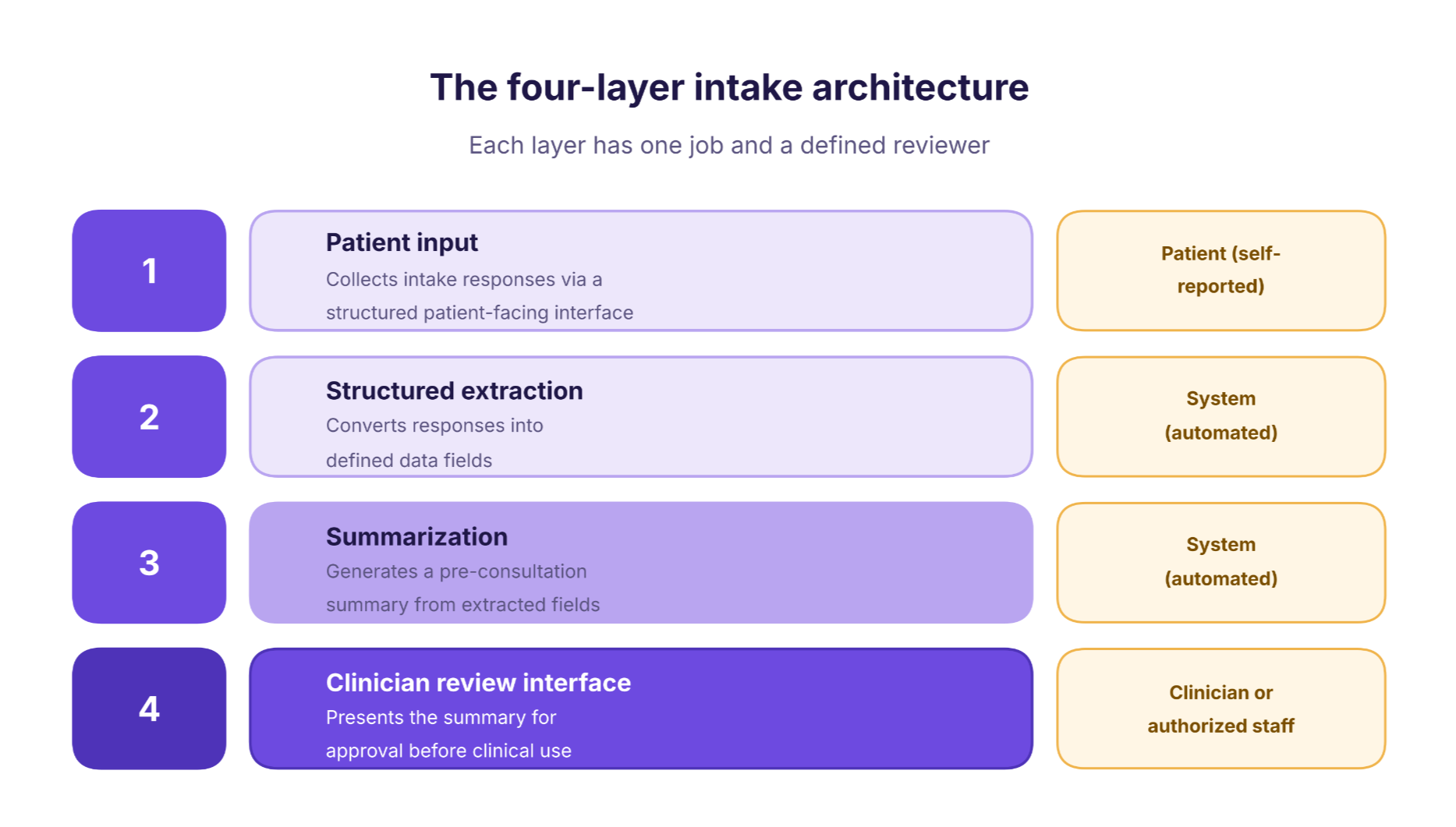
arsuno.ai built the clinical assistant across four distinct layers, each with a defined responsibility and a clear handoff point. The architecture kept the AI in the preparation lane and the clinician in the approval lane, with no ambiguity between the two.
The data extraction process converted intake responses into structured fields before the summarization layer processed them. Comparable implementations follow the same pattern: document ingestion, structured extraction, and a staff review dashboard before any output reaches clinical use.
The assistant did not diagnose, recommend treatment, or make any autonomous clinical decision. Every summary was a preparation aid, held at the review interface until a clinician approved it. That boundary wasn't a late addition, it was the design requirement the entire architecture was built around.
Privacy and compliance as architectural decisions
Data minimization was a design constraint from the start. Only intake fields required for pre-consultation preparation entered the system. Nothing was retained beyond its defined purpose, and processing occurred within a private environment. Role-based access controls restricted AI-generated summaries to authorized clinical staff. arsuno.ai's security commitments include encryption in transit and at rest across all deployments.
The clinician-review gate served as both a clinical safeguard and a governance mechanism: no AI output reached clinical use without human approval. Research in PLOS Digital Health supports this model, finding greater efficiency gains among AI-assisted clinicians working under senior-physician review.
Under GDPR, clinical AI tools carry specific obligations covering DPIAs, traceability, and human oversight requirements. The EU AI Act may classify certain clinical AI tools as high-risk depending on intended purpose, adding further governance requirements. Technical controls alone do not establish legal compliance. Lawful basis, DPIA completion, subprocessor contracts, and retention policies remained the clinic's governance responsibility, treated as architectural decisions rather than post-launch additions.
Implementation timeline: phase by phase
arsuno.ai's published delivery model begins onboarding within one to two weeks of engagement and targets full deployment within one to six months, depending on complexity. This project fell within that range. The table below reflects the actual phases, not a generic industry estimate.
The dependencies that stretched the timeline most were data readiness and governance review completion. Intake materials in inconsistent formats required additional processing before the extraction layer could perform reliably. Governance steps needed to be completed before the pilot could go live. Neither delay was unusual, and both are predictable if you plan for them.
Results: what the 70% and 3.5x figures actually mean
The 70% reduction applies specifically to manual intake-preparation work: the time clinical staff spent synthesizing patient data before consultations. It does not cover patient outcomes, diagnostic accuracy, revenue, or headcount changes. The 3.5x automation efficiency figure reflects throughput improvement over the manual baseline for that preparation step. Both are arsuno.ai's own published metrics and have not been independently verified by a third party.
Staff were freed from preparation work that had consumed time they needed for patient interaction. Structured summaries gave clinicians a clearer starting point for each consultation.
A PLOS Digital Health study evaluated AI documentation support across 15,615 documents and found greater writing-efficiency gains among AI-assisted clinicians working under senior-physician supervision. This supports the human-review model used here, though it is not a benchmark for the arsuno.ai figures. Anyone evaluating a comparable build should ask the same scoping questions: which workflow step, compared to what baseline, over what period.
What we would do differently
Two lessons from this project stand out as genuinely transferable. Both concern sequencing: when you do something matters as much as what you do.
1. Assess data readiness before configuration
The quality and format of existing intake materials had a larger effect on the extraction layer's early accuracy than anticipated. Inconsistent formats required remediation before the system could process responses reliably, extending the testing phase. Treat your intake data audit as a prerequisite, not a parallel task.
2. Sequence staff onboarding before the pilot
Clinical staff who understood the review interface before the first live consultations adopted it faster and flagged edge cases more clearly. Running training alongside the pilot slowed that process. Onboarding should precede the pilot, not run concurrently.
Governance review, including DPIA and subprocessor contracts, should also run in parallel with the build, not after it. Starting late is a recurring cause of go-live delays in regulated environments. Get in touch to discuss how these phases apply to your clinic.
Frequently Asked Questions
Can an AI clinical assistant process sensitive patient intake data?
Processing sensitive patient intake data is feasible when the system is designed around data minimization, controlled processing environments, role-based access, and defined retention limits. In this implementation, only the intake fields required for pre-consultation preparation entered the system, and access to AI-generated summaries was restricted to authorized clinical staff. Technical controls are necessary but not sufficient: legal obligations including DPIAs, traceability, and human oversight requirements must also be addressed.
Does a clinician need to review the AI-generated intake summary?
Yes. Every summary produced by the assistant was held at the clinician review interface until an authorized clinician or staff member approved it before clinical use. The system did not diagnose, recommend treatment, or act autonomously on any patient data. When intake responses were incomplete or ambiguous, the summary was flagged for staff review rather than passed through automatically.
Can an AI patient intake system integrate with an existing clinic workflow?
Integration is possible, but compatibility depends on the clinic's existing systems, available APIs, authentication requirements, and the depth of data transfer needed. In this implementation, the assistant connected to the clinic's existing intake and scheduling workflow without replacing the systems already in use. Human approval at the review interface remained required regardless of integration depth, so the system added a preparation layer rather than bypassing existing processes.
How long does it take to implement an AI clinical assistant for a clinic?
arsuno.ai's published delivery model targets onboarding within one to two weeks and full deployment within one to six months, depending on integration complexity and data readiness. This project followed a six-phase structure from workflow discovery through full deployment and optimization. The factors that most affected timeline were the consistency of existing intake materials and the completion of governance review before the pilot phase began.
How does AI summarize patient intake information for clinicians?
The system extracted structured fields from patient intake responses and passed them to a summarization layer that generated a pre-consultation summary for each appointment. That summary was presented to the clinician through a review interface before any clinical use. The output was a preparation aid only, no diagnosis, treatment recommendation, or autonomous decision was produced at any stage.
What happens when a patient's response is incomplete or ambiguous?
When the system encountered incomplete or ambiguous intake responses, the summary was flagged for staff review rather than passed through to the clinician automatically. Authorized staff could then review the raw intake data and decide how to proceed before the consultation. This escalation path was part of the original design, ensuring that gaps in patient-reported information were handled by a person rather than resolved by the system.
What privacy controls should an AI clinical assistant have?
The controls confirmed in this implementation included data minimization at the point of collection, processing within a private environment, role-based access restrictions limiting summary visibility to authorized clinical staff, and encryption in transit and at rest. Retention was limited to defined purposes, and no data was held beyond those boundaries. These technical controls were complemented by governance obligations, including DPIA completion and subprocessor contracts, which remained the clinic's responsibility.
.webp)