

Key takeaways
- AI resume screening is a reliable prioritization tool when confined to parsing and ranking; it becomes a liability when used to reject candidates without documented human review.
- Run a role-specific accuracy test on your own candidate data before deployment, not the vendor's benchmark.
- Bias exposure is both technical and legal; anonymization alone does not fix either layer.
- Map compliance obligations by candidate location, client location, and degree of automation before deployment, not after.
What AI can and cannot do in candidate screening
The safe boundary for AI in candidate screening is clear: it handles the volume work, and humans handle the consequential decisions. Understanding that boundary before you configure a single screening rule is the most important step in the whole deployment.
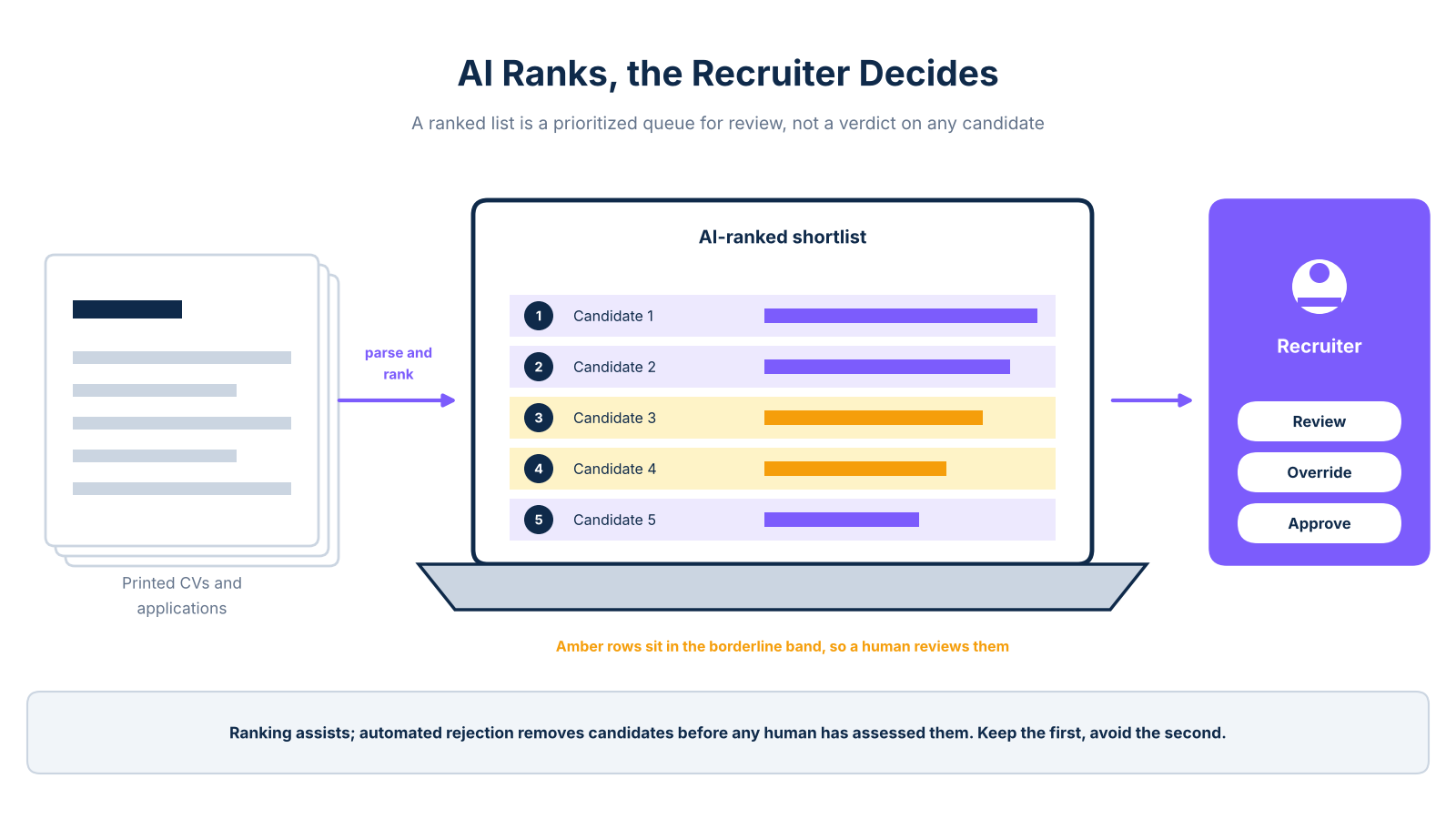
AI handles resume ingestion, structured data extraction, requirement matching, and initial candidate prioritization well. These are assistive tasks, as described in screening workflow stages, where the system parses applications, extracts skills and employment history, compares candidates against defined criteria, and surfaces a ranked list for recruiter review. None of those steps constitutes a hiring decision. They are filters that reduce the volume a recruiter needs to manually process, not verdicts on who gets the job.
The critical operational distinction is between AI-assisted candidate ranking and automated rejection. A ranked list gives a recruiter a prioritized queue to work through. Automated rejection removes a candidate from consideration before any human has assessed them. These carry materially different liability profiles, and conflating them is a common mistake agencies make when deploying screening tools.
Automated rejection is where legal and reputational risk concentrates. A ranked list that a recruiter genuinely reviews and can override carries a lower liability profile. A system that silently discards applications before any human sees them carries a significantly higher one. If a candidate later asks why they were not considered, "the algorithm filtered them out" is not an answer that protects your agency. The system should surface candidates for review, not eliminate them from contention.
AI shortlisting for recruitment agencies is most defensible when the tool's output is treated as a recommendation layer, and the recruiter retains visible authority over every decision that affects a candidate's progression. That framing is not just good practice. It is the architecture that keeps your agency on the right side of employment law across every market you operate in.
How to test AI candidate vetting accuracy before you commit
No single independent benchmark generalizes across AI screening tools, roles, candidate populations, and resume formats. Vendor-supplied accuracy claims are self-reported and based on proprietary test sets that may not reflect your roles, your candidates, or the resume formats your applicants actually submit. Before you commit budget or change a client-facing process, test the tool against your own data.
A role-specific acceptance test works as follows: take a representative sample of 30 to 50 applications from a recently closed role where you already know the outcome. Run them through the tool and measure four things: how many qualified candidates fell below the shortlist threshold; how many inappropriate inclusions appeared in the top tier; whether rankings stay consistent across two runs of the same applications; and how the system treats candidates with non-standard career histories. This is an illustrative pilot size, for high-stakes or high-volume deployment, seek statistical or legal guidance on appropriate sample design.
That last question matters most for agencies. Test specifically for candidates with non-linear histories or employment gaps, multilingual resumes where formatting differs from the tool's training set, equivalent certifications standing in for degree requirements, and candidates whose job titles don't match the role title verbatim. A system that performs well on straightforward applications but consistently misranks portfolio-career candidates will create problems precisely where your judgment adds the most value.
Accuracy for ranking and accuracy for rejection are different thresholds. A ranking tool that misorders a few candidates is recoverable with human review. A rejection tool that silently drops qualified applicants is not, because those candidates never reach a recruiter's queue. If the tool is configured to exclude candidates automatically, your acceptance test must reflect that higher standard.
Bias in AI hiring tools: technical sources and legal exposure
Bias in AI screening tools has two distinct layers: the technical sources embedded in how models are trained, and the legal exposure that follows when those models produce disparate outcomes. Addressing one without the other leaves your agency exposed.
On the technical side, models trained on historical hiring data inherit the preferences embedded in past decisions. Proxy variables are the mechanism: institution name, employer brand, address, career gap length, and employment pattern can all correlate with protected characteristics even when explicit demographic fields are excluded. Anonymizing candidate names does not remove these indirect signals.
Stanford HAI research on algorithmic hiring tools found that automated screening can scale rejection patterns rather than neutralize them. Simulation research on proxy variable risk reaches the same conclusion: indirect indicators survive name removal and continue to influence ranking.
The legal exposure maps differently by jurisdiction. The EU AI Act classifies systems that filter or rank candidates as potentially high-risk, requiring documentation, human oversight, and bias monitoring. ICO guidance confirms that GDPR Article 22 restricts solely automated decisions with significant effects; where human review is involved, it must be genuine and independent, not a rubber-stamp of algorithmic output. The UK Equality Act 2010 and EEOC guidance on adverse impact apply to any screening process producing disparate outcomes across protected groups, regardless of intent. Confirm the applicable enforcement context for your jurisdiction before deployment.
Monitor outcome distributions across candidate groups regularly, investigate materially different selection patterns, and treat vendor fairness assurances as a starting point for independent monitoring, not a substitute for it.
Human-in-the-loop checkpoints every agency needs
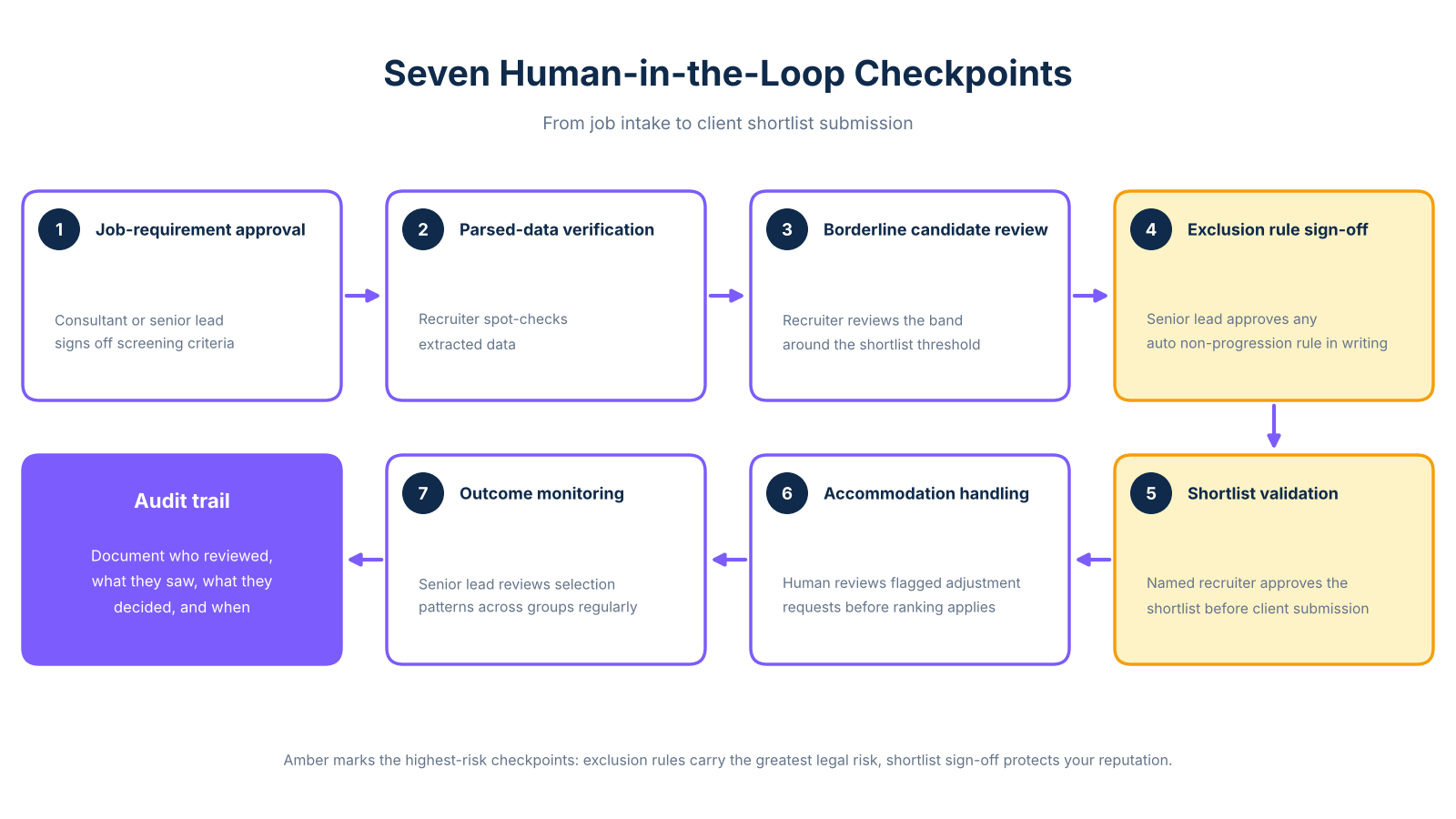
Human-in-the-loop recruitment is a process specification, not a reassurance phrase. "We keep humans involved" is not a defensible answer to a client or regulator. A named checkpoint model defines who reviews what, at which stage, and what must be documented before the process moves forward.
Checkpoint 1: Job-requirement approval. The recruiting consultant or senior lead signs off the criteria fed into the screening tool before any applications are processed. Underdefined criteria upstream corrupt every downstream ranking.
Checkpoint 2: Parsed-data verification. A recruiter spot-checks extracted data on a sample of applications before the ranking is used. Parsing errors on non-standard formats or multilingual CVs will not announce themselves.
Checkpoint 3: Borderline candidate review. Any candidate within a defined band around the shortlist threshold is reviewed by a recruiter before inclusion or exclusion is confirmed.
Checkpoint 4: Exclusion rule sign-off. Any rule causing automatic non-progression must be approved in writing by a senior lead before activation. Exclusion rules carry the highest legal risk of any configuration decision.
Checkpoint 5: Shortlist validation before client submission. A named recruiter approves the final shortlist. No AI-generated output reaches a client without this sign-off, this is the checkpoint that matters most to your professional reputation.
Checkpoint 6: Accommodation and adjustment handling. Any candidate who has flagged a disability or requested an adjustment is reviewed by a human before automated ranking applies. Specific duties vary by jurisdiction; confirm requirements for each market you operate in.
Checkpoint 7: Post-deployment outcome monitoring. A senior lead reviews selection patterns across candidate groups regularly, monthly or quarterly depending on role volume, subgroup sample sizes, and model updates.
Document each checkpoint: who reviewed, what they saw, what decision they made, and when. That audit trail turns a governance model into a defensible process.
Compliance obligations mapped by your agency's context
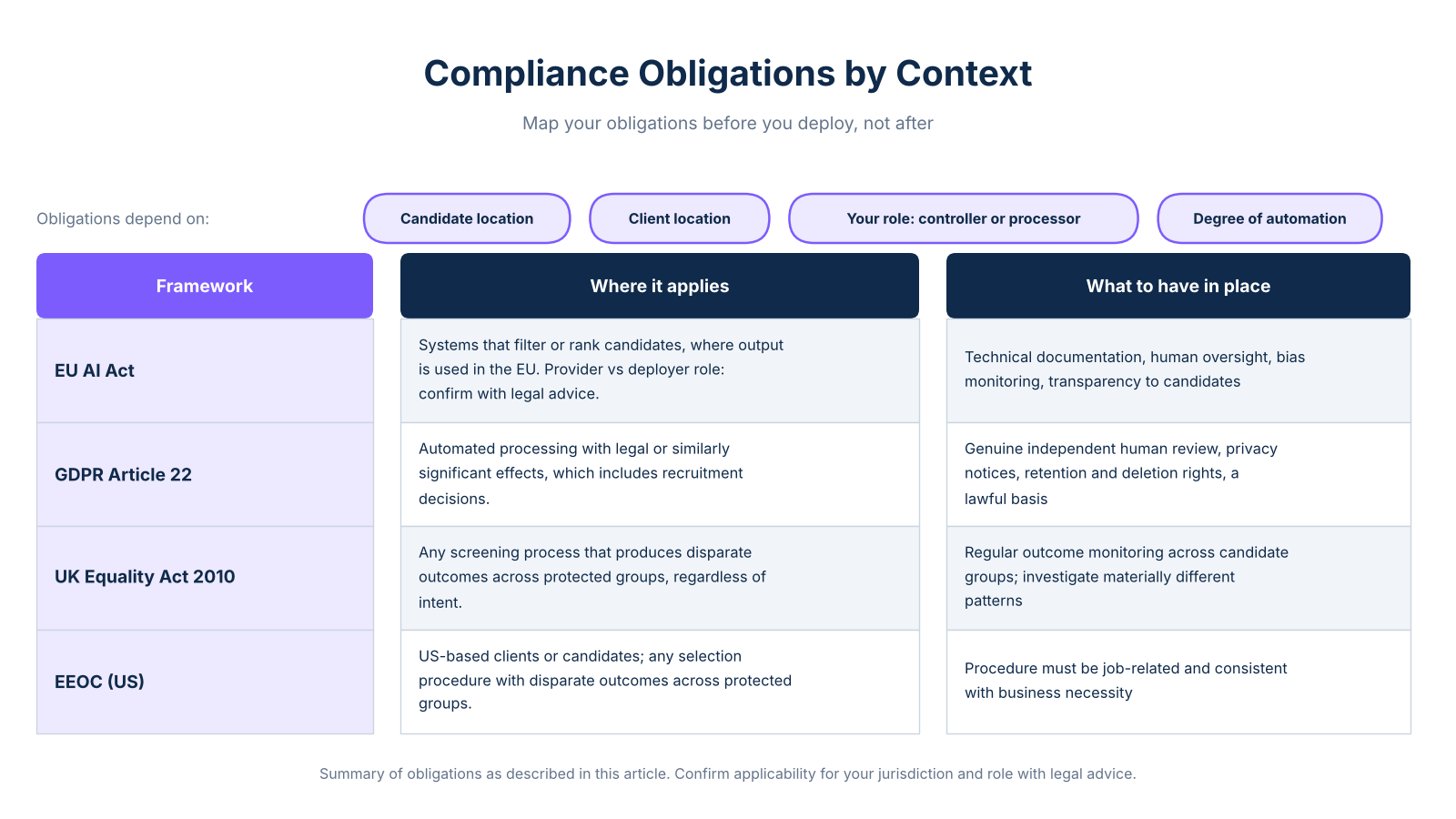
Compliance is a mapping exercise shaped by four variables: where your candidates are located, where your clients are located, your agency's role as data controller or processor, and the degree to which the screening system influences consequential decisions. Each combination produces a different set of obligations.
For agencies placing candidates in EU markets, the EU AI Act classifies candidate-filtering and ranking systems as potentially high-risk under its employment provisions. Obligations include technical documentation, human oversight, bias monitoring, and transparency to candidates about automated tools. The Act can apply to systems whose output is used in the EU even where the agency is based outside it. Territorial scope depends on whether your agency acts as provider or deployer; confirm applicability with legal advice.
GDPR Article 22 applies when automated processing produces a decision with legal or similarly significant effects. Recruitment decisions fall within this scope. Where AI screening feeds human review, that review must constitute genuine independent judgment, not a confirmation of an algorithmic output. Transparency about automated processing, retention periods, and deletion rights must appear in your privacy notices before you process a single application. The applicable lawful basis depends on your role and jurisdiction; consent, legitimate interests, and contractual necessity may all apply.
Agencies already using AI across their operations, as covered in our guide to ai for recruitment agencies, will recognise this as an extension of existing data governance work. For US-based clients or candidates, EEOC adverse impact principles require that any selection procedure producing disparate outcomes across protected groups be job-related and consistent with business necessity, regardless of discriminatory intent.
Before signing with any vendor, request documentation covering: what data the model processes, whether applicant data trains the model, where data is stored, and retention and deletion procedures. Confirm also how scores are explained to candidates, how the agency is notified of model updates, and how the tool supports accommodation requests. These questions separate a genuinely auditable system from one that only claims to be.
Building a deployment decision your clients can trust
The agencies that deploy automated candidate screening successfully treat it as an assistive prioritization layer, not a replacement for recruiter judgment. They run a role-specific accuracy test before going live, configure human checkpoints at every stage where a candidate could be excluded or a shortlist submitted, and maintain a documented audit trail that answers a client or regulator with a process rather than a reassurance.
For specialist practices the stakes are higher still, as explored in our piece on ai executive search, where shortlist credibility directly reflects the agency's professional reputation. A tool that surfaces strong candidates faster is an asset. A tool that silently filters out qualified candidates before a recruiter sees them is a liability, regardless of how the vendor describes its accuracy.
The question for your agency is not whether automated screening is reliable enough in the abstract. It is whether you have run the acceptance test on your own roles, named the checkpoints, and mapped your compliance obligations. If you have built the audit trail that turns any client inquiry into a documented process, automated candidate screening makes your team faster and your shortlists more defensible. If you have not, the speed gain carries a liability profile that the vendor's terms and conditions will not protect you from.
Frequently Asked Questions
How accurate is AI resume screening?
Accuracy varies by role, resume format, language, data quality, and the distinction between parsing, matching, ranking, and job-performance prediction. No single, widely accepted independent benchmark generalizes across screening tools, roles, and candidate populations. The most reliable test is to run a sample of applications from your own recently closed roles through the tool and measure missed qualified candidates, inappropriate inclusions, consistency across repeated runs, and treatment of non-traditional career paths.
Is AI resume screening GDPR compliant?
Compliance depends on your workflow, the jurisdiction of your candidates and clients, the legal basis for processing, the notices you provide, your data minimization and retention practices, and the degree to which the system makes or influences consequential decisions. You must distinguish AI-assisted review, where a human genuinely evaluates the output, from solely automated decisions with legal or similarly significant effects, which trigger stricter safeguards under GDPR Article 22.
What is the difference between AI candidate ranking and automated rejection?
Ranking is an assistive prioritization output: the system orders candidates by relevance and a recruiter works through the queue. Automated rejection is a consequential exclusion decision: a candidate is removed from consideration before any human has assessed them. These two functions carry materially different liability profiles. Automatic rejection requires stricter controls, documented exclusion rules, human sign-off, and an appeal or correction route where applicable.
Can AI screen CVs for recruitment?
AI can reliably assist with resume ingestion, parsing, structured data extraction, requirement matching, candidate prioritization, and duplicate detection. These are assistive tasks that reduce manual processing volume without substituting for recruiter judgment. Human checks are required for unclear parsing outputs, unusual career histories, accommodation requests, borderline candidates, and final shortlist approval before client submission.
What data does AI resume screening use?
Screening systems typically process resume text, skills, education credentials, employment history, job titles, dates, certifications, and the criteria extracted from job descriptions. Historical hiring data used in model training can introduce proxy risks, where fields such as employer name, institution, address, career gap length, or employment pattern correlate with protected characteristics even when demographic fields are excluded.
What is human-in-the-loop recruitment?
Human-in-the-loop recruitment means that a named person with genuine authority and sufficient information reviews and can override the system's output at every stage where a candidate could be excluded or a shortlist finalized. It is a process design specification, not a general reassurance. Minimum checkpoints include job-requirement approval, parsed-data verification, borderline candidate review, exclusion rule sign-off, shortlist validation before client submission, accommodation handling, and post-deployment outcome monitoring.
Can AI resume screening introduce bias?
Yes. Models trained on historical hiring data can inherit past preferences through proxy variables: institution name, employer brand, address, career gap, language, and employment pattern can all correlate with protected characteristics even after names are removed.