

Key takeaways
- Autonomous resolution means AI closes the ticket end to end: no human touch. Containment means the interaction stayed in the AI channel but the issue may not be solved. These are not the same metric.
- Track autonomous resolution rate and escalation rate in the first 30 days. CSAT delta and cost-per-ticket need 60-90 days to be meaningful.
- Before any vendor demo, ask: "What is your measured autonomous resolution rate in deployments like mine?" If they answer with deflection numbers, you have your answer.
Why 2026 is an architecture decision, not a feature upgrade
Most support teams evaluating AI right now are comparing chatbot features. That's the wrong frame. According to Forrester, 2026 is a year of hard operational restructuring for customer service. Teams that treat it as a feature-upgrade cycle end up moving tickets around rather than removing them. Service quality can actually dip if the architectural work is skipped.
The distinction that matters is between two patterns. The first is the bolt-on: a chatbot layer added on top of an unchanged support stack. Tickets still flow through the same queues, agents handle the same volume, and the AI intercepts some interactions before routing them back into the existing system. The second is the rebuilt pattern: AI becomes the primary resolution layer, with humans handling judgment-heavy escalations. The support stack itself changes around this new operating model.
Most vendor demos show you the bolt-on and describe it as the rebuild. The difference isn't visible in a demo. It shows up at month three, when your ticket volume hasn't moved.
In our 2025 overview of AI in customer support, the central question was whether AI could reliably handle support interactions. That question is settled. The 2026 question is whether your team is rebuilding around AI or patching it onto a model that wasn't designed for it.
Best Buy made this distinction concrete by deploying a generative AI virtual assistant across BestBuy.com, the app, and phone support to enable self-service resolution. That was an operating model decision from the start, not a feature addition. It's what separates deployments that deliver sustained results from those that plateau after 90 days.
The architectural question to answer before evaluating any vendor: are you adding AI to your current support model, or redesigning the model around AI? That answer determines everything else, from staffing to escalation logic to the KPIs you report to leadership.
Autonomous resolution vs. containment: why the distinction matters
Before your team can evaluate a vendor, report progress to leadership, or know whether a deployment is working, you need precise definitions for two metrics that are routinely conflated.
Autonomous resolution means the AI closes the ticket end to end without any human intervention. The issue is verifiably solved: the customer's question is answered, the action is completed, the case is closed. No human reviewed it, escalated it, or touched it. That's the metric that proves work removal.
Containment is different. An interaction is contained when it stays within the AI channel, but the underlying issue may not be resolved. The customer didn't escalate to a human agent during that session. They may have abandoned the conversation, accepted a partial answer, or re-contacted through a different channel an hour later. Containment inflates apparent deflection without proving resolution.
This distinction matters most when you're reading vendor reports. A vendor showing high deflection numbers may be delivering only a fraction of that as genuine autonomous resolution. The remainder are contained interactions where the customer gave up or the issue persists. That gap produces misleading board reports and means your customers are still experiencing the same problems with fewer ways to escalate them.
The conflation of deflection, containment, and resolution is the single most common credibility gap in vendor demos. When a vendor presents a high deflection rate as the headline metric, the correct follow-up question is: "Of those interactions, what percentage resulted in verified issue closure without human intervention?" That question separates vendors with genuine outcome data from those measuring channel containment and calling it resolution.
For a deeper breakdown of how to measure autonomous resolution and build a KPI set around it, the core principle is this: resolution is a closed ticket, not a contained interaction.
The new support stack: where AI sits in the architecture
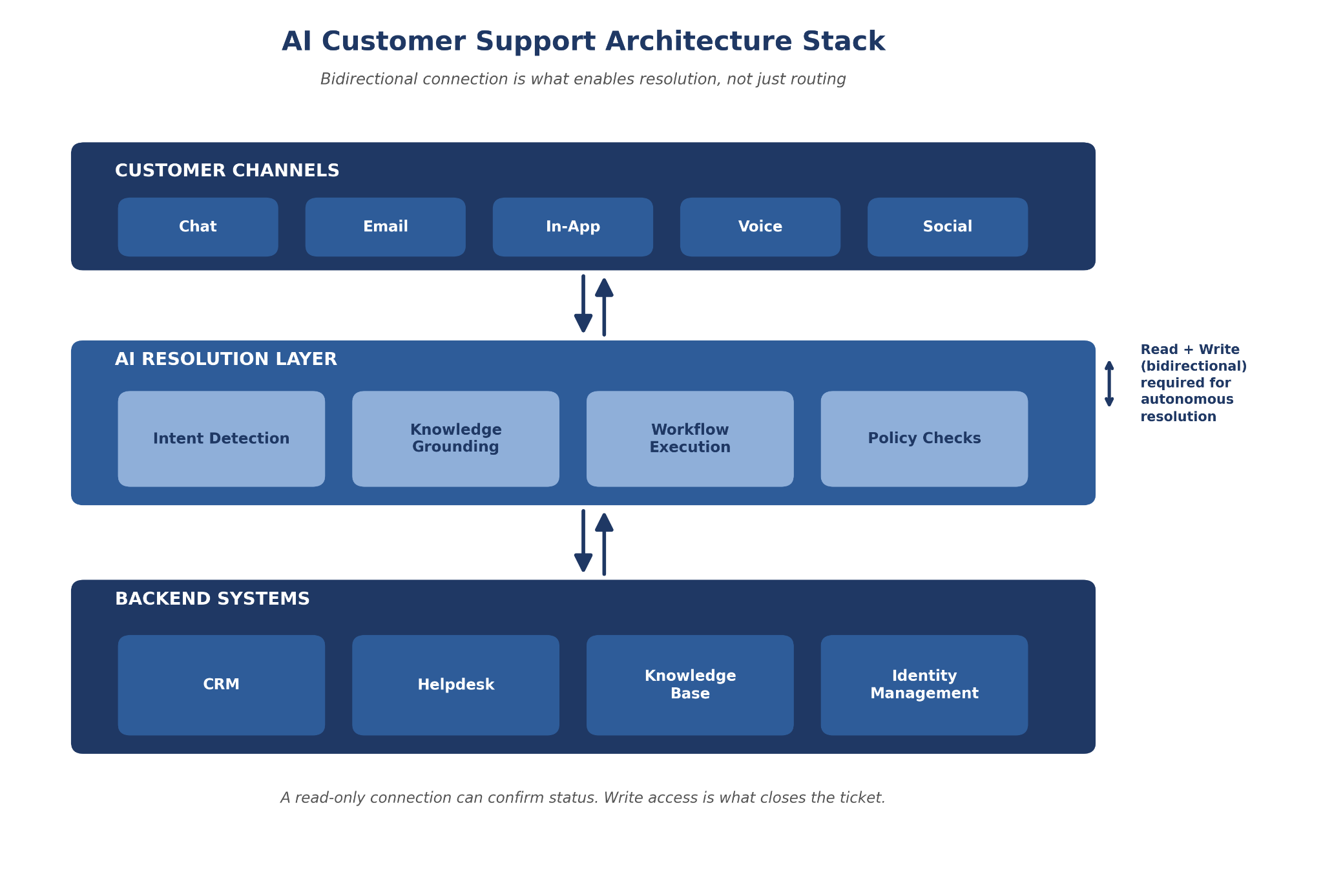
AI can only resolve issues reliably when it connects to the systems that hold the information and authority to close them. A standalone AI layer that answers questions but can't update a record or trigger a workflow is a sophisticated FAQ, not a resolution engine.
The stack has three layers. Customer channels sit at the top: chat, email, in-app messaging, voice, and social. The AI resolution layer sits in the middle, handling intent detection, knowledge grounding, workflow execution, and policy checks. Backend systems sit at the base: CRM, helpdesk, knowledge base, and identity management. The AI layer must connect bidirectionally to all of them. That bidirectional access is what enables autonomous case resolution rather than simple routing.
Orchestration depth determines resolution quality. An AI that can read from your CRM but not write to it can confirm an account status but can't update it. The integration question isn't "does it connect to Salesforce?" It's "what actions can it complete inside Salesforce without a human in the loop?" That distinction separates resolution platforms from routing tools. The SaaS integration requirements post covers the full stack picture.
Knowledge-base governance is a structural responsibility, not a one-time setup task. According to USU, AI resolution quality degrades when the knowledge base is stale or unstructured. Treat it as a living operational asset with regular review cycles.
In regulated industries and under frameworks such as GDPR, compliance is an architectural input, not an afterthought. Data flows must be logged, AI decisions must be auditable, and encryption in transit and at rest is required for deployments involving personal customer data in those contexts.
How the human agent role changes in an AI-first support team
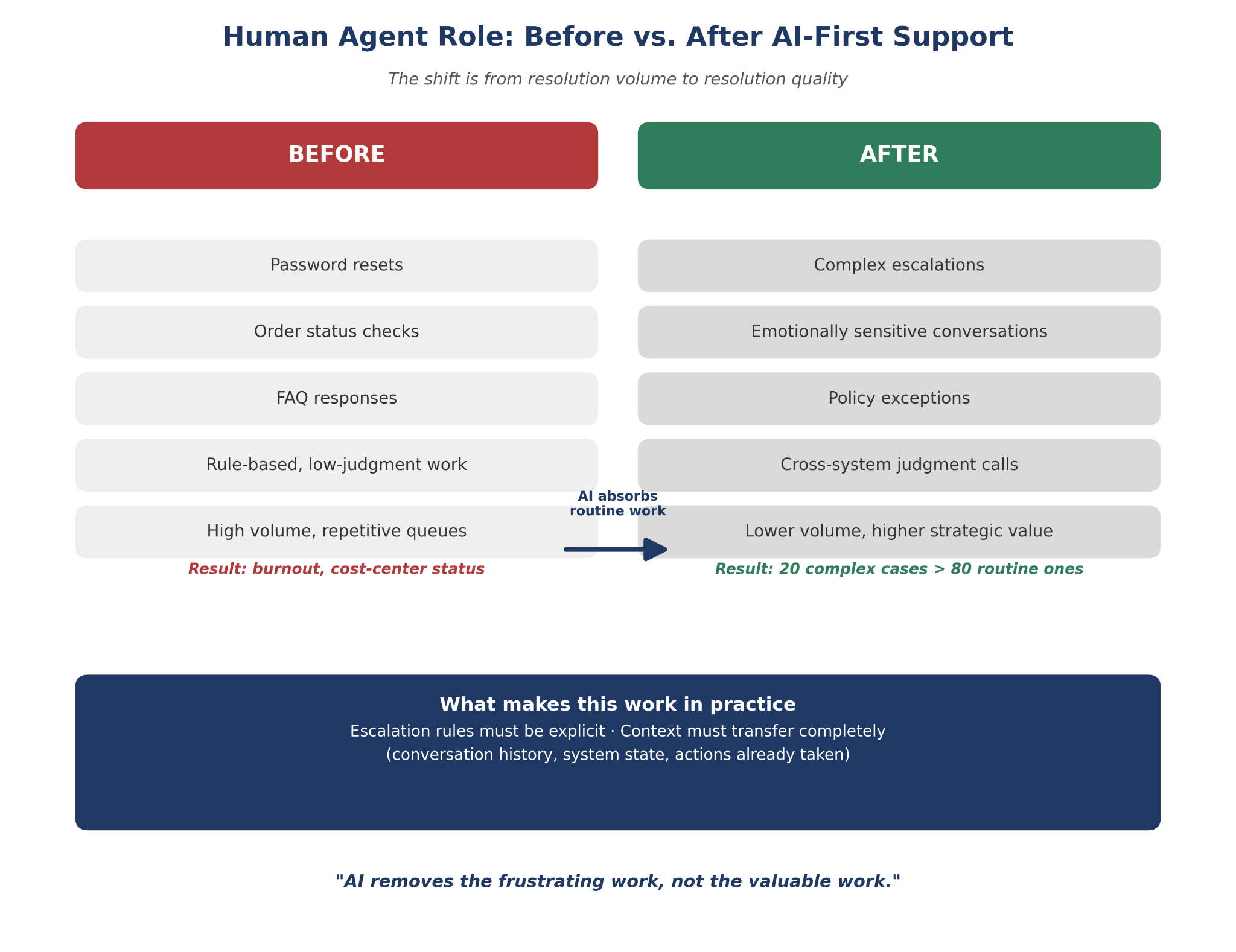
The before state is familiar: agents handle high-volume, repetitive queues covering password resets, order status checks, and FAQ responses. This work is rule-based, low-judgment, and time-consuming. It's also what burns out good agents and keeps support locked in cost-center status.
The after state is different in kind. When AI owns routine resolution, human agents handle complex escalations, emotionally sensitive conversations, policy exceptions, and cross-system judgment calls. The role shifts from resolution volume to resolution quality. An agent handling 20 complex cases per day delivers more strategic value than the same agent clearing 80 routine ones.
Escalation threshold design is where most deployments succeed or fail quietly. Escalation rules must be explicit: which intent categories trigger a handoff, which sentiment signals force human review, and which compliance-adjacent interactions require a human in the loop. Context must transfer completely, including the full conversation history, system state, and actions the AI has already taken. A handoff that drops context forces customers to repeat themselves and forces agents to reconstruct what happened. That friction drives poor CSAT scores in otherwise well-designed deployments.
Change management risk during the first 90 days is real. Forrester identifies staff resistance as a documented deployment risk. Framing matters: "AI removes the frustrating work, not the valuable work" is the narrative that reduces resistance. Agents who understand that AI is clearing the password-reset queue so they can focus on cases requiring genuine expertise are more likely to adopt the new model.
arsuno.ai has launched 30+ AI systems and retained 10+ long-term partners for two or more years. That retention reflects what happens when the staffing transition is managed as an ongoing partnership, not a one-time deployment.
Measuring what matters: a 90-day performance framework
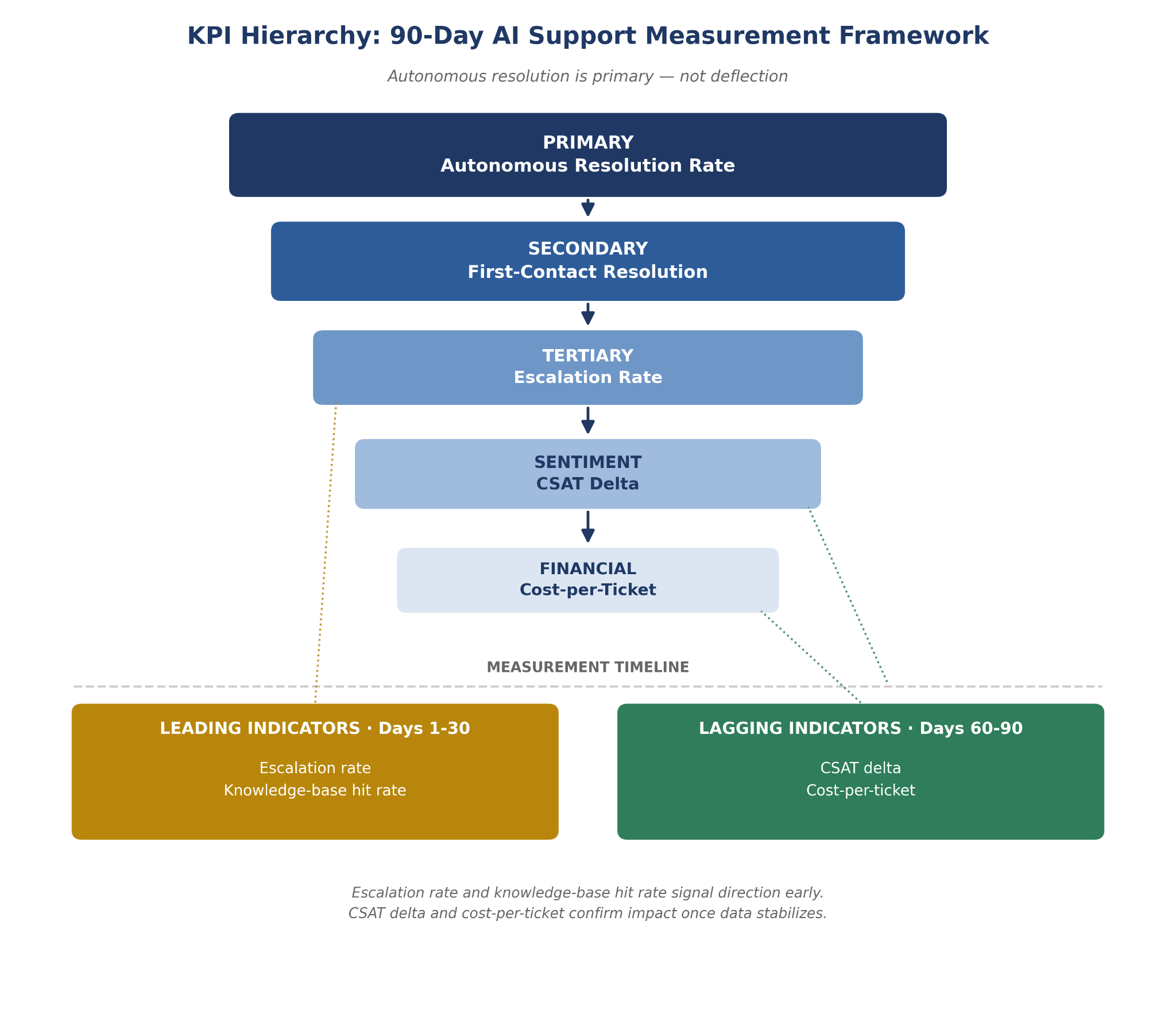
The primary metric is autonomous resolution rate: the percentage of support interactions closed by AI without human intervention, measured at ticket closure, not at deflection. This is what distinguishes work removal from work rerouting. If your autonomous resolution rate is flat while deflection climbs, you're containing interactions, not resolving them.
The KPI hierarchy builds from there. Autonomous resolution rate is primary. First-contact resolution is secondary: it captures whether issues are solved in a single interaction regardless of channel. Escalation rate is tertiary: a rising escalation rate in the first 30 days usually signals knowledge-base gaps or misconfigured intent detection, not a fundamental deployment failure. CSAT delta measures sentiment change against your pre-deployment baseline. Cost-per-ticket is the financial layer.
The leading indicators that matter most in the first 90 days are escalation rate and knowledge-base hit rate. These are the earliest signals of whether the AI is resolving issues or routing them. CSAT delta and cost-per-ticket require 60-90 days of data to be meaningful. Don't let a vendor use week-two CSAT numbers as proof of success.
On ROI timelines: many businesses report positive returns within 12 months, but timelines vary by deployment complexity, data readiness, and integration depth. G2 research provides useful adoption benchmarks for framing realistic expectations in a board presentation. Qualify any 12-month figure by your specific deployment scope.
A deployment showing clean escalation rate trends and improving knowledge-base hit rates by week four is on track, even before CSAT data is statistically meaningful.
Four questions to ask any AI support vendor before you commit
Most demos show deflection metrics and call them resolution metrics. These four questions are designed to surface that gap before you commit budget.
1. What is your measured autonomous resolution rate in deployments like mine?
This separates vendors with real outcome data from those with only deflection numbers. The answer should be a specific percentage from a comparable deployment: similar industry, similar ticket volume, similar integration complexity. If a vendor responds with a containment rate or a deflection rate, they haven't answered the question. No deployment-specific resolution data means they're offering containment, not resolution.
2. Does your system reduce ticket volume, or redirect it?
Genuine work removal shows as a decline in total ticket intake over time. Work rerouting shows as a channel shift: fewer tickets in one queue, more in another, with total volume unchanged. Ask for a before-and-after total ticket volume chart from a comparable deployment, not a channel-specific deflection graph. That single data distinction tells you whether a vendor removes work or just moves it.
3. What does your escalation logic look like at six months?
Early deployments often have simple escalation rules. The real test is how the system handles edge cases, ambiguous intents, and compliance-sensitive interactions after the initial configuration is complete. A vendor with a mature escalation framework can describe the specific triggers, handoff conditions, and context-transfer protocols they use in live deployments. A vendor without one will describe their routing logic and call it escalation.
4. Can you show me knowledge-base governance in a live deployment?
Resolution quality depends on the freshness and structure of the knowledge base the AI draws from. Ask to see how a current customer manages knowledge-base updates, flags stale content, and measures knowledge hit rate over time. HubSpot's support automation research confirms that knowledge quality is a primary driver of resolution accuracy. A vendor who treats knowledge-base governance as a customer responsibility without tooling or process support is transferring deployment risk onto your team.
Frequently Asked Questions
How do I know if an AI support deployment is actually resolving issues?
Look at autonomous resolution rate, not deflection or containment rate.
Autonomous resolution means the AI closed the ticket end to end with no human intervention and the issue is verifiably solved.
Containment only confirms the customer stayed in the AI channel: they may have abandoned the conversation or contacted support again later.
Ask vendors to separate these figures before accepting any headline deflection number.
What is the difference between deflection and resolution in AI customer support?
Deflection measures whether a customer avoided a human agent; resolution measures whether their issue was actually solved.
A high deflection rate can mask low resolution quality if customers are abandoning conversations rather than getting answers.
The metric that proves genuine work removal is autonomous resolution rate, tracked at ticket closure.
Always ask vendors which of these figures their reported numbers represent.
How should I structure vendor evaluation for an AI support platform?
Start by asking for autonomous resolution rate data from deployments comparable to yours in industry and ticket volume.
Request a before-and-after total ticket volume chart, not a channel-specific deflection graph.
Ask how escalation logic is configured at six months, and how knowledge-base governance is maintained in live deployments.
These questions surface the gap between vendors with real outcome data and those measuring containment.
How does AI affect human agent workload in a support team?
AI takes ownership of high-volume, rule-based work such as password resets, order status checks, and FAQ responses.
Human agents shift toward complex escalations, emotionally sensitive conversations, and policy exceptions.
The role changes from resolution volume to resolution quality, which typically means fewer cases handled but higher strategic value per case.
Escalation design and context transfer are the operational details that determine whether this shift works in practice.
What does a 90-day AI support measurement framework look like?
Track autonomous resolution rate and escalation rate in the first 30 days: these are the earliest signals of whether the system is resolving or routing.
Knowledge-base hit rate is a useful leading indicator in the first month.
CSAT delta and cost-per-ticket require 60-90 days of data before they are statistically meaningful.
Do not allow a vendor to use week-two satisfaction scores as proof of deployment success.
What integration depth does an AI support layer require to resolve tickets?
The AI layer needs bidirectional access to the CRM, helpdesk, knowledge base, and identity management systems.
Read access alone allows the AI to confirm information but not complete actions: write access is what enables genuine resolution.
Orchestration depth determines whether the system can close tickets or only route them.
Before any deployment, map the specific actions the AI must complete in each connected system and confirm the integration supports them.
What compliance considerations apply to AI customer support deployments?
Under frameworks such as GDPR, deployments involving personal customer data require logged data flows, auditable AI decisions, and encryption in transit and at rest.
Compliance must be treated as an architectural input, not a post-deployment checklist item.
The integration design, data retention policies, and escalation logic all have compliance implications that need to be resolved before go-live.
Engage your legal and security teams during the architecture phase, not after the vendor contract is signed.