
Key takeaways
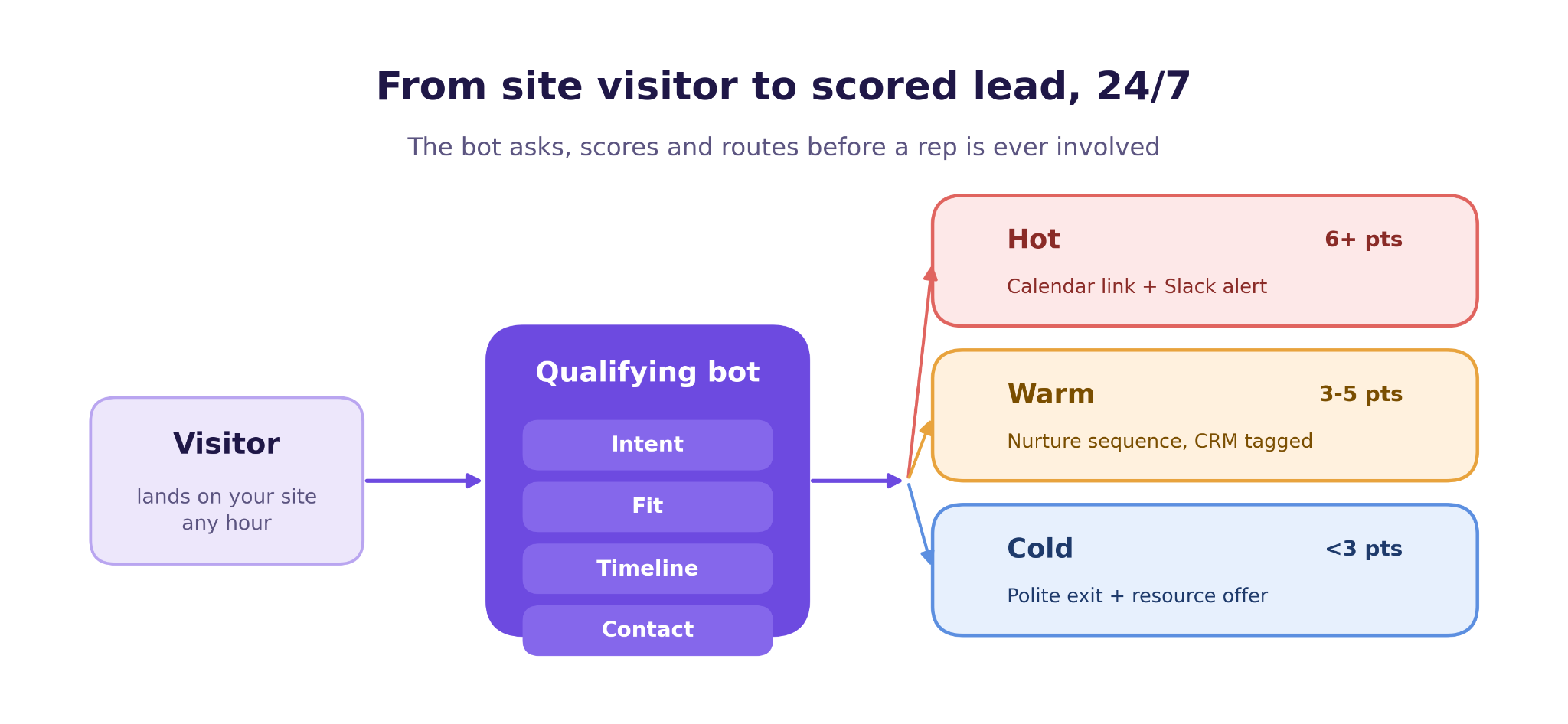
A lead generation chatbot qualifies prospects by scoring branching answers, not just collecting contact details. Ask intent first, then fit, then timeline, then request contact details: 3-5 questions total. Score each answer: hot leads (6+ points) get a calendar link, warm leads enter nurture, cold leads exit politely. Qualification complexity, not budget, determines whether to build custom or use a platform.
Why your current setup is leaking qualified leads
A prospect visits your site at 11 PM on a Sunday. They read your pricing page, scroll through your services, and leave without a trace. No form filled. No chat initiated. No pipeline signal of any kind. That visit is gone, and you have no way to recover it.
The problem is not that the visitor was uninterested. The problem is that nothing on your site was built to intercept them, ask the right questions, and separate a real buyer from a casual browser. Without a qualification mechanism running around the clock, every off-hours visit produces zero usable data.
A contact form does not solve this. It captures an email address, but it cannot tell you whether the person has a real budget, a relevant use case, or a timeline that matches your sales cycle. A ready-to-buy decision-maker and a student doing research land in the same inbox with no priority signal. Your sales rep then spends time following up on leads that should never have reached them.
The competitor who responds first often wins the callback. That gap between a Sunday-night visit and a Monday-morning reply is wide enough for a rival to book the meeting. Automated prospect qualification closes that gap by running the first conversation for you, at any hour, without a rep involved.
The qualification conversation: what your bot actually asks
Question order determines whether your bot qualifies or interrogates. Ask for name and email first and visitors drop off before you learn anything useful. Ask about intent and fit first, and you collect the signals that matter before requesting contact details.
As the Spur qualification guide describes, a well-designed flow opens with a broad intent question, narrows to use-case fit, then timeline, and only then requests contact details. The Hyperleap playbook reinforces this: 3-5 questions is the practical norm, with each branching from the answer before it.
That branching is what separates a qualifying bot from a survey:
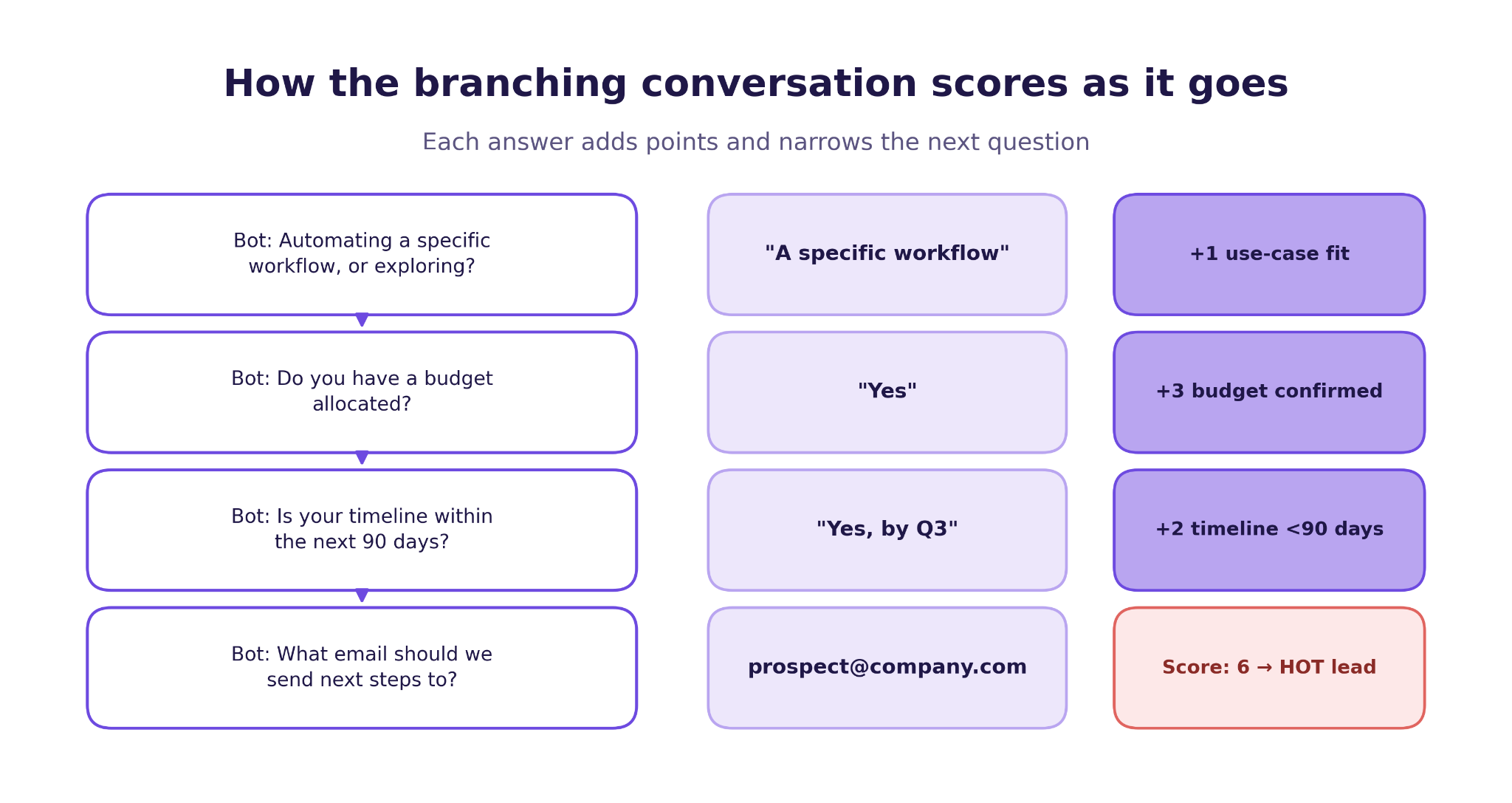
Bot: Are you looking to automate a specific workflow, or still exploring options?
Visitor: A specific workflow.
Bot: Do you have a budget allocated?
Visitor: Yes. Bot: Is your timeline within the next 90 days?
Visitor: Yes, we need this by Q3.
Bot: Last step: what email should we send next steps to?
A "still exploring" answer at step one routes the visitor to a nurture path with a useful resource, creating a warm record for follow-up when their timeline shifts.
How to score chatbot answers and route each lead
Every answer your bot receives should carry a point value. That is how a conversation becomes a routing decision rather than a data dump.
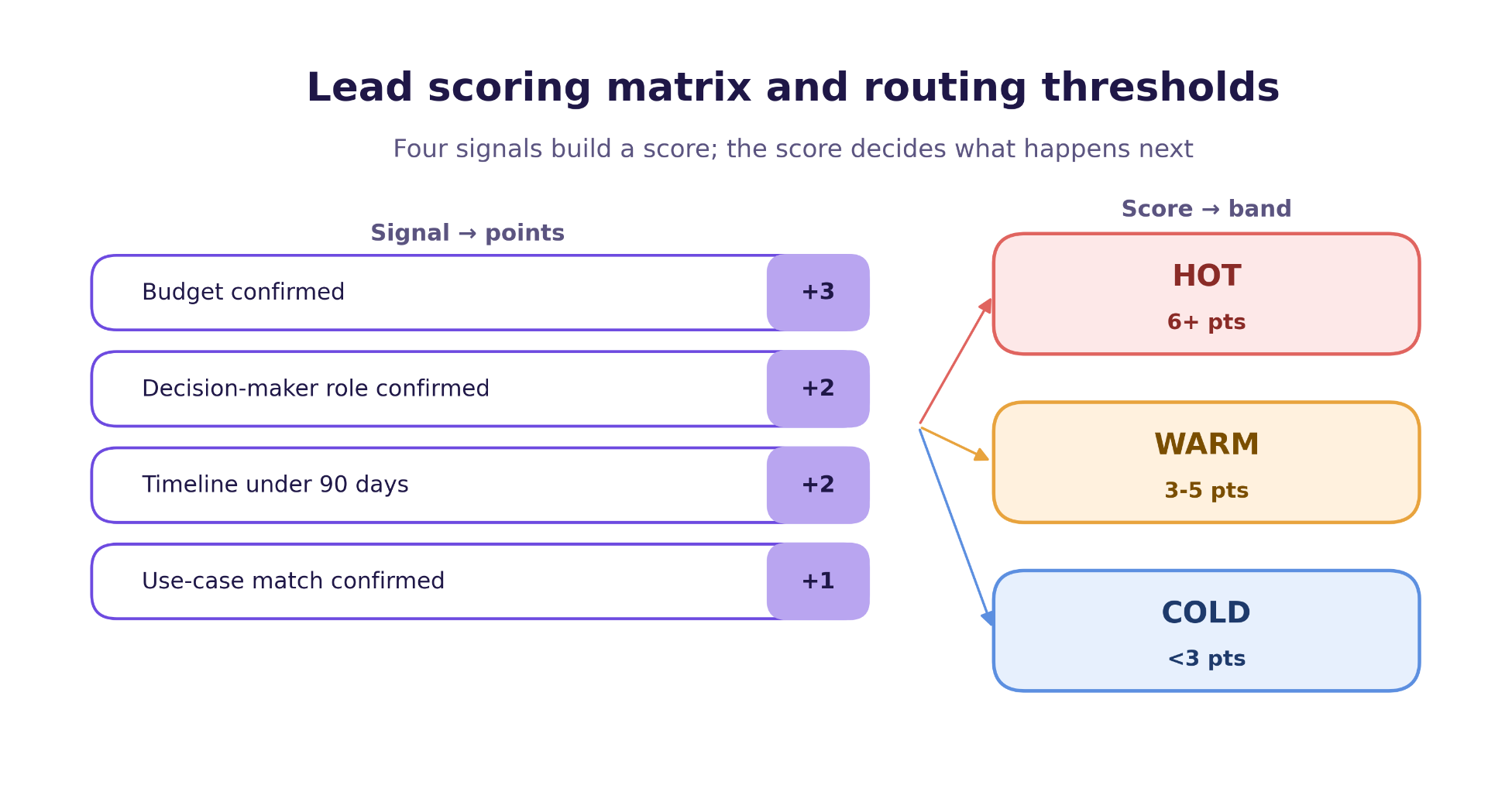
Here is an illustrative scoring model you can adapt, drawing on the point-based threshold approach described by Chatonbo's qualification guide:
Thresholds: 6 or more points = hot lead. 3-5 points = warm lead. Under 3 points = cold lead.
Each band maps to a specific action, covered in the next section. Treat this as a starting model, not a universal prescription. BANT (budget, authority, need, timeline) is a useful framework to build from, but your actual deal criteria will differ. A healthcare clinic asking about patient intake automation needs different fit signals than a SaaS founder asking about CRM automation. Map your own ICP criteria to the scoring variables rather than copying a generic template.
What happens after the bot scores a lead
Scoring a lead is only useful if the routing outcome is concrete. Here is what each band should trigger.
A hot lead (6 or more points) gets an instant calendar booking link inside the chat window. The bot fires a Slack or email alert to the founder with scored answers attached. As Salesforce's chatbot guide notes, CRM field mapping at this stage pre-populates the lead record before the first human conversation. The rep walks into the call already knowing budget, role, and timeline.
A warm lead (3-5 points) enters an automated nurture sequence with qualification answers stored as CRM field data. A rep can review and accelerate or let the sequence run. No manual sorting required.
A cold lead (under 3 points) receives a polite exit message with an optional resource offer. No rep time is spent, and the record is preserved for re-engagement. For healthcare use cases involving EU residents or US protected health information, GDPR- and HIPAA-compliant architecture may be required. Confirm compliance scope with your legal team before deployment.
Chatbot vs a contact form: the functional difference
A contact form collects all fields simultaneously. Every visitor sees the same fields regardless of whether they are a ready-to-buy decision-maker or someone who found your site by accident. There is no branching logic, no early disqualification, and no way to separate high-fit buyers from casual browsers before their details reach your inbox. As Featurebase's qualification guide explains, static capture defers qualification entirely to a human, meaning rep time gets spent on leads that should never have been passed.
A qualifying bot adapts every subsequent question based on the previous answer. It can disqualify a visitor before contact details are ever captured, routing them to a resource instead of a sales rep. That is not a UI improvement: it is a different mechanism for making a qualification decision, resulting in a cleaner pipeline with structured data attached to every lead that does get through.
Forms are not obsolete. For low-complexity submissions like newsletter sign-ups or simple quote requests, a form remains the right tool. The chatbot wins when qualification depth matters and routing the wrong lead to a rep carries a real cost.
When to use a platform and when to build custom
The build-vs-buy decision is not primarily about budget. It is about whether the platform's branching limits will force you to simplify your qualification criteria. Simplifying those criteria defeats the purpose of building a qualifying bot in the first place.
Simple linear flows work well on no-code platforms. If your logic runs 3-5 generic questions and requires basic CRM sync with no compliance requirements, a no-code builder is fast to launch. It is also manageable without engineering support. Typebot's AI qualification guide is a useful reference for what no-code tooling handles well at this level.
Multi-branch ICP-specific flows are a different situation. If your logic requires custom scoring rules, deep CRM or calendar integration, or domain-trained responses, pre-built connectors will hit their limits. Compliance requirements like GDPR or HIPAA accelerate that ceiling further. You will either simplify your criteria to fit the platform, or build workarounds that break over time. The full chatbot development cost custom build vs breakdown covers when a custom flow pays for itself, including realistic timelines and integration costs.
The decision hinge is qualification complexity, not sticker price. A platform that forces generic questions is not cheaper than a custom build: it is just a more expensive contact form.
Frequently Asked Questions
What qualification questions should a lead generation chatbot ask first?
Start with intent, then move to fit, then timeline, and only then ask for contact details. According to Hyperleap's qualification guide, 3-5 questions is the practical norm supported across multiple practitioner sources. The first question should be broad enough to match different visitor intents. Later questions branch from earlier answers to keep the flow short for visitors who are already an obvious fit.
How should chatbot answers translate into lead-scoring thresholds?
Assign point values to the signals that matter most in your sales motion: budget confirmation, decision-maker role, timeline urgency, and use-case fit. As Conferbot's qualification guide describes, each score band should map to a concrete action: a calendar link for high scorers, a nurture sequence for mid-range leads, and a polite exit for low-fit visitors. Keep the model simple enough to update thresholds without.
When should a chatbot hand off a lead to sales?
It depends on the task, the tools already in place, and how much should stay with a person. Start with one clear job that has a known input and a known output. Review the result before you widen the setup.
Should I build or buy a lead generation chatbot?
It depends on the task, the tools already in place, and how much should stay with a person. Start with one clear job that has a known input and a known output. Review the result before you widen the setup.
How does a lead generation chatbot work?
It depends on the task, the tools already in place, and how much should stay with a person. Start with one clear job that has a known input and a known output. Review the result before you widen the setup.
Is a lead generation chatbot better than a contact form?
It depends on the task, the tools already in place, and how much should stay with a person. Start with one clear job that has a known input and a known output. Review the result before you widen the setup.
What questions should a lead generation chatbot ask for B2B?
It depends on the task, the tools already in place, and how much should stay with a person. Start with one clear job that has a known input and a known output. Review the result before you widen the setup.
.webp)