

Key takeaways
- AI clinical documentation for small practices follows six steps: consent, ambient capture, transcription, draft generation, clinician review, and filing. Skipping review creates medico-legal risk.
- Audio, transcript, and final note are three separate data types with potentially different retention obligations: verify all three in writing before signing with any vendor.
- Build clinician review time into the workflow from day one. HIPAA and GDPR are distinct frameworks; confirm which applies and request written evidence from your vendor.
Why documentation burden is the right problem to solve first
Clinicians in small practices routinely spend a significant share of their working hours on documentation rather than patient care. For a practice of five to fifteen staff, that proportion represents a meaningful slice of clinical capacity sitting in note-writing rather than in the consultation room.
The scale of the problem is visible even in larger settings. A review reports that Kaiser Permanente's deployment enabled thousands of physicians to use ambient AI documentation across hundreds of thousands of encounters in its first 10 weeks. A majority of users reported reduced burnout, according to published research. The specific numbers belong to a health system most small practices will never match. However, the underlying dynamic is identical: clinicians spending time on administrative tasks at the direct expense of patient-facing work.
For a small practice, the calculation is straightforward. Every hour a clinician spends on notes is an hour not spent with patients. The alternative is usually another administrative hire, which does not reduce the documentation burden on the clinician. It simply shifts other tasks while the note-writing stays exactly where it is.
Documentation burden also compounds adjacent problems. If you are already dealing with delays in pre-visit paperwork, the documentation backlog from the consultation itself adds a second layer of friction to the same patient journey. That is why documentation is the right place to start.
How voice becomes a structured clinical record, step by step
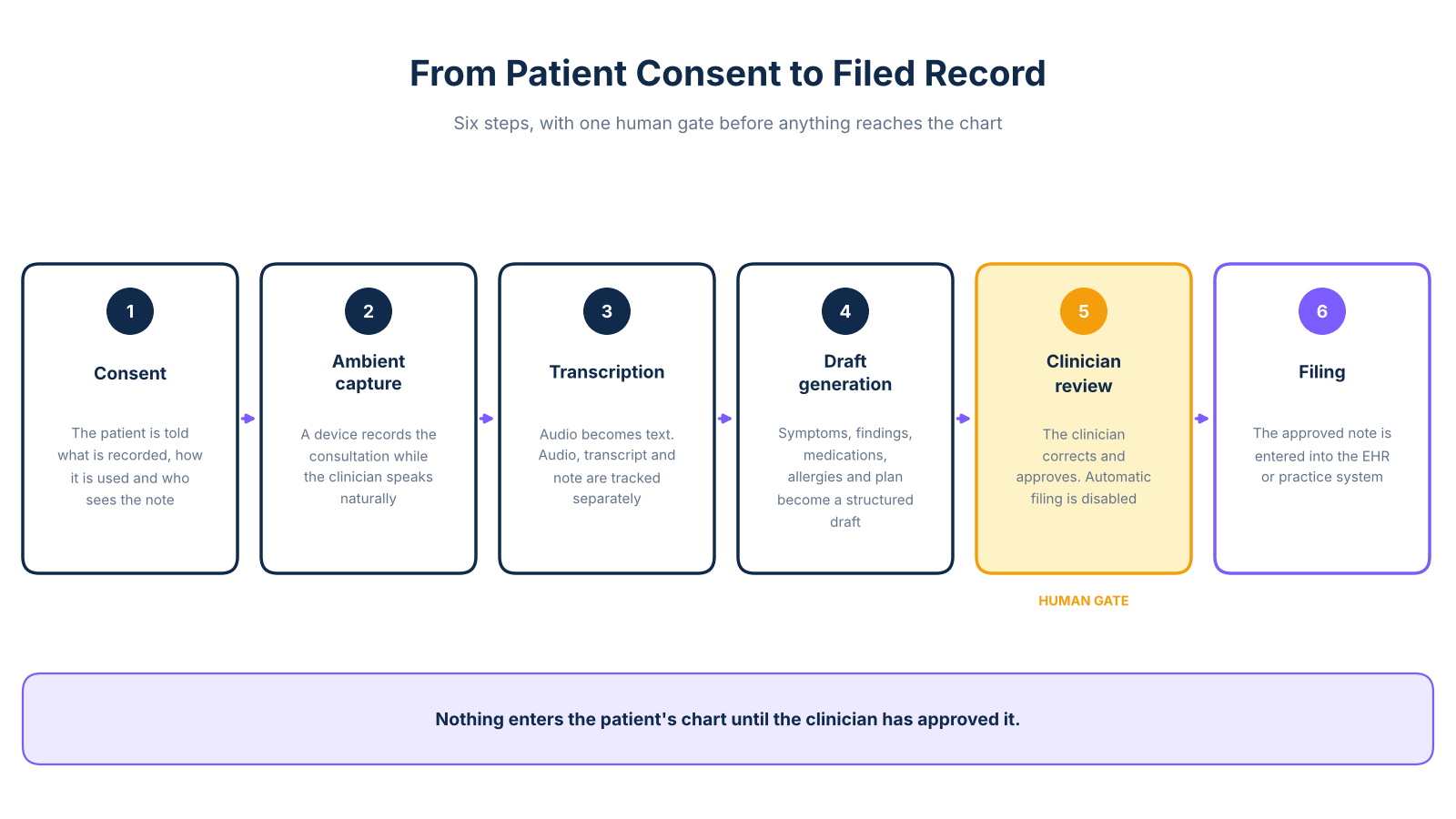
An AI scribe for small practice settings does not require a dedicated recording suite or a post-visit dictation session. The workflow runs alongside a normal consultation, with the clinician speaking naturally and the system handling conversion in the background.
1. Consent
Before the session begins, the clinician or a staff member informs the patient that the consultation will be captured, explains the purpose, and documents the process. The patient is told what will be recorded, how it will be used, and who will have access to the resulting note. The practice also needs a clear process for when a patient declines. Consent obligations vary by jurisdiction, so confirm the applicable recording and privacy rules for your location before going live.
2. Ambient capture
A device or application records the spoken consultation. Unlike dictation, the clinician speaks naturally, no additional documentation time is required during the session itself.
3. Transcription
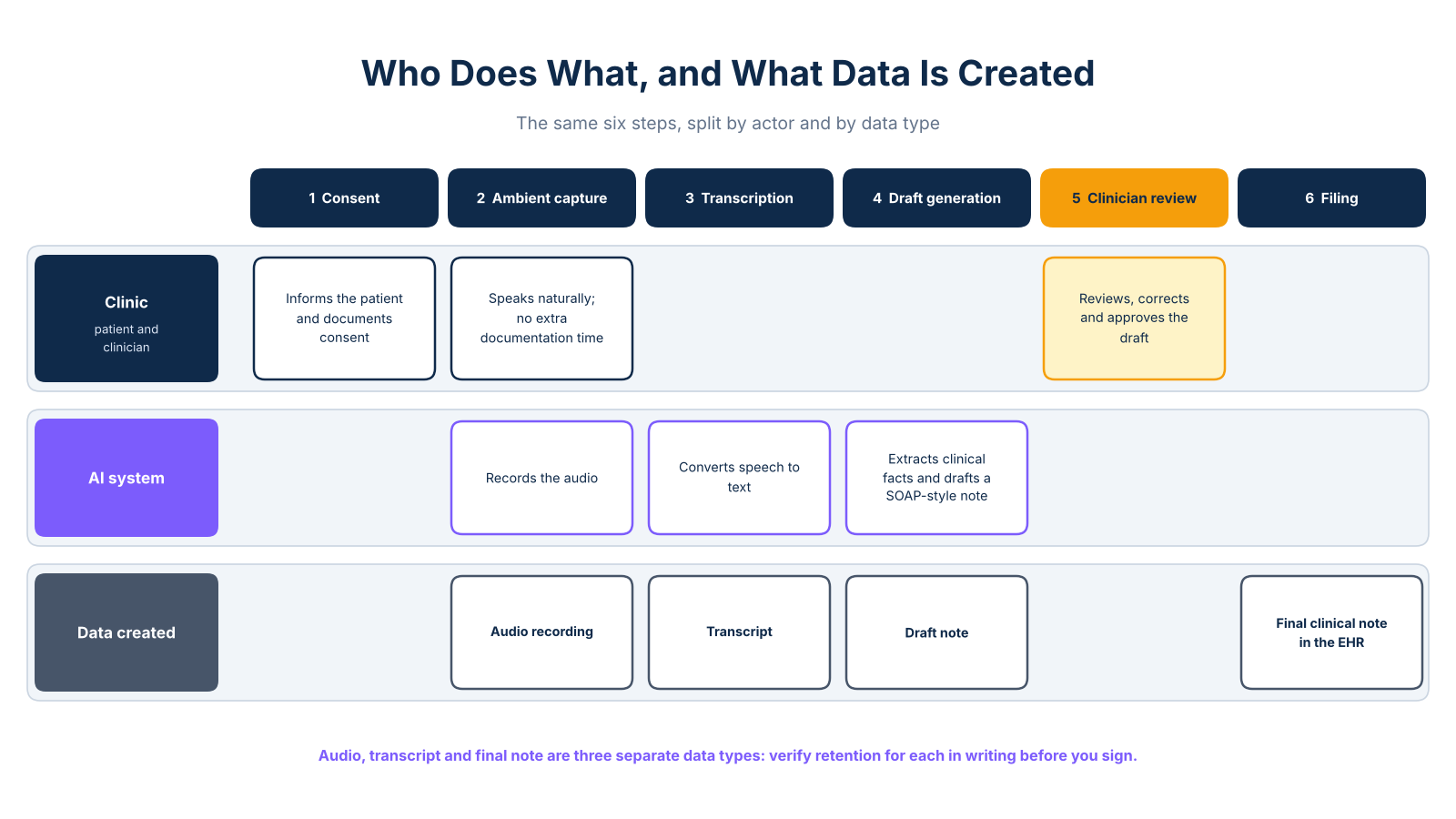
The audio is converted to text, producing three distinct outputs: the audio file, the transcript, and the final clinical note. Each may carry different retention, deletion, and access obligations. Treat them separately from the start, and verify with your vendor how each is stored and for how long.
4. Clinical fact extraction and summary generation
The system identifies symptoms, findings, diagnoses, medications, allergies, assessment, and plan, then organizes those elements into a structured draft, typically in SOAP format or a specialty-specific equivalent. This is similar to how structured data is pulled from unstructured documents, as described in this guide to automated document processing.
5. Clinician review
The draft is returned to the clinician for review, correction, and approval. Nothing enters the patient's chart until the clinician has approved it. Confirm with your vendor that automatic filing is disabled.
6. Filing
The approved note is entered into the EHR or practice-management system. Voice-to-record conversion is complete only at this point.
Cleveland Clinic documented this sequence when it deployed an ambient AI documentation system across its ambulatory care network, reaching more than 4,000 clinicians within four months, as described in published research. The same six steps, review requirement, and data-separation principles apply whether you have 10 staff or 10,000.
The clinician review step: why it is non-negotiable
The generated draft is a starting point, not a finished record. APA guidance states explicitly that providers must review and edit AI-generated notes before they enter the clinical record. That requirement is not a formality. The clinician holds professional responsibility for what the record says and, in most jurisdictions, bears primary legal accountability for the accuracy of signed documentation.
Published research shows that clinicians regularly revise AI-generated drafts before signing. The value of clinical note automation is reducing drafting effort, not transferring responsibility to an algorithm. A human-centered evaluation of clinician editing behavior also identifies a documented risk: AI-generated drafts can produce records that are longer but not more useful. Review standards should therefore prevent unnecessary detail, duplicated history, and unsupported narrative from entering the record.
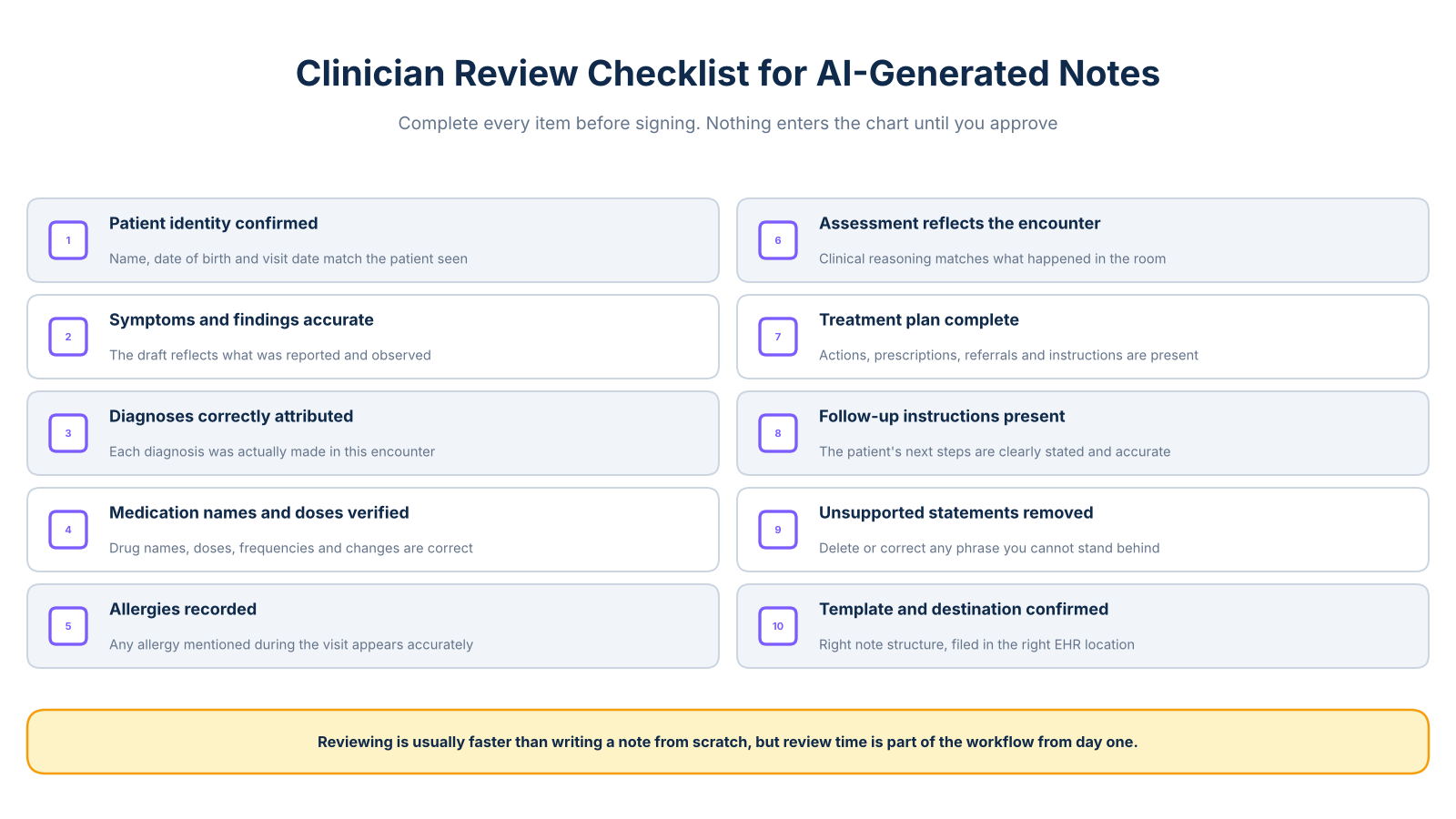
The following checklist can serve as a standing protocol for clinician review of AI-generated medical notes.
- Patient identity confirmed: name, date of birth, and visit date match the patient seen.
- Symptoms and findings accurately captured: the draft reflects what the patient reported and what the clinician observed, without omissions or additions.
- Diagnoses correctly attributed: each diagnosis was actually made during this encounter.
- Medication names and doses verified: drug names, doses, frequencies, and any changes are correct and complete.
- Allergies recorded: any allergy information mentioned during the visit appears accurately.
- Assessment reflects the encounter: clinical reasoning is consistent with what happened in the room.
- Treatment plan complete: all agreed actions, prescriptions, referrals, and instructions are present.
- Follow-up instructions present: the patient's next steps are clearly stated and accurate.
- Unsupported or ambiguous statements removed: any phrase the clinician cannot stand behind is deleted or corrected before signing.
- Correct template and destination confirmed: the note structure matches the visit type and will be filed in the right EHR location.
Working through this checklist is faster than composing a note from scratch for most encounter types, though review time varies by clinician and visit complexity. Either way, that time is part of the workflow. Build it in from day one.
What patient data privacy actually requires you to verify
Patient data privacy obligations are not satisfied by a vendor's marketing label. Compliance depends on your practice, your vendor's contracts, your jurisdiction, and the specific configuration of the system you deploy. The phrase "HIPAA compliant" on a product page tells you almost nothing on its own.
HIPAA applies in the USA to covered entities and business associates handling protected health information. The EU operates under GDPR; the UK has its own UK GDPR and Data Protection Act regime. Switzerland follows the Swiss Federal Act on Data Protection; Germany falls under EU GDPR. These are distinct frameworks with meaningfully different obligations. Confirm which applies to your practice before evaluating any vendor.
For the data itself, distinguish three separate outputs: the audio recording, the transcript, and the final clinical note. Each may carry different retention, deletion, and access obligations depending on your jurisdiction and how your vendor classifies them. Do not assume that a vendor's audio-deletion policy automatically covers transcripts or draft notes.
When evaluating a vendor, request written answers to the following:
- Encryption in transit and at rest for all three data types
- Retention periods for audio and transcripts after note generation, and whether deletion follows a defined schedule
- Whether patient data is used to train AI models or shared with third parties, and request a written restriction if it is not
- Where data is hosted and whether it crosses international borders
Also request a Business Associate Agreement where HIPAA applies, or a data processing agreement under Article 28 where GDPR applies. Ask for documentation of access controls, audit logs, and the deletion process at contract end.
Detailed vendor due diligence guidance and consent and privacy considerations for AI scribes are available from credible sources and are worth reviewing before you sign anything. Compliance is a verification task, not a product feature. Request the evidence in writing and, where appropriate, seek legal or privacy advice specific to your jurisdiction.
Connecting AI documentation to your existing systems
Structured voice-to-record workflows do not require replacing your current EHR. For most small practices, the goal is to add a drafting step that connects to the system you already use, without rebuilding anything else.
Three connection types are typical. First, direct API integration: the AI system writes the approved note directly into the EHR via a supported interface. This is typically the most efficient connection and, when logging is configured correctly, the most straightforward to audit. Second, review within a separate interface: the clinician reviews and approves the draft in the AI system's own interface, then transfers the finalized note to the EHR. Third, governed copy-and-paste: the clinician copies the approved draft and pastes it into the EHR manually. This approach is the most common in small practices using EHRs without API support, but it carries the highest risk of transcription error and requires clear governance to ensure only approved notes are transferred.
Before going live, confirm several things with your current EHR vendor. Ask whether the system supports API write-back from third-party tools, and if so, what authentication and permission model applies. Ask whether drafts can enter the chart automatically without clinician action, and if so, how to disable that behavior. Ask what audit trail the EHR maintains for notes created via API or manual entry.
For practices managing the broader clinic workflow, the documentation step fits into a larger pattern of clinic automation that connects intake, consultation, and administrative tasks without replacing existing systems. The principle is the same: add structured automation at the points of highest friction, verify that the connections are auditable, and confirm that nothing moves forward without a human approval step.
Running a low-risk pilot before you commit
A pilot covering two to four clinicians and a defined set of visit types is the right starting point. It gives you real data on workflow fit, review quality, and operational issues before you commit to wider adoption.
Define the pilot parameters clearly before you start. Select clinicians who are willing to test the workflow and represent a range of visit types. Choose predictable visit structures, follow-up appointments or routine assessments, rather than complex new-patient encounters. Set a duration of four to six weeks: long enough to generate meaningful data, short enough to adjust quickly if problems emerge.
Establish a consent script that staff can deliver consistently before each session. Train all participating clinicians on the review checklist before the pilot begins. Assign one person as the accountable owner, responsible for logging issues, collecting metrics, and reviewing results.
Measure four things during the pilot:
- Time per note: How long does it take the clinician to review, correct, and approve the draft compared to their previous method?
- Chart closure rate: Are notes filed within the expected timeframe, or is the review step creating a backlog?
- Clinician editing volume: How many corrections does each clinician make per note, and are they concentrated in specific sections?
- Operational issues: What problems arise with consent, recording, EHR transfer, or staff responsibilities, and how are they resolved?
Review those metrics before expanding. If review time is longer than expected, investigate whether draft quality or the checklist needs adjustment. If editing volume is high in a specific section, medication details or follow-up instructions, address that with your vendor before going further.
A psychiatry clinic that arsuno.ai worked with achieved a significant reduction in manual work and automation efficiency gains after implementing a structured documentation workflow. That result came from a deliberate process, not from deploying a tool and hoping for the best. The pilot phase was central to identifying where the workflow needed adjustment before practice-wide rollout.
Frequently Asked Questions
How does AI clinical documentation work for small practices?
AI documentation for small practices follows a defined sequence: the clinician and patient consent to ambient capture, the consultation is recorded, the audio is converted to a transcript, and the system extracts clinical facts to generate a structured draft note. The clinician then reviews, corrects, and approves the draft before it enters the EHR. The generated document is a draft at every stage before approval, not an automatically finalized record.
How do AI scribes create structured clinical notes?
The system uses speech recognition to convert the spoken consultation into a transcript, then applies natural language processing to identify symptoms, findings, diagnoses, medication details, allergies, assessment, and treatment plan. Those elements are organized into a structured format, typically SOAP or a specialty-specific equivalent, depending on the product configuration.
Does AI clinical documentation require patient consent?
Consent or another legally sufficient notice and authorization process may be required, depending on your jurisdiction and deployment. In some U.S. states, recording laws require all-party consent before a conversation is captured. Under GDPR and UK GDPR, processing may rely on different legal bases, but transparency obligations still apply.
Is AI clinical documentation HIPAA compliant?
Compliance depends on the practice, the vendor's contracts, the applicable configuration, and the contractual safeguards in place, not on a product label. Where HIPAA applies, the vendor must sign a Business Associate Agreement covering protected health information. You should also verify encryption in transit and at rest, access controls, audit logging, retention and deletion schedules, and whether patient data is used for model training.
Does a clinician review AI-generated clinical notes before filing?
Yes, and this step is a professional standard strongly supported by APA guidance. The clinician must review the draft for accuracy across every section, including patient identity, symptoms, diagnoses, medications, allergies, assessment, plan, and follow-up instructions. Any unsupported or ambiguous statement must be corrected or removed before the note is signed. The clinician signs or approves the note only after completing that review.
Does AI clinical documentation work with an existing EHR?
Yes, in most cases, though the connection type depends on your EHR's capabilities. Direct API integration allows the approved note to be written into the EHR automatically after clinician sign-off. Some practices use a separate review interface and transfer the finalized note manually. Governed copy-and-paste is also common where API support is unavailable, though it requires clear protocols to prevent errors.
What should a small practice ask an AI documentation vendor about data retention?
Ask how long audio recordings and transcripts are retained after the clinical note is generated, and whether they are deleted on a defined schedule.
Ask whether patient data, including audio, transcripts, draft notes, backups, and logs, is used for model training or shared with third parties.
Ask where data is hosted, whether it crosses international borders, and what transfer mechanisms are in place.