

Key takeaways
- Building the right ai tech stack for startups means adding tools in stage order, not all at once, start with one general-purpose AI assistant before anything else.
- Idea-stage stacks can run on roughly $60-$110 per month for a small team.
- The build vs buy decision belongs at the scale stage, not before.
- The most common premature purchase is a CRM adopted before the underlying sales process is defined.
Why stage matters more than tool choice
The most common mistake founders make when assembling an AI stack is treating it as a shopping list rather than a sequence. A five-person team at the idea stage and a 25-person team scaling outbound sales have almost nothing in common operationally. Yet most "best AI tools for startups" guides show them the same list. That mismatch is not a minor inconvenience. It is the root cause of low adoption, tool abandonment, and the creeping suspicion that AI is not actually useful for your business.
The cost of a poorly timed tool is not just the monthly subscription fee. It is also the onboarding hours your team spends learning a system that does not fit the current workflow, and the disruption to processes that were working well enough. That last cost is the hardest to recover from. The next time you introduce a new tool, the default response is skepticism.
So the right question is not "which tools are best?" It is "which tools belong in my stack right now?" The answer changes based on stage triggers, not headcount milestones. Adding a CRM when you have 12 employees does not automatically make sense. Adding one when your sales motion repeats reliably and someone owns follow-up does.
This article organizes recommendations around three distinct operating modes: idea, MVP, and scale. Each stage has a primary constraint the stack should solve. At the idea stage, that constraint is speed of thinking and validation. At the MVP stage, it shifts to execution and early user feedback. At the scale stage, it becomes operational volume and repeatability. As stack evolution research shows, AI stacks are increasingly replacing entire toolchains, which makes sequencing more consequential. Adding the right tool at the wrong stage does not just waste money. It locks in the wrong behavior at speed.
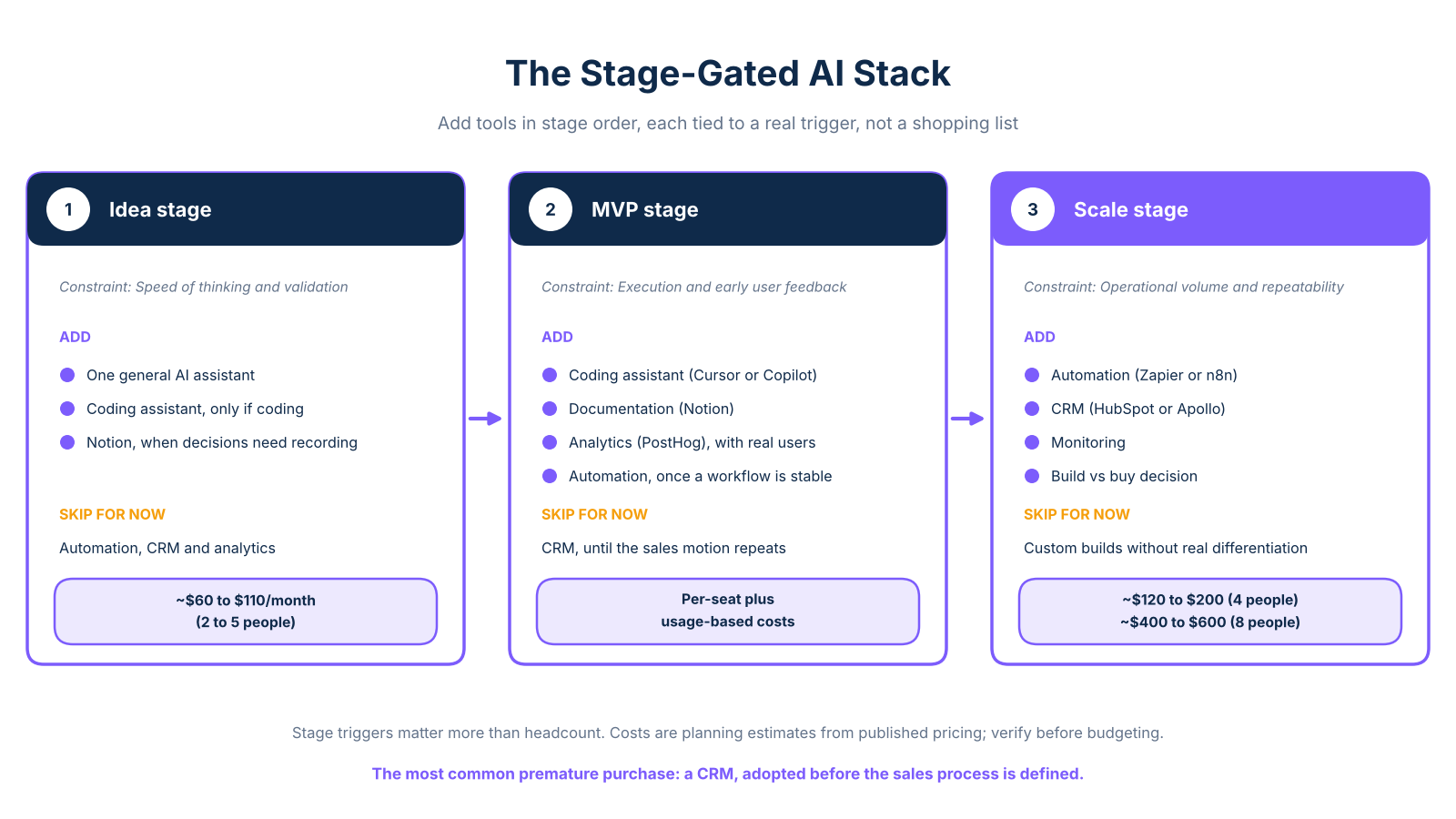
The stage-gated stack at a glance
Before walking through each stage in detail, the table below gives you the full framework in one view. All cost figures are current planning estimates based on published pricing from rework.com and the two-person team planning range from we.inc. Pricing changes frequently, and API usage, seat count, and automation volume can materially change your actual bill. For a fuller picture of how to calculate ROI against these costs, the ai automation roi post walks through the justification framework in detail.
The figures above are estimates tied to current plan pricing, which changes. Per-user subscriptions are straightforward to budget, but automation platforms and CRMs often carry usage-based charges that compound with volume. The three sections below walk through each stage in detail, covering what to add, what to skip, and why the timing matters.
Stage 1: what an idea-stage startup actually needs
At the idea stage, your primary constraint is speed of thinking, not operational volume. You are validating assumptions, synthesizing research, and drafting faster than competitors still doing it manually. The stack should solve exactly that, nothing else yet.
A general-purpose AI assistant earns its place immediately. ChatGPT Plus and Claude Pro each run at approximately $20 per user per month per OpenAI's and Anthropic's current pricing. Both cover research synthesis, drafting, ideation, and competitor analysis well enough that running both in parallel is redundant. Pick one, use it consistently, and only add the second if it offers something meaningfully different.
If your team is writing code, add a coding assistant. Cursor runs at approximately $20 per user per month per its published plans, verify before budgeting, as pricing has changed before. It earns its place the moment someone opens a code editor. If no one is writing code yet, skip it.
What to skip matters as much as what to add. Automation tools, CRMs, and product analytics platforms have no place here, there is no stable workflow to automate, no repeating sales motion to track, and no users to measure.
According to we.inc, a two-to-five person team using a lean early-stage stack can expect roughly $60-$110 per month in subscriptions, a useful planning floor, not a fixed budget.
Stage 2: building the MVP stack without over-engineering
When the team shifts from idea to MVP, the bottleneck changes. You are no longer validating assumptions, you are building, shipping to early users, and capturing signal. Stack additions should solve for building faster, documenting decisions, and measuring early behavior. They should not solve for operations that do not yet exist.
Coding assistance becomes essential for software teams. Cursor suits iterative development where the developer is actively shaping the codebase. GitHub Copilot starts at approximately $10 per user per month per GitHub's documentation and integrates naturally into existing GitHub workflows. The right choice depends on how your team already works.
Rapid app builders like Lovable and Bolt.new are useful for validation prototyping but should not automatically become production infrastructure. Before committing, check code ownership terms, security controls, deployment options, and maintainability. A prototype that cannot be handed off or scaled without a full rewrite is a demo, not a foundation.
Documentation is worth adding here. Notion's Business plan, which includes Notion AI, runs approximately $20 per user per month billed annually per its published pricing.
Product analytics belong at this stage only once you have real users. PostHog's free tier is a practical starting point, verify current event limits at PostHog's pricing page before relying on it for production workloads.
Avoid tools that require significant configuration and maintenance before you have the volume to justify them. The ai automation services scope timelines and pricing post covers these trade-offs in detail.
Stage 3: scaling the stack and the build vs buy decision
At the scale stage, the bottleneck shifts again. You are running a repeating operational machine and trying to make it faster, more consistent, and less dependent on individual contributors. This is where automation, CRM, and monitoring earn their place, and where the build vs buy question becomes genuinely consequential.
Automation earns its place when a recurring workflow runs at least weekly, has been stable for at least one month, and has a named owner who can define what "correct" looks like. Automating an unstable process speeds up the wrong behavior. Zapier handles most early automation needs well. n8n is worth considering when workflows become complex enough that a developer is already involved in maintaining them.
A CRM earns its place when the sales motion repeats reliably and someone owns follow-up. Before that point, it is a data-entry obligation, not a pipeline tool. HubSpot and Apollo are both reasonable choices, depending on whether the team's primary need is pipeline management or outbound prospecting.
The build vs buy question moves from theoretical to practical here. Buy commodity capabilities, and build only where differentiation is real and volume justifies the investment. The custom ai vs off the shelf post covers the decision criteria in detail. According to Groovy Web's build-vs-buy analysis, the honest comparison requires evaluating total ownership cost, implementation time, vendor dependence, reversibility, and data requirements together.
A four-person team at this stage can expect roughly $120-$200 per month for the off-the-shelf layer, based on current per-tool pricing per rework.com. An eight-person team with higher automation volume may see $400-$600 per month, excluding custom automation. Treat these as planning ranges, not fixed budgets.
What a real startup stack looks like across all three stages
The following is a planning illustration based on a stack we recommended to a B2B SaaS founder, presented as a generalized example rather than a named case study. Specific figures are planning estimates, not guaranteed outcomes.
Months one through three: ChatGPT Plus, Cursor, and Notion for a two-person team at roughly $60-$80/month per current published pricing. No automation, no CRM, no analytics beyond basic signup tracking. The constraint was intentional, validate the core use case before adding operational complexity.
Months four through nine: PostHog was added once real users arrived. A lightweight Zapier workflow eliminated a two-hour-per-week lead-routing task. The CRM question came up at month six; we advised against it. The sales motion was still irregular, and adding a CRM would have created a system to maintain rather than use.
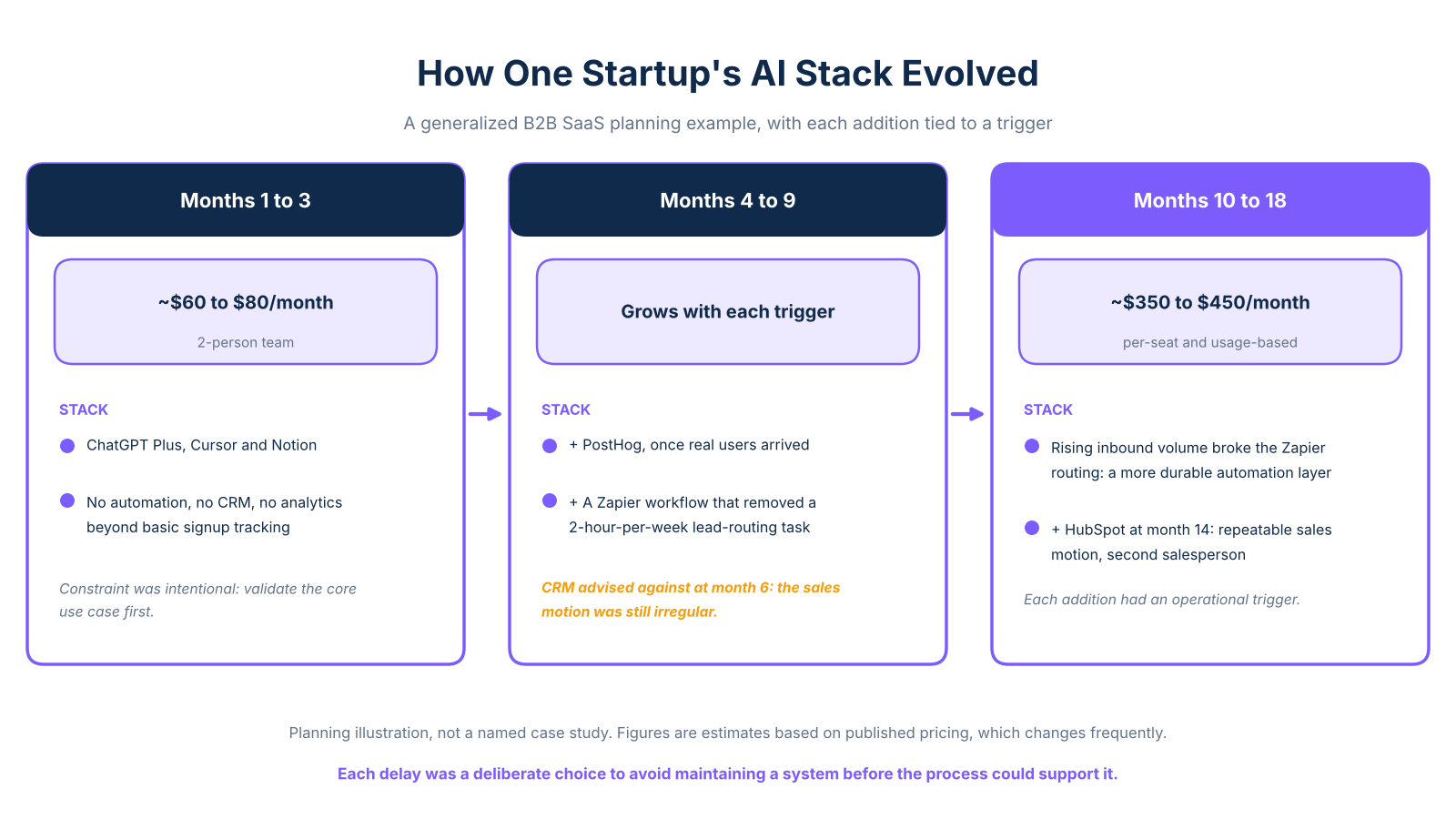
Months ten through eighteen: Rising inbound volume broke the Zapier routing logic, the trigger for a more durable automation layer. HubSpot followed at month fourteen when the sales motion became repeatable and a second salesperson joined. Total stack cost reached approximately $350-$450 per month, based on per-seat and usage-based pricing across the tools in use.
Each addition was tied to a specific operational trigger. Each delay was a deliberate choice to avoid maintaining a system before the underlying process could support it.
Frequently Asked Questions
What AI tools should a startup buy first?
Start with one general-purpose AI assistant, either ChatGPT Plus or Claude Pro, and use it consistently before adding anything else. Add a coding tool only if the team is actively writing software, and add automation or CRM only when a recurring workflow exists and a named person owns it.
How much does an AI stack cost for a startup?
Costs depend on how many people need access, how heavily each tool is used, and whether the stack includes usage-based platforms like automation or analytics. Early stacks for a two-to-five person team can run on $60 to $110 per month as a planning estimate, based on a small number of per-user subscriptions.
How many AI tools does a startup need?
The right number depends on the team's current bottleneck, not its size or ambition. A three-person idea-stage team may only need one or two tools used consistently. A 20-person scaling team may justify six or seven layers, but only if each has a defined owner and a measurable workflow attached to it.
How does an AI stack change as a startup grows?
At the idea stage, the stack focuses on research, drafting, and validation. The MVP stage adds coding assistance, documentation, early analytics, and the first automation layer once a stable workflow exists. The scale stage introduces CRM, more sophisticated automation, monitoring, and potentially custom-built systems where off-the-shelf tools no longer fit the workflow's volume or specificity.
Which AI tools are best for startup MVP development?
Coding assistants like Cursor and GitHub Copilot are the most immediately useful for teams actively building software. Rapid app builders like Lovable and Bolt.new are useful for prototyping and validation, but they should not automatically be treated as production infrastructure without checking code ownership, security, and maintainability.
Should a startup build or buy AI tools?
Buy commodity capabilities first: general assistants, standard integrations, and common infrastructure are well-served by existing products. Build only when the workflow, data, or user experience creates meaningful differentiation that off-the-shelf tools cannot replicate. The honest comparison requires evaluating total ownership cost, implementation time, vendor dependence, and data requirements together.
How do startups choose the right AI tools?
Start with a documented business problem and a measurable outcome you want to change. Then check integration depth, data privacy terms, team adoption requirements, and the realistic cost of switching if the tool does not work. Run a limited pilot with a named owner and a defined review point before committing to a full rollout.